Mass Media Course: Admission, Syllabus, and Job Opportunities
Nishit Kumar is a senior EdTech industry leader with over a decade of experience in building and scaling education platforms, shaping their product, content, and growth strategy. At…
Mass media courses in India are offered at Diploma, Certificate, Undergraduate (UG), Postgraduate (PG), and Doctoral levels, ranging from 4 months to 3 years in duration. Popular programs include BA Hons Journalism & Mass Communication (BJMC), Bachelor of Mass Media (BMM), and PG Diplomas offered by top institutes like IIMC Delhi, ACJ, XIC, Jamia Millia Islamia, and FTII Pune.
Students looking to pursue a career in media can explore course structures, fee ranges, top government and private colleges, specialization choices, and placement prospects across print, broadcast, digital media, and cinema.
| Parameter | Details |
|---|---|
| Course Levels Available | UG, PG, Diploma, Certificate, Doctoral |
| Shortest Course Duration | 4 months (Diploma in Development Journalism) |
| UG Degree Duration | 3 years (BA Journalism, BJMC, BMM, BMMMC, BHJMC) |
| PG Degree Duration | 2 years (M.A. in Journalism and Mass Communication) |
| PG Diploma Duration | 1 to 2 years |
| Major Specialisations | Journalism, TV & Radio Broadcasting, Film Making, Advertising & Public Relations |
What is BA Mass Communication
| Name of the Mass Communication Course | Type of Course | Duration |
|---|---|---|
| Diploma Course in Development Journalism | Diploma | 4 months |
| Post Graduate Diploma in Business Journalism & Corporate Communication (DBJCC) | Post-graduate Diploma | 1 year |
| P.G. Certificate Course in Hindi Journalism | Post-graduate Certification | 1 year |
| Diploma in Journalism and Mass Communication | Diploma | 2 years |
| M.A in Journalism and Mass Communication | Post-graduate Degree | 2 years |
| P.G. Diploma in Hindi Journalism | Post-graduate Diploma | 2 years |
| BA in Journalism | Undergraduate Degree | 3 years |
| BA Hons Journalism & Mass Communication (BJMC) | Undergraduate Degree | 3 years |
| Diploma in Media Studies | Diploma | 3 years |
| BA Hons Multimedia & Mass Communication (BMMMC) | Undergraduate Degree | 3 years |
| Bachelor of Mass Media (BMM) | Undergraduate Degree | 3 years |
| BA Hons in Hindi Journalism & Mass Communication (BHJMC) | Undergraduate Degree | 3 years |
| B.A. Film Making and Mass Communication | Undergraduate Degree | 3 years |
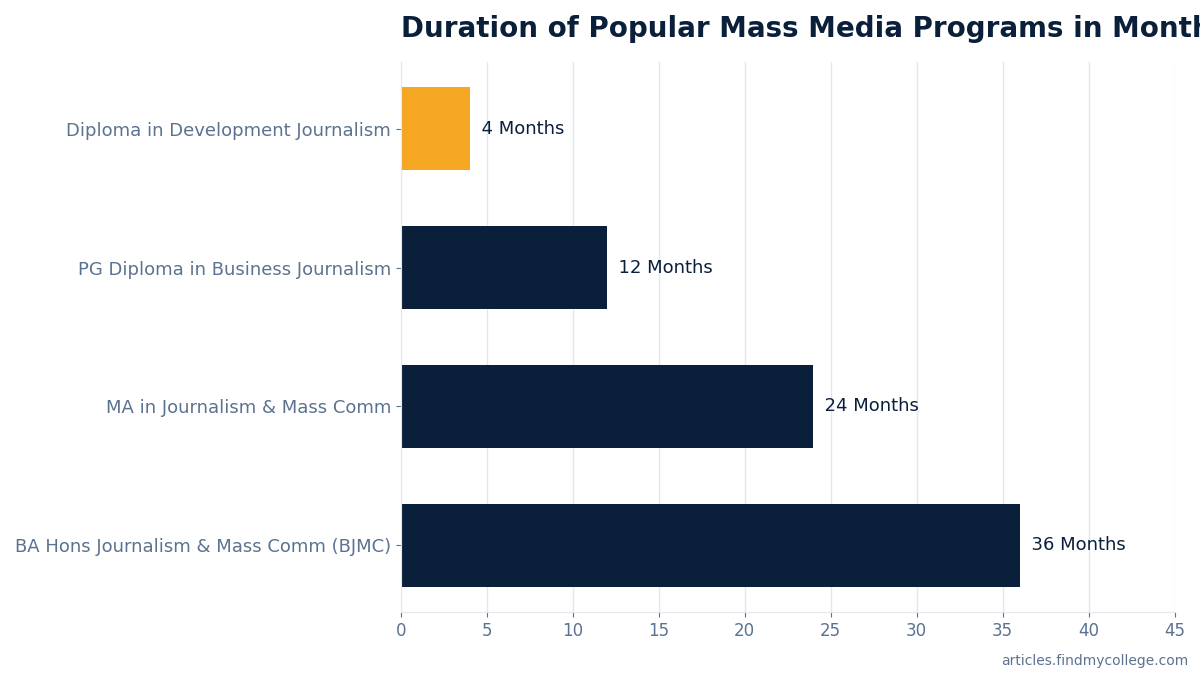
Mass communication programs in India range from 4-month diplomas to 3-year undergraduate degrees and postgraduate options. Courses like BA in Journalism, BJMC, BMM, BMMMC, BHJMC, and B.A. Film Making and Mass Communication require 3 years to complete.
Top BA Mass Communication Colleges
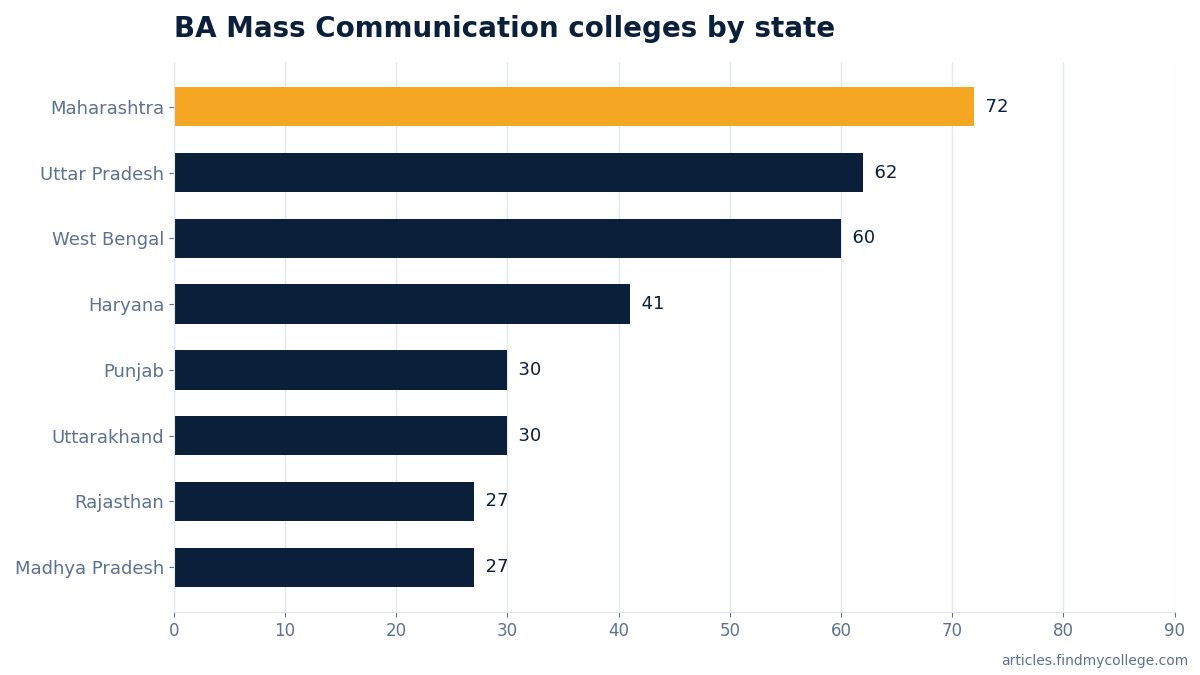
At least 563 colleges offer BA Mass Communication, including 53 government and 195 private colleges. State-wise options include Maharashtra with 72, Uttar Pradesh with 62, West Bengal with 60, Haryana with 41, Punjab with 30, and Uttarakhand with 30 institutions.
| City | Colleges | Fee range | Well-known options |
|---|---|---|---|
| Mumbai | 39 | ₹46,122 – ₹10.53 lakh | Amity University Mumbai, Wilson College |
| Kolkata | 38 | ₹5,385 – ₹6.30 lakh | Amity University Kolkata, Derozio Memorial College |
| Delhi | 21 | ₹62,045 – ₹7.02 lakh | Delhi University, Management Education & Research Institute |
| Dehradun | 20 | ₹45,200 – ₹6.54 lakh | University of Petroleum and Energy Studies, Uttaranchal University |
| Hyderabad | 17 | ₹42,000 – ₹4.74 lakh | Osmania University, St. Francis College for Women |
| Jaipur | 15 | ₹66,000 – ₹5.52 lakh | Manipal University Jaipur, Banasthali Vidyapith |
| Noida | 13 | ₹41,175 – ₹8.07 lakh | Amity University Noida, Sharda University |
| Indore | 12 | ₹62,500 – ₹4.49 lakh | IPS Academy Indore, Devi Ahilya Vishwavidyalaya |
Mass media education is widely distributed across major urban hubs with varying fee ranges. Top institutes offering journalism and mass communication include Asian College of Journalism, IIMC Delhi, XIC, Jamia Millia Islamia, and Banaras Hindu University.
Radio, TV Broadcasting, and Cinema Courses
Students focusing on broadcast television, radio production, or film technology can pursue specialized post-graduate diplomas and degree tracks. Premier training centers include Film and Television Institute of India (FTII) Pune, which conducts a 3-Year PG Diploma in Sound Recording And Sound Design along with 1-Year PG Certificates in TV Direction, Video Editing, and Sound Recording & TV Engineering.
Satyajit Ray Film & Television Institute (SRFTI) Kolkata offers a Postgraduate Programme in Cinema, while Mumbai University provides a BA Programme in Film, Television And New Media Production. Ajeenkya DY Patil University offers a BSc in Film Making, and M.G.R. Government Film And Television Institute awards a Diploma in Film Technology And TV Production (Cinematography).
For broadcast journalism, specialized programs are offered by India Today Media Institute, NDTV Media Institute, Pioneer Media School, Express Institute Of Media Studies, ITV School Of Media And Management, Calcutta Media Institute, and Eenadu Journalism School.
BA Mass Communication Fees
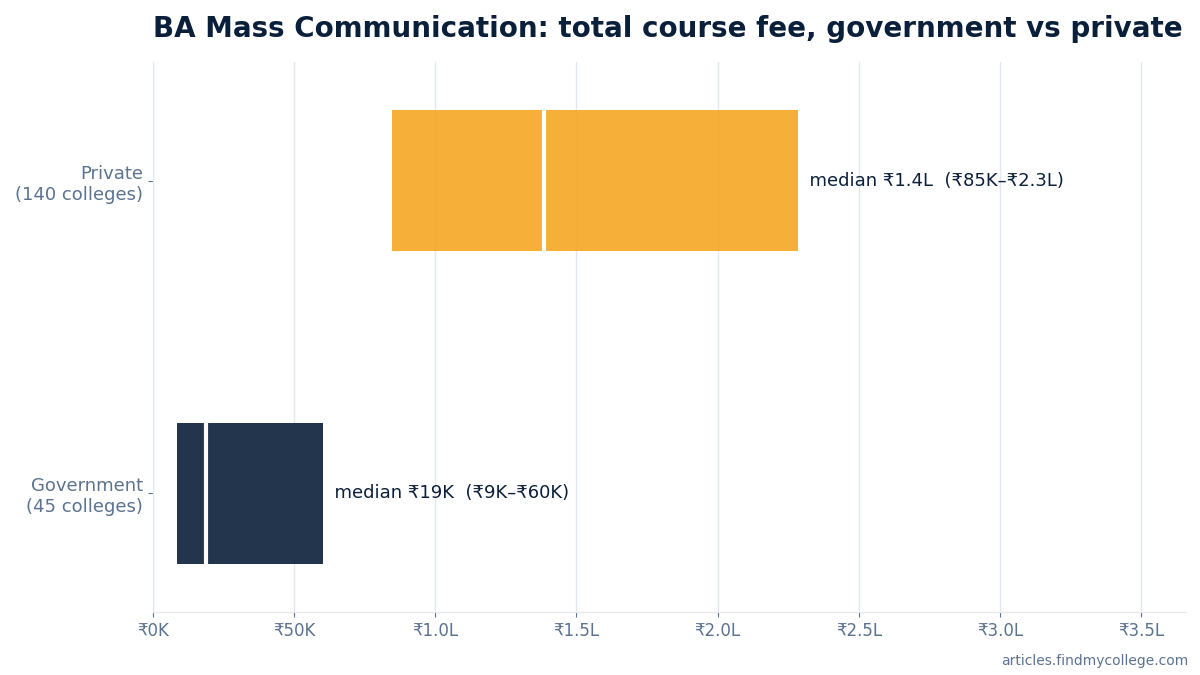
Course fees vary based on institutional management and infrastructure. For government colleges, the median total course fee is ₹18,930, with the middle half of institutions charging between ₹8,710 and ₹60,157 (based on 45 colleges with fee data). Private colleges have a median total course fee of ₹1.39 lakh, with the middle half ranging between ₹84,587 and ₹2.28 lakh (based on 140 colleges with fee data).
| College | City | Ownership | Total course fee |
|---|---|---|---|
| Kakatiya Government Degree College | Hanamkonda | Government | ₹5,230 |
| Government Degree College Baramulla | Baramulla | Government | ₹5,288 |
| Dum Dum Motijheel College | Kolkata | Government | ₹5,385 |
| Acharya Prafulla Chandra College | Kolkata | Government | ₹5,412 |
| Panihati Mahavidyalaya | Kolkata | Government | ₹5,800 |
| Government College (Autonomous) Rajahmundhry | Rajahmundhry | Government | ₹5,890 |
| Swami Vivekanand Government College | Bilaspur | Government | ₹6,322 |
| Sree Chaitanya College | North 24 Parganas | Government | ₹7,230 |
| Gurudas College | Kolkata | Government | ₹7,645 |
| Gour Mahavidyalya | Malda | Government | ₹8,010 |
Distance and Online BA Mass Communication Options
Distance and correspondence options allow working professionals and remote candidates to earn media credentials. Key universities offering distance BA Mass Communication programs include:
- School of Distance Learning, Jagan Nath University, Jaipur (Total course fee: ₹66,000)
- Amity University, Noida (Total course fee: ₹1.90 lakh)
- Directorate of Distance Education, I.K Gujral Punjab Technical University, Jalandhar (Total course fee: ₹1.63 lakh)
- Amity University Online, Noida (Total course fee: ₹1.70 lakh)
- Yashwantrao Chavan Maharashtra Open University, Nashik (Total course fee: ₹9,524)
BA Mass Communication Career Scope and Salary
The median average placement package reported across 31 media colleges is 2.72 LPA. Graduates enter diverse professional environments spanning newsrooms, production houses, advertising agencies, corporate communication desks, and digital media platforms.
| College | City | Ownership | Total course fee | Average package |
|---|---|---|---|---|
| Prestige Institute of Management and Research | Indore | Private (aided) | ₹4.49 lakh | 6 LPA |
| Guru Nanak Khalsa College of Arts, Science & Commerce | Mumbai | Private (aided) | ₹1.04 lakh | 4.75 LPA |
| St. Francis College for Women | Hyderabad | Private (aided) | ₹2.03 lakh | 4.59 LPA |
| Maharaja Agrasen Institute of Managment Studies | Delhi | Private | ₹5.59 lakh | 4.08 LPA |
| BFIT Group of Institutions | Dehradun | Private | ₹1.65 lakh | 4 LPA |
| St. Joseph’s College Devagiri | Calicut | Private (aided) | ₹1.92 lakh | 3.33 LPA |
| Ramniranjan Jhunjhunwala College | Mumbai | Private (aided) | ₹84,405 | 2.79 LPA |
| Loreto College | Kolkata | Private (aided) | ₹1.02 lakh | 2.78 LPA |
Job designations depend heavily on the candidate’s chosen stream of specialization during or after the mass media degree.
| Media Specialisation | Career Roles & Job Profiles |
|---|---|
| Journalism (Print, Digital & News) | Broadcast Journalist, Anchor, Reporter, Writer/Editor in Newspaper/Magazine, Travel Blogger/Columnist, News Reporter, Photojournalist, Researcher |
| TV Broadcasting & Radio | Reporter, Editor, Anchorperson, Camera-person, Video Editor, Sound Recordist, Graphic Artist, Content Writer |
| Film Making & Cinema | Sound Technician, Television/Film/Video Producer, Television Camera Operator, Television Production Coordinator |
How to Apply for BA Mass Communication Admission: Step by Step
- Identify interest area: Match personal interest areas with specific media sectors such as Journalism, TV and Radio Broadcasting, Film Making, or Advertising and Public Relations.
- Select program level and duration: Choose from Undergraduate degrees (3 years), Postgraduate degrees or PG Diplomas (1 to 2 years), Certificate courses (1 year), or short diplomas (4 months).
- Choose general or specialized program: Enrol in a general mass communication course if unsure of a specialization, and select a specialized stream midway through the program.
- Research target institutes: Select institutions offering the desired specialization, such as ACJ, IIMC Delhi, XIC, Jamia Millia Islamia, FTII Pune, or Banaras Hindu University.
| What to do | Where | Link |
|---|---|---|
| Compare colleges, fees and cutoffs | BA Mass Communication colleges in India | findmycollege.com |
Candidates can choose general or specialized programs across UG, PG, diploma, certificate, and doctoral levels based on their career goals. Top offering institutes include IIMC Delhi, ACJ, XIC, Jamia Millia Islamia, FTII Pune, and BHU.
FAQs
What is the course of mass media?
A mass media course covers core components of media, offering training in journalism, TV/radio broadcasting, film making, advertising, and public relations across UG, PG, diploma, certificate, and doctoral levels.
What is the duration of undergraduate mass media courses like BJMC or BMM?
Undergraduate mass media courses, including BA in Journalism, BJMC, BMM, BMMMC, BHJMC, and B.A. Film Making and Mass Communication, have a standard duration of 3 years.
Which institute is best for Mass Communication?
Top institutes include IIMC Delhi, Asian College of Journalism (ACJ), Xavier Institute of Communications (XIC), Jamia Millia Islamia, FTII Pune, and Banaras Hindu University (BHU).
What career options exist after studying TV broadcasting and radio?
Graduates can work as reporters, editors, anchorpersons, camera-persons, video editors, sound recordists, graphic artists, and digital content writers across broadcast and online media.
What job roles are available in the film making stream?
Film stream job roles include sound technician, television/film/video producer, television camera operator, and television production coordinator.
How to choose the best mass communication course?
Align your interest with specific sectors (journalism, broadcasting, films, advertising). If unsure, start with a general mass communication course and choose a specialization midway through the program.