

Master of Surgery (MS) in ENT 2026: Course Overview
Nishit Kumar is a senior EdTech industry leader with over a decade of experience in building and scaling education platforms, shaping their product, content, and growth strategy. At…
Latest update: Master of Surgery in Ear, Nose, Throat 2026 admissions & dates updated. Read more ›
Welcome to the comprehensive overview of the Master of Surgery (MS) in Ear, Nose, Throat (ENT) program in India for the academic year 2026. This page is designed to provide prospective students and their parents with a detailed understanding of this specialized medical postgraduate course, covering everything from eligibility and admission processes to career opportunities and financial considerations. An MS ENT degree equips medical graduates with advanced surgical and medical skills to diagnose and treat conditions related to the head and neck region, making it a highly sought-after specialization.
What is Master of Surgery (MS) in Ear, Nose, Throat (ENT)?
The Master of Surgery (MS) in Ear, Nose, Throat (ENT), also known as Otorhinolaryngology, is a three-year postgraduate medical degree program in India. It focuses on the surgical and medical management of diseases and disorders affecting the ear, nose, throat, and related structures of the head and neck.
This specialization involves extensive training in both clinical and surgical aspects, including diagnostics, medical treatment, and various surgical procedures such as tonsillectomy, septoplasty, cochlear implants, and head and neck cancer surgeries. Graduates are trained to become expert Otorhinolaryngologists capable of handling complex cases in both pediatric and adult populations.
What is the eligibility for Master of Surgery in Ear, Nose, Throat in 2026?
To be eligible for the Master of Surgery in Ear, Nose, Throat program in 2026, candidates must possess an MBBS degree from a recognized medical college and have completed a compulsory rotating internship.
The primary eligibility criteria include:
- MBBS Degree: Candidates must hold a Bachelor of Medicine, Bachelor of Surgery (MBBS) degree from an institution recognized by the Medical Council of India (MCI) or the National Medical Commission (NMC).
- Compulsory Rotating Internship: Completion of a one-year compulsory rotating internship is mandatory.
- Permanent/Provisional Registration: Candidates must have permanent or provisional registration with the MCI/NMC or a State Medical Council.
- Entrance Examination: Qualification in a national-level postgraduate medical entrance examination, primarily the NEET PG 2026, is essential. Some state-level exams or institutional exams might also be considered, though NEET PG is the dominant pathway.
- Minimum Marks: While there isn’t a universal minimum percentage for MBBS, a strong academic record is beneficial, and qualifying cut-offs in NEET PG are crucial.
How do I get admission to MS ENT in 2026?
Admission to MS ENT programs in 2026 is primarily through a centralized counseling process based on the scores obtained in the NEET PG examination.
The admission process typically involves the following steps:
- Appear for NEET PG 2026: Register and appear for the National Eligibility cum Entrance Test (Postgraduate) 2026. This is the single entrance examination for admission to various MD/MS/PG Diploma courses across India.
- NEET PG Result & Merit List: After the examination, a merit list is published based on the scores. Candidates must meet the minimum qualifying percentile.
- Counseling Registration: Eligible candidates must register for the counseling process conducted by the Medical Counseling Committee (MCC) for All India Quota (AIQ) seats (15%) and by respective State Counseling Authorities for State Quota seats (85%).
- Choice Filling & Locking: During counseling, candidates choose their preferred colleges and specializations (MS ENT) based on their rank.
- Seat Allotment: Seats are allotted based on NEET PG rank, choices filled, reservation criteria, and availability of seats.
- Document Verification & Admission: Selected candidates must report to the allotted college with original documents for verification and complete the admission formalities.
Key Dates for MS ENT Admission 2026 (Tentative)
The following table provides tentative dates for the NEET PG 2026 examination and subsequent counseling rounds. Exact dates will be released by the National Board of Examinations (NBE) and MCC.
| Event | Tentative Dates (2026) |
|---|---|
| NEET PG 2026 Application Start | October – November 2025 |
| NEET PG 2026 Application End | December 2025 |
| NEET PG 2026 Exam Date | March 2026 |
| NEET PG 2026 Result Declaration | April 2026 |
| MCC AIQ Counseling Round 1 | May – June 2026 |
| MCC AIQ Counseling Round 2 | June – July 2026 |
| State Quota Counseling Rounds | June – August 2026 |
| Academic Session Commencement | August – September 2026 |
How much does Master of Surgery in Ear, Nose, Throat cost in India?
The cost of pursuing an MS ENT degree in India varies significantly depending on the type of institution (government vs. private) and its location, ranging from a few thousand rupees to over 30 lakhs per annum.
Here’s a breakdown of the typical fee structure:
- Government Colleges: Fees in government medical colleges are substantially lower, typically ranging from INR 50,000 to INR 3,00,000 per annum. These institutions are often highly subsidized, making them very competitive.
- Private Colleges/Deemed Universities: Private institutions and deemed universities have much higher fees, which can range from INR 8,00,000 to INR 35,00,000 per annum. Some may also have additional charges like caution deposits, development fees, and hostel fees.
- Other Expenses: Beyond tuition, students should budget for living expenses, study materials, examination fees, and other miscellaneous costs.
What is the syllabus for MS ENT?
The MS ENT syllabus is comprehensive, covering both theoretical knowledge and practical surgical skills across various sub-specialties of Otorhinolaryngology over three years.
The curriculum is designed to provide in-depth knowledge and hands-on experience in:
- Basic Sciences: Anatomy, Physiology, Pathology, Microbiology, Pharmacology relevant to ENT.
- General ENT: Common ear, nose, and throat conditions, their diagnosis, and management.
- Otology & Neuro-Otology: Diseases of the ear, hearing loss, balance disorders, otoneurology, and related surgeries (e.g., tympanoplasty, mastoidectomy, cochlear implants).
- Rhinology & Allergy: Diseases of the nose and paranasal sinuses, allergic rhinitis, functional endoscopic sinus surgery (FESS), septorhinoplasty.
- Laryngology & Pharyngology: Diseases of the larynx and pharynx, voice disorders, swallowing disorders, laryngeal surgeries.
- Head & Neck Oncology: Diagnosis and surgical management of cancers of the head and neck region, including reconstructive surgery.
- Pediatric ENT: ENT conditions specific to children.
- Audiology & Speech Therapy: Understanding and interpreting audiograms, basic speech pathology.
- Emergency ENT: Management of ENT emergencies.
- Research & Thesis: Compulsory dissertation/thesis work on a chosen topic.
Typical Semester-wise Subjects (Illustrative)
| Year | Key Subjects/Focus Areas |
|---|---|
| Year 1 | Applied Anatomy & Physiology of Head & Neck, Basic Pathology & Microbiology, General ENT Principles, Otology (Basic), Rhinology (Basic), Laryngology (Basic), Clinical Examination & Diagnostics, Minor Procedures. |
| Year 2 | Advanced Otology & Neuro-Otology, Advanced Rhinology & Sinus Surgery, Advanced Laryngology & Voice Disorders, Head & Neck Oncology (Principles), Pediatric ENT, Audiology & Vestibulometry, Emergency ENT Management, Surgical Skills Training. |
| Year 3 | Comprehensive Head & Neck Oncology (Surgical & Reconstructive), Advanced Endoscopic Procedures, Skull Base Surgery, Facial Plastic Surgery (ENT aspects), Research Methodology & Thesis Submission, Clinical Case Discussions, Advanced Surgical Rotations. |
Is Master of Surgery in Ear, Nose, Throat worth it for jobs? What are the career prospects?
Yes, pursuing a Master of Surgery in Ear, Nose, Throat is highly worth it for career prospects, offering a stable and rewarding career path with excellent job opportunities and significant earning potential in both clinical practice and academia.
Graduates with an MS ENT degree have a wide range of career options:
- Consultant Otorhinolaryngologist: Work in government or private hospitals, polyclinics, or establish independent practice.
- Academician/Professor: Join medical colleges as faculty members, teaching and conducting research.
- Specialized Clinics: Focus on specific sub-specialties like Otology, Rhinology, Laryngology, Head & Neck Oncology, or Pediatric ENT in specialized centers.
- Research Scientist: Engage in medical research in pharmaceutical companies or research institutions.
- Hospital Administration: Take up administrative roles in healthcare settings.
Average Salary for MS ENT Graduates in India
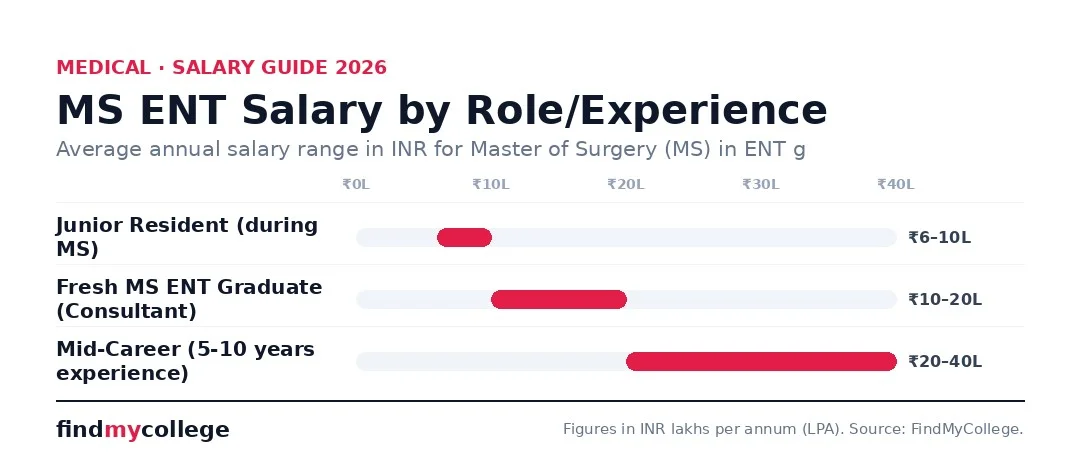
Salaries for MS ENT specialists vary based on experience, location, type of employer (government vs. private), and sub-specialization. The earning potential significantly increases with experience and reputation.
| Role/Experience Level | Average Annual Salary Range (INR) |
|---|---|
| Junior Resident (during MS) | 6,00,000 – 10,00,000 |
| Fresh MS ENT Graduate (Consultant) | 10,00,000 – 20,00,000 |
| Mid-Career (5-10 years experience) | 20,00,000 – 40,00,000 |
| Senior Consultant/Specialist (10+ years) | 40,00,000 – 1,00,00,000+ |
| Private Practice (established) | Highly Variable, often 50,00,000 – 1,50,00,000+ |
What is the difference between MS ENT and DNB ENT?
Both MS ENT and DNB ENT are postgraduate medical degrees that qualify a doctor to practice as an Otorhinolaryngologist, but they differ primarily in their awarding body and institutional affiliation.
- MS ENT (Master of Surgery in ENT): Awarded by universities affiliated with medical colleges recognized by the National Medical Commission (NMC). It is typically more structured with a strong emphasis on academic teaching and direct surgical training within a university hospital setting.
- DNB ENT (Diplomate of National Board in ENT): Awarded by the National Board of Examinations (NBE). DNB programs are offered in various hospitals (both government and private) that are accredited by the NBE. The training is often more hands-on and clinical, with less emphasis on traditional academic lectures, though research and thesis are still mandatory.
In terms of recognition and career prospects, both degrees are considered equivalent for practicing as a specialist in India. The choice often comes down to the type of training environment preferred and the availability of seats.
What are the top colleges for MS ENT in India?
The top colleges for MS ENT in India are generally those with excellent clinical facilities, high patient loads, experienced faculty, and strong research output, often including AIIMS, PGIMER, and other well-established government medical colleges.
Some of the highly regarded institutions include (but are not limited to):
- All India Institute of Medical Sciences (AIIMS), New Delhi
- Postgraduate Institute of Medical Education and Research (PGIMER), Chandigarh
- Jawaharlal Institute of Postgraduate Medical Education and Research (JIPMER), Puducherry
- Maulana Azad Medical College (MAMC), New Delhi
- Seth G.S. Medical College and KEM Hospital, Mumbai
- Christian Medical College (CMC), Vellore
- King George’s Medical University (KGMU), Lucknow
- Institute of Medical Sciences, Banaras Hindu University (IMS-BHU), Varanasi
- Grant Medical College and Sir J.J. Group of Hospitals, Mumbai
- Armed Forces Medical College (AFMC), Pune
Private institutions like Manipal Academy of Higher Education (MAHE) and Amrita Vishwa Vidyapeetham also offer excellent MS ENT programs.
Frequently Asked Questions
What are the sub-specialties within ENT?
Within ENT, doctors can further specialize in areas such as Otology (ear), Rhinology (nose and sinuses), Laryngology (throat and voice), Head & Neck Oncology (cancers), Pediatric ENT, Neuro-Otology, and Facial Plastic Surgery.
Is MS ENT a difficult course?
MS ENT is a challenging and demanding postgraduate course requiring extensive study, long working hours, and significant surgical skill development. However, it is highly rewarding for those passionate about the field.
Can I pursue a fellowship after MS ENT?
Yes, after completing MS ENT, many specialists pursue fellowships (1-2 years) in specific sub-specialties like Head & Neck Oncology, Cochlear Implants, Rhinology, or Facial Plastic Surgery to gain advanced expertise and surgical skills.
What is the typical work-life balance for an ENT specialist?
The work-life balance for an ENT specialist can vary. While residency and early career stages involve demanding hours, established consultants in private practice or government roles often achieve a more balanced schedule, though emergencies can always arise.
Are there any age limits for MS ENT admission?
Generally, there is no upper age limit for pursuing MS ENT in India, provided the candidate meets all other eligibility criteria, including the NEET PG requirements.
What skills are essential for an ENT surgeon?
Essential skills for an ENT surgeon include excellent diagnostic abilities, fine motor skills for intricate surgeries, strong communication skills, empathy, resilience, and a commitment to continuous learning.
How competitive is admission to MS ENT?
Admission to MS ENT is highly competitive, especially in top government colleges, due to the limited number of seats and the high demand for this specialization. A very good NEET PG rank is usually required.