M.Sc in Neuroscience Salary in India 2026: A Comprehensive Guide
Nishit Kumar is a senior EdTech industry leader with over a decade of experience in building and scaling education platforms, shaping their product, content, and growth strategy. At…
Latest update: M.Sc in Neuroscience 2026 admissions & dates updated. Read more ›
Pursuing an M.Sc in Neuroscience in India opens doors to a fascinating and rapidly evolving field, with promising career prospects and competitive salaries. This comprehensive guide details the salary expectations, career opportunities, and return on investment for neuroscience postgraduates in India for the year 2026.
What is the average M.Sc in Neuroscience salary in India in 2026?
The average M.Sc in Neuroscience salary in India for fresh graduates in 2026 typically ranges from INR 3.5 LPA to INR 7.5 LPA, depending on the institution, specific role, and location. With experience and specialization, salaries can significantly increase, reaching upwards of INR 15 LPA to INR 25 LPA for senior roles in research or industry.
Neuroscience is an interdisciplinary field that combines biology, chemistry, physics, computer science, and psychology to understand the structure and function of the nervous system. Graduates are highly sought after in research, healthcare, pharmaceuticals, and even technology sectors.
What are the top career paths after M.Sc in Neuroscience and their salaries?
Graduates of M.Sc in Neuroscience can pursue diverse career paths, primarily in research, academia, clinical settings, and the pharmaceutical industry. Each path offers distinct salary ranges based on responsibilities, required expertise, and industry demand.
Neuroscientist/Research Scientist Salary
A Neuroscientist or Research Scientist typically earns between INR 4.5 LPA to INR 9 LPA as a fresher, with experienced professionals commanding salaries from INR 10 LPA to INR 20 LPA or more. These roles involve designing and conducting experiments, analyzing data, and publishing findings in academic or industrial settings.
People Also Read




Clinical Research Coordinator/Associate Salary
Clinical Research Coordinators or Associates can expect salaries ranging from INR 3.8 LPA to INR 7 LPA initially, growing to INR 8 LPA to INR 15 LPA with experience. They manage clinical trials, ensuring compliance with protocols and regulations, often working in hospitals or Contract Research Organizations (CROs).
Medical Writer Salary
Medical Writers, who translate complex scientific information into clear, concise documents, typically start with salaries of INR 3.5 LPA to INR 6.5 LPA. Experienced writers can earn INR 7 LPA to INR 14 LPA, working for pharmaceutical companies, medical communication agencies, or as freelancers.
Data Scientist (Neuroscience focus) Salary
With a strong foundation in data analysis and computational neuroscience, graduates can enter Data Science roles, earning INR 5 LPA to INR 10 LPA as freshers. Senior Data Scientists with neuroscience expertise can command INR 12 LPA to INR 25 LPA, especially in companies developing AI/ML solutions for healthcare or brain-computer interfaces.
Lecturer/Professor (Academia) Salary
Entry-level lecturers in academia might earn INR 4 LPA to INR 8 LPA, often requiring a Ph.D. for higher positions. Salaries for Assistant Professors and Professors can range from INR 8 LPA to INR 20 LPA, depending on the institution (government vs. private) and experience.
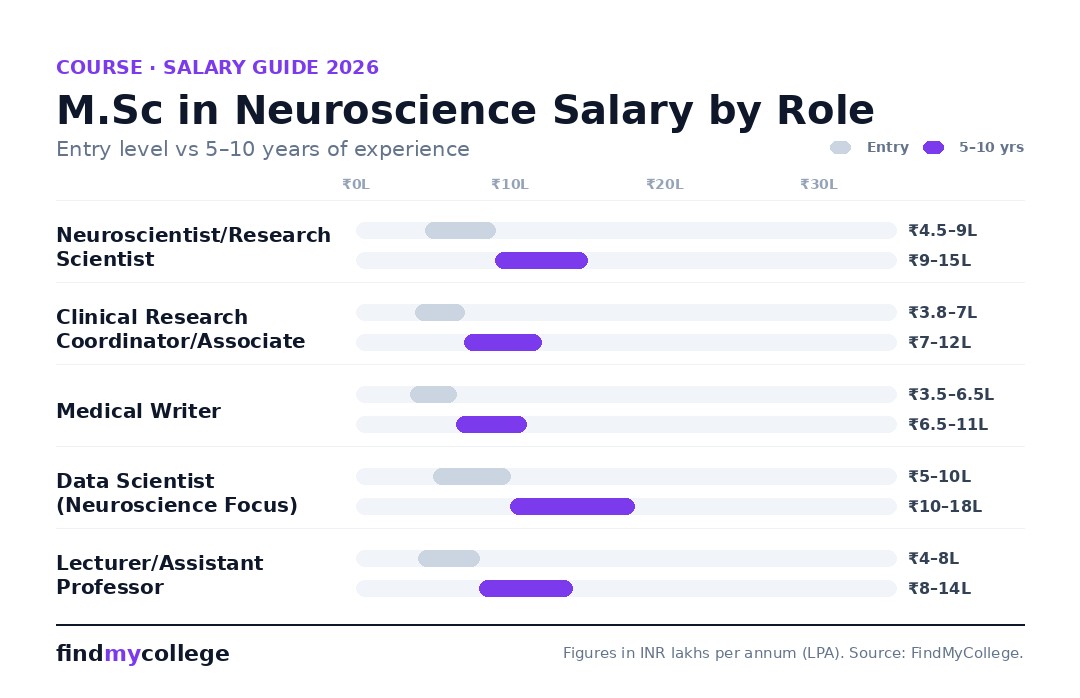
Here’s a table summarizing potential salary ranges by role for M.Sc Neuroscience graduates in India (2026):
| Job Role | Entry-Level Salary (INR LPA) | Mid-Career Salary (INR LPA) | Senior-Level Salary (INR LPA) |
|---|---|---|---|
| Neuroscientist/Research Scientist | 4.5 – 9.0 | 9.0 – 15.0 | 15.0 – 25.0+ |
| Clinical Research Coordinator/Associate | 3.8 – 7.0 | 7.0 – 12.0 | 12.0 – 18.0 |
| Medical Writer | 3.5 – 6.5 | 6.5 – 11.0 | 11.0 – 16.0 |
| Data Scientist (Neuroscience Focus) | 5.0 – 10.0 | 10.0 – 18.0 | 18.0 – 25.0+ |
| Lecturer/Assistant Professor | 4.0 – 8.0 | 8.0 – 14.0 | 14.0 – 20.0+ |
Which factors influence M.Sc in Neuroscience salary in India?
Several factors significantly influence the salary package for M.Sc Neuroscience graduates in India, including the reputation of the institution, specialization, location, and the type of employer.
- Institution Reputation: Graduates from top-tier institutions (e.g., AIIMS, NIMHANS, IITs with neuroscience programs) often secure higher starting salaries due to perceived quality of education and networking opportunities.
- Specialization: Niche specializations like computational neuroscience, neuroimaging, or neuropharmacology can command higher salaries due to specific skill demands.
- Location: Metropolitan cities like Bangalore, Hyderabad, Pune, Mumbai, and Delhi/NCR, which are hubs for pharmaceutical companies, biotech firms, and research institutions, generally offer higher salaries compared to smaller cities.
- Employer Type: Salaries vary between government research institutes, private pharmaceutical companies, CROs, academic institutions, and startups. Private sector and multinational companies often offer more competitive packages.
- Skills and Experience: Proficiency in advanced lab techniques, data analysis tools (Python, R, MATLAB), and strong research publication records can significantly boost earning potential.
Is M.Sc in Neuroscience worth it for jobs and salary in India?
Yes, an M.Sc in Neuroscience is increasingly worth it for jobs and salary in India, especially given the growing emphasis on brain research, mental health, and neurological disorders. The field offers strong long-term growth potential and competitive compensation for skilled professionals.
The demand for neuroscientists is on the rise due to advancements in neurotechnology, drug discovery, and a deeper understanding of brain functions. Graduates contribute to critical areas like Alzheimer’s research, Parkinson’s disease, mental health treatments, and even artificial intelligence development.
What is the Return on Investment (ROI) for M.Sc in Neuroscience in India?
The Return on Investment (ROI) for an M.Sc in Neuroscience in India is generally favorable, especially when considering the long-term career growth and impact. While initial salaries might seem moderate compared to some engineering streams, the specialized nature of the degree leads to significant salary appreciation with experience and further specialization (e.g., Ph.D.).
The average course fee for an M.Sc in Neuroscience can range from INR 50,000 to INR 3,00,000 per annum for government institutions and INR 1,50,000 to INR 6,00,000 per annum for private universities. With an average starting salary of INR 3.5 LPA to INR 7.5 LPA, students can typically recover their investment within 1-3 years, assuming a two-year program.
Who are the top recruiters for M.Sc Neuroscience graduates in India?
Top recruiters for M.Sc Neuroscience graduates in India include leading pharmaceutical companies, biotechnology firms, Contract Research Organizations (CROs), government research institutions, and academic bodies.
- Pharmaceutical Companies: Cipla, Dr. Reddy’s Laboratories, Sun Pharma, Biocon, Lupin, AstraZeneca, Novartis, Pfizer (for R&D roles).
- Biotechnology Firms: Syngene International, Strand Life Sciences, various startups focusing on neurotechnology.
- Contract Research Organizations (CROs): IQVIA, Parexel, Covance, ICON (for clinical research roles).
- Government Research Institutions: National Brain Research Centre (NBRC), Indian Institute of Science (IISc), Centre for Cellular and Molecular Biology (CCMB), various CSIR labs.
- Academic Institutions: AIIMS, NIMHANS, various IITs, central and state universities (for research and teaching roles).
- Healthcare & Diagnostics: Hospitals with neurology departments, diagnostic labs.
How does M.Sc in Neuroscience salary compare to other Science M.Sc degrees?
M.Sc in Neuroscience salaries are generally competitive with or slightly higher than other traditional M.Sc Science degrees like M.Sc in Biochemistry or M.Sc in Zoology, especially for specialized roles. It often offers more diverse career paths than some other pure science streams.
Here’s a comparative overview of average starting salaries (2026):
| M.Sc Program | Average Entry-Level Salary (INR LPA) | Key Industries |
|---|---|---|
| M.Sc in Neuroscience | 3.5 – 7.5 | Pharma, Biotech, Research, Clinical, Academia, AI/ML |
| M.Sc in Biotechnology | 3.0 – 6.0 | Biotech, Pharma, Food, Agriculture |
| M.Sc in Biochemistry | 2.8 – 5.5 | Pharma, Diagnostics, Research, Food |
| M.Sc in Microbiology | 2.5 – 5.0 | Pharma, Food, Environment, Healthcare |
| M.Sc in Physics | 3.0 – 6.0 | Research, Education, IT, Engineering |
Neuroscience, being a highly specialized and interdisciplinary field, often provides an edge in securing roles that require specific analytical and research skills, leading to potentially higher compensation in specialized sectors.
What are the eligibility criteria for M.Sc in Neuroscience?
To be eligible for an M.Sc in Neuroscience in India, candidates typically need a Bachelor’s degree in Science (B.Sc) with a strong background in subjects like Biology, Zoology, Biochemistry, Biotechnology, Physiology, or related life sciences. A minimum aggregate score, usually 50-60%, is required from a recognized university.
Some top institutions may also consider candidates with B.Tech in Biotechnology or B.Pharm degrees. Admission is often based on entrance exams conducted by individual universities or national-level tests, followed by an interview.
Explore more on FindMyCollege
Related pages for M.Sc in Neuroscience aspirants on findmycollege.com:
Frequently Asked Questions
Is a Ph.D. necessary after M.Sc in Neuroscience for good salaries?
While not strictly necessary for all roles, a Ph.D. significantly enhances career prospects and salary potential, especially for advanced research positions, senior academic roles, and leadership positions in R&D within pharmaceutical and biotech industries. Many M.Sc graduates start working and then pursue a Ph.D. later.
What skills are essential to get a high-paying job after M.Sc in Neuroscience?
Key skills include strong analytical and critical thinking, proficiency in laboratory techniques (e.g., cell culture, molecular biology, electrophysiology), data analysis and statistical software (R, Python, MATLAB), scientific writing, presentation skills, and a solid understanding of neuroanatomy, neurophysiology, and neuropharmacology.
Can M.Sc Neuroscience graduates work abroad?
Yes, an M.Sc in Neuroscience from a reputable Indian institution can open doors to opportunities abroad, particularly in countries with strong research ecosystems like the USA, UK, Canada, Germany, and Australia. However, additional qualifications, certifications, or entrance exams might be required depending on the country and specific role.
Are there government jobs available for M.Sc Neuroscience graduates?
Yes, government jobs are available in various research institutions (e.g., NBRC, AIIMS, CSIR labs), public health organizations, and universities. These roles often offer stability, good benefits, and opportunities for long-term research contributions, though the initial salaries might be slightly lower than in the private sector.
What is the future scope of M.Sc in Neuroscience in India?
The future scope is highly promising. With increasing investment in healthcare, mental health, and neurodegenerative disease research, coupled with advancements in AI and neurotechnology, the demand for skilled neuroscientists is expected to grow substantially. The field is at the forefront of understanding the human brain, offering impactful and evolving career paths.
Do M.Sc Neuroscience programs include clinical exposure?
While primarily a research-oriented science degree, some M.Sc Neuroscience programs may offer limited clinical exposure through collaborations with hospitals or research centers, especially for specializations like clinical neuroscience or neuroimaging. However, it is not a clinical degree like an MBBS or MD.