
M.Sc Physics Salary in India (2026) – Science Stream
Nishit Kumar is a senior EdTech industry leader with over a decade of experience in building and scaling education platforms, shaping their product, content, and growth strategy. At…
Latest update: M.Sc in Physics 2026 admissions & dates updated. Read more ›
An M.Sc in Physics opens doors to diverse career opportunities in India, with salaries varying significantly based on specialization, industry, and experience. In 2026, fresh graduates can expect an average starting salary ranging from ₹3,50,000 to ₹6,00,000 per annum, while experienced professionals can command much higher packages.
Average M.Sc Physics Salary in India (2026)
The average salary for M.Sc Physics graduates in India in 2026 is projected to be between ₹4,50,000 and ₹9,00,000 per annum, depending on the role and sector. This figure is influenced by factors such as the reputation of the institution, individual skills, and the demand for specific physics specializations.
Entry-Level M.Sc Physics Salary
For fresh M.Sc Physics graduates in 2026, entry-level salaries typically fall within the range of ₹3,50,000 to ₹6,00,000 per annum. These initial packages are often offered in academic research, junior scientist roles, or as teaching assistants.
Experienced M.Sc Physics Salary
With 3-5 years of experience, M.Sc Physics professionals can expect their salaries to increase significantly, ranging from ₹6,00,000 to ₹12,00,000 per annum. Senior roles and specialized positions, especially in R&D or advanced technology sectors, can command even higher compensation.
M.Sc Physics Salary by Job Role (2026)
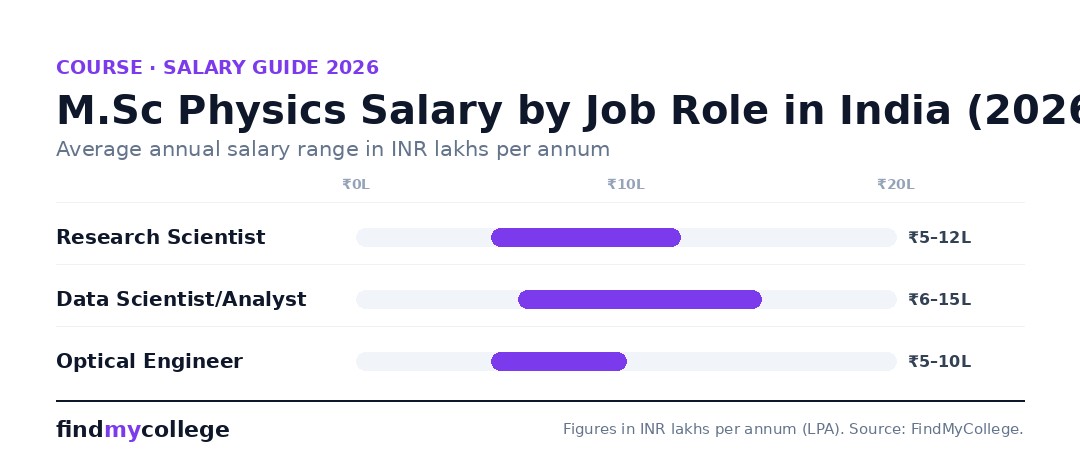
The salary for an M.Sc Physics graduate varies considerably across different job roles, reflecting the diverse applications of physics knowledge. Roles in research and development, data science, and engineering often offer higher compensation compared to entry-level teaching positions.
| Job Role | Average Annual Salary Range (INR) – 2026 | Key Responsibilities |
|---|---|---|
| Research Scientist | ₹5,00,000 – ₹12,00,000 | Conducting experiments, analyzing data, developing new theories or technologies. |
| Lecturer/Professor (Entry-level) | ₹4,00,000 – ₹7,50,000 | Teaching undergraduate/postgraduate physics, curriculum development, student mentorship. |
| Data Scientist/Analyst | ₹6,00,000 – ₹15,00,000 | Applying statistical and computational methods to large datasets, predictive modeling. |
| Medical Physicist | ₹5,50,000 – ₹11,00,000 | Applying physics principles in healthcare, radiation therapy, diagnostic imaging. |
| Quality Control/Assurance Engineer | ₹4,50,000 – ₹9,00,000 | Ensuring product quality, developing testing procedures, analyzing defects. |
| Optical Engineer | ₹5,00,000 – ₹10,00,000 | Designing and developing optical systems, lasers, and photonic devices. |
M.Sc Physics Salary by Industry (2026)
Different industries offer varying salary scales for M.Sc Physics graduates, with the private sector, particularly in technology and R&D, generally offering higher packages than government or academic institutions. The demand for specialized skills also plays a crucial role in industry-specific compensation.
| Industry Sector | Average Annual Salary Range (INR) – 2026 | Typical Roles |
|---|---|---|
| IT & Technology (R&D) | ₹6,00,000 – ₹18,00,000 | Data Scientist, AI/ML Engineer, Quantum Computing Researcher |
| Academia & Education | ₹4,00,000 – ₹10,00,000 | Lecturer, Research Associate, Professor |
| Healthcare & Medical Devices | ₹5,50,000 – ₹12,00,000 | Medical Physicist, Biomedical Engineer, Imaging Scientist |
| Manufacturing & Engineering | ₹4,50,000 – ₹10,00,000 | Quality Control Engineer, Materials Scientist, Process Engineer |
| Government & Public Sector | ₹4,00,000 – ₹9,00,000 | Scientist (DRDO, ISRO), Research Officer, Patent Examiner |
| Energy & Renewable Resources | ₹5,00,000 – ₹11,00,000 | Solar Physicist, Energy Analyst, Materials Scientist |
Factors Influencing M.Sc Physics Salary
Several key factors significantly influence the salary an M.Sc Physics graduate can expect in India. These include educational background, specialized skills, geographical location, and the reputation of the hiring organization.
Specialization and Skills
Specializations like quantum physics, astrophysics, materials science, and data science often command higher salaries due to their demand in advanced research and technology sectors. Proficiency in programming languages (Python, R), data analysis tools, and simulation software also boosts earning potential.
Geographical Location
Major metropolitan cities and industrial hubs like Bangalore, Hyderabad, Pune, Mumbai, and Delhi-NCR generally offer higher salaries due to a greater concentration of job opportunities and higher cost of living. Tier-2 cities may offer slightly lower packages but often come with a better work-life balance.
Recruiting Companies
Top-tier companies and research institutions, both national and international, tend to offer more competitive salary packages and better benefits. These include organizations in IT, R&D, defense, and academic research.
Career Prospects After M.Sc Physics
An M.Sc in Physics opens up a wide array of career prospects in both the public and private sectors, ranging from fundamental research to applied technology and education. Graduates can pursue roles in scientific research, data analysis, engineering, and academia.
Higher Education and Research
Many M.Sc Physics graduates opt for further studies like Ph.D. programs, leading to careers as research scientists, university professors, or post-doctoral fellows in national and international research labs.
Private Sector Opportunities
The private sector offers roles in IT (data science, AI/ML), manufacturing (quality control, R&D), healthcare (medical physics), and finance (quantitative analysis). Companies in these sectors value the analytical and problem-solving skills of physics graduates.
Government and Public Sector Jobs
Government organizations like DRDO, ISRO, BARC, and various national laboratories recruit M.Sc Physics graduates for scientist and research positions. Public sector undertakings also offer opportunities in energy, defense, and technology sectors.
Explore more on FindMyCollege
Related pages for M.Sc in Physics aspirants on findmycollege.com:
Frequently Asked Questions
Q: What is the average starting salary for an M.Sc Physics graduate in India in 2026?
A: The average starting salary for an M.Sc Physics graduate in India in 2026 is expected to range from ₹3,50,000 to ₹6,00,000 per annum, depending on the role, specialization, and recruiting organization.
Q: Which cities in India offer the highest salaries for M.Sc Physics graduates?
A: Major metropolitan cities such as Bangalore, Hyderabad, Pune, Mumbai, and Delhi-NCR generally offer the highest salaries for M.Sc Physics graduates due to a higher concentration of research institutions, IT companies, and R&D centers.
Q: What are the top career paths after completing an M.Sc in Physics?
A: Top career paths include Research Scientist, Lecturer/Professor, Data Scientist, Medical Physicist, Quality Control Engineer, and roles in various government scientific organizations like ISRO and DRDO.
Q: Does a specialization in M.Sc Physics affect salary?
A: Yes, specializations significantly affect salary. Fields like quantum physics, astrophysics, materials science, and data science often lead to higher-paying roles due to their relevance in cutting-edge research and technology industries.
Q: Are there opportunities for M.Sc Physics graduates in the IT sector?
A: Absolutely. M.Sc Physics graduates are highly sought after in the IT sector for roles such as Data Scientist, Data Analyst, Machine Learning Engineer, and AI Researcher, owing to their strong analytical and problem-solving skills.