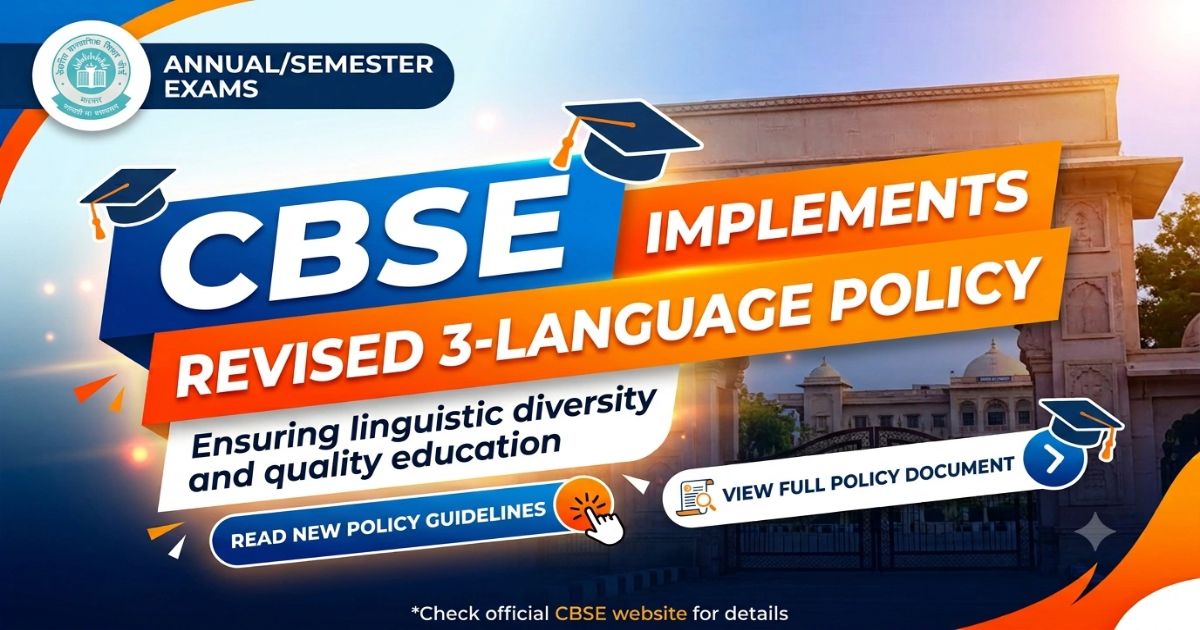
CBSE Details Three-Language Policy Implementation 2026-27: Retirees, PGs to Bridge Staffing Gaps
The Central Board of Secondary Education (CBSE) has detailed its implementation strategy for the revised three-language policy, effective from the 2026-27 academic session, addressing concerns about resource crunch and ongoing legal challenges. The policy aims to align with the National Education Policy (NEP) 2020 and National Curriculum Framework for School Education (NCF-SE) 2023, promoting multilingualism and national integration. CBSE has implemented the revised three-language policy for Class 9 students from July 1, 2026, as part of the 2026-27 academic session.
CBSE Three-Language Policy 2026-27: Important Dates and Details
The CBSE three-language policy introduces the R1-R2-R3 language framework for students from Classes 6 and 9. These students will study three languages, with a focus on including Bhartiya Bhashas (Indian languages). Schools are required to update their language offerings, while NCERT is providing supporting textbooks for the implementation of the policy.
| Policy Aspect | Details |
|---|---|
| Policy implementation session | 2026-27 academic session |
| CBSE circular on three-language policy issued | May 15, 2026 |
| Supreme Court notice on circular challenge | May 27, 2026 |
| CBSE guidelines/press statement released | June 29, 2026 |
| Schools update R3 language offerings on OASIS portal by | June 30, 2026 |
| Class 9 compulsory three-language framework begins | July 1, 2026 |
| Class 6 R3 textbooks availability | Available in 22 Scheduled Bhartiya Bhashas through NCERT |
| Scheduled languages available before implementation | 19 languages available before July 1, 2026 |
| NEP 2020 language recommendation | Three languages, including at least two native Indian languages |
| Class 9 language requirement | Three languages, including at least two Bhartiya Bhashas |
| Class 6 language requirement from 2026-27 | Three languages, including two Bhartiya Bhashas |
| Mathematics and Science levels for Class 9 | Two levels: Mandatory Standard and Optional Advanced |
| Common Mathematics/Science examination marks | 80 marks |
CBSE Three-Language Policy 2026-27: Revised Framework and Exemptions
Under the CBSE three-language framework, Class 9 students must study three languages, including at least two Bhartiya Bhashas (Indian languages). Non-Indian languages such as French, German, Arabic, and Spanish can be chosen as the third or an additional language only after meeting this requirement.
Students already studying two non-native languages will get transitional relaxation and can add one Bhartiya Bhasha as their third language (R3). The R3 language will be assessed through school-based internal assessment only and will not have a Class 10 Board examination.
Key Provisions Under the Policy
| Category | Details |
|---|---|
| Class 9 language requirement | Three languages, including at least two Bhartiya Bhashas |
| Third language (R3) assessment | Internal school-based assessment only |
| Class 10 Board exam for R3 | No Board examination for R3 |
| Existing students studying two foreign languages | Can continue and add one Bhartiya Bhasha as R3 |
| Current Class 10 students | Exempt from the new language policy |
| Classes 7 and 8 students (2026-27) | Will continue with three languages (including two Bhartiya Bhashas) when they reach Classes 9 and 10 |
| Class 6 students from 2026-27 onwards | Will study three languages, including two Bhartiya Bhashas, and appear for R3 Board assessment in Class 10 |
| Children with Special Needs (CwSN) | Exempted from compulsory third language requirement |
| CBSE schools outside India | Exempted from compulsory Indian language as R3 |
| Foreign students returning to India | Exempted from studying an Indian language as R3 |
CBSE Three-Language Policy 2026-27: Addressing Staffing Challenges
Recognizing potential resource constraints, the CBSE has suggested practical solutions for schools to manage staffing for the third language. Schools can engage existing teachers with functional proficiency, retired teachers, or postgraduates. Additionally, the Board recommended utilizing Sahodaya clusters and virtual/hybrid teaching methods to address shortages. The CBSE emphasized its commitment to a balanced learning process, stating, “While CBSE aims to equip learners with competence in multiple Bhartiya Bhashas (native Indian languages) and promote the vibrancy of language learning, it is equally committed to ensuring that the process of learning and growth remains balanced.”
People Also Read



CBSE Three-Language Policy 2026-27: Legal Challenges and Expert Views
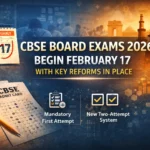
The CBSE three-language policy has faced legal challenges over concerns regarding its constitutional validity and implementation. The Supreme Court issued notice on a plea challenging the policy, particularly questioning the use of Class 6 textbooks for Class 9 students and teacher eligibility for language instruction.
While the government highlighted the policy’s role in promoting multilingualism and national integration, experts have raised concerns about ensuring equal language choices and effective implementation across schools.
CBSE Three-Language Policy 2026-27: Other Key Changes
In addition to the language policy, the CBSE also announced a two-level system for mathematics and science for Class 9, effective from the 2026-27 academic session. Under this system, mathematics and science will have mandatory standard and optional advanced courses. All students will appear for a common 80-mark examination for both mathematics and science, regardless of their chosen level.





📰 More Education News
- M.Sc. in Business Analytics in Australia: courses, fees, and eligibility for 2026Oct 13, 2026 • Nishit Kumar
- XAT 2027 form correction dates out: edit details from October 16Oct 13, 2026 • Nishit Kumar
- CAT and NMAT 2026: key differences in difficulty, pattern, and marking schemeOct 13, 2026 • Nishit Kumar
- KCET vs COMEDK 2026: Key differences in eligibility, fees, and exam patterns detailedOct 13, 2026 • Nishit Kumar