DU Approves Direct PhD Entry for Four-Year UG Students: Key Highlights
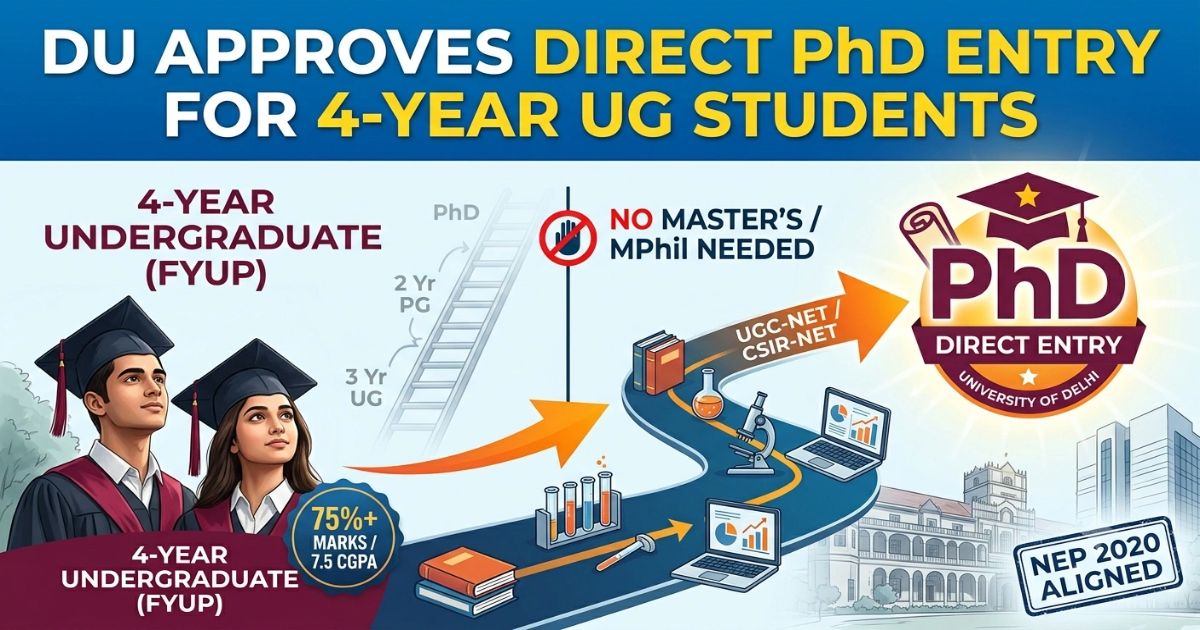
In a landmark structural shift for higher education in India aligned with the National Education Policy (NEP) 2020 and UGC 2022 guidelines, the University of Delhi (DU) has officially approved amendments allowing four-year undergraduate (FYUP) graduates to enroll directly into PhD programs.
Bypassing the traditional 1-to-2-year Master’s or MPhil degree requirements, this streamlined pathway enables eligible candidates—holding a 4-year Bachelor’s degree with a minimum of 75% aggregate marks (7.5 CGPA) and a valid UGC-NET or CSIR-NET qualification—to fast-track their research careers straight into doctoral studies.
What Has Changed in DU’s PhD Admission Rules?
The approval was granted during DU’s Academic Council (AC) meeting, following recommendations from the university’s Research, Innovation, and Entrepreneurship Council (RIEC).
Historically, Ordinance VI of the University of Delhi dictated that candidates needed a postgraduate (Master’s) degree with a minimum of 55% marks to apply for a PhD track. Under the newly amended regulations, Four-Year Undergraduate Programme (FYUP) graduates can bypass the 1-to-2-year Master’s degree requirement altogether, fast-tracking their transition into advanced academic research.
Eligibility Criteria for Direct PhD Entry After Four-Year UG Programme
To qualify for direct PhD entry at Delhi University, candidates must fulfill strict academic thresholds set in accordance with national guidelines.
-
Academic Performance: A minimum aggregate of 75% marks or an equivalent 7.5 CGPA on a 10-point scale in the four-year/8-semester bachelor’s degree program.
-
Category Relaxation: A 5% mark relaxation (or equivalent grade relaxation) is granted to candidates belonging to SC, ST, OBC (non-creamy layer), Differently-Abled, Economically Weaker Sections (EWS), and other reserved categories (lowering their cutoff threshold to 70%).
-
National Entrance Examinations: Candidates must hold a valid scorecard in national-level examinations such as the UGC-NET or CSIR-NET.
-
Disciplinary Flexibility: Candidates are allowed to apply for a PhD in their area of choice, even if it differs from the discipline of their four-year bachelor’s degree, provided they qualify in the relevant NET exam and clear the department interview.
How the New Four-Year UG to PhD Pathway Will Work
The new pathway will allow eligible four-year undergraduate students to directly pursue PhD admission through the following process:
Step 1: Complete Four-Year UG Programme: Finish the FYUP with required academic performance and research coursework.
Step 2: Clear Eligibility Requirements: Meet the minimum marks/CGPA criteria and qualify the required national-level test.
Step 3: Submit PhD Application: Apply to DU with a research proposal and required documents.
Step 4: Attend Departmental Interview: Appear before the Departmental Research Committee (DRC) for evaluation.
Step 5: Get PhD Admission: Selected candidates receive direct entry into the PhD programme.
DU’s Decision Under the National Education Policy (NEP) 2020 Framework
Delhi University implemented the Undergraduate Curriculum Framework (UGCF 2022) as part of the NEP 2020 rollout. NEP 2020 advocates for holistic, multidisciplinary education with flexible exit and entry options.
Key Regulatory Context: The University Grants Commission (UGC) updated its PhD regulations in late 2022 to enable high-performing 4-year undergraduate students to transition directly into doctoral studies. DU’s Academic Council decision officially updates the university’s internal statutes to conform to these overarching national standards.
Who Will Benefit from the Direct PhD Entry Option?
-
First Batch of FYUP Graduates: Students enrolled in DU’s 4-year undergraduate programs (introduced in the 2022–23 academic session) who graduate in 2026 gain immediate access to doctoral admissions.
-
External 4-Year Degree Holders: Graduates holding 4-year degrees (such as B.Tech, B.S., or equivalent FYUP models) from other recognized institutions across India.
-
Young Scholars: Early-career researchers looking to save one to two years of postgraduate study before starting doctoral work.
Previous PhD Admission Route vs New Four-Year UG Pathway
| Parameter | Traditional Pathway | New Direct Pathway (NEP 2020) |
| Minimum UG Duration | 3 Years | 4 Years (8 Semesters) |
| Master’s Degree Required? | Yes (1 or 2 years mandatory) | No (Direct transition permitted) |
| Minimum Qualifying Marks | 55% in Master’s Degree | 75% aggregate or 7.5 CGPA in UG |
| Total Years to PhD Entry | 5 Years (3 Yr UG + 2 Yr PG) | 4 Years (Saves 1 to 2 academic years) |
| Required Entrance | UGC-NET / CSIR-NET / University Test | UGC-NET / CSIR-NET |
DU PhD Admission Process for Four-Year UG Graduates
-
Online Registration: Eligible candidates must register through the official University of Delhi PhD portal du.ac.in during the active application cycles.
-
Document Submission: Applicants submit their academic transcripts, 4-year degree completion certificates, NET scorecard, category certificates (if applicable), and a research proposal summary.
-
Application Fee: Pay the non-refundable registration fee via the online portal.
-
Departmental Screening: Shortlisted candidates are invited by individual departments to present their research proposal before an interview board.
Expert Views and Academic Impact of the New Policy
While university administrators have hailed the move as progressive, the policy decision has also sparked debate among faculty members.
Supporting Arguments
-
Global Alignment: Proponents emphasize that direct entry aligns Indian higher education with international frameworks (such as in the U.S.), where direct-to-PhD tracks exist for top-tier bachelor’s graduates.
-
Early Retention of Research Talent: Prevents “brain drain” by allowing young talent to settle into long-term academic research earlier in their career trajectories.
Dissenting Views & Concerns
-
Reservation Policy Implementation: Certain Academic Council members submitted formal dissent notes, citing concerns over how reservation categories will be distinctly mapped for FYUP direct-entrants versus master’s applicants.
-
Research Fellowships: Concerns were raised regarding university-funded non-JRF fellowship limits, with calls for clearer financial support structures for full-time direct-entry PhD scholars without external JRF funding.
What This Means for DU Students Pursuing Research Careers
-
Shorter Time-to-Degree: Reduces the cumulative timeline to earn a doctorate, enabling students to enter post-doctoral positions or academic jobs at a younger age.
-
Higher Academic Bar: The 75% cutoff ensures that direct entry remains a competitive, merit-based route reserved for top-performing undergraduate researchers.
-
Early Specialization: Students who identify their research interests during their 4th-year undergraduate thesis can build on their research without interruption.

📰 More Education News
- INI-CET Jan 2027: Download admit card today, Oct 26Oct 26, 2026 • Nishit Kumar
- TN BSc Nursing 2026 round 3 seat allotment result on October 27: report by October 31Oct 26, 2026 • Nishit Kumar
- AP OAMDC Phase 3 counselling web option entry begins: exercise choices by October 27Oct 26, 2026 • Nishit Kumar
- BPSC TRE 4.0 application deadline extended: apply for 33,320 vacancies by November 3Oct 26, 2026 • Nishit Kumar