GATE 2026 branch-wise cutoff and passing marks released: check qualifying and admission scores
In short
- IIT Guwahati released the GATE 2026 branch-wise cutoff and passing marks on 31 October 2026 at gate2026.iitg.ac.in.
- Candidates can check their score status and the topper's list using their enrollment ID and password via the GOAPS login.
- The GATE qualifying cutoff is the minimum mark required to pass the exam and obtain a valid scorecard for admissions and scholarships.
- The GATE admission cutoff, which is typically higher, represents the realistic score needed for securing a seat in IITs, NITs, and IIITs.
- The counselling process for eligible candidates will be conducted by COAP for IITs and IISc Bangalore, and by CCMT for NITs, IIITs, and other institutions.
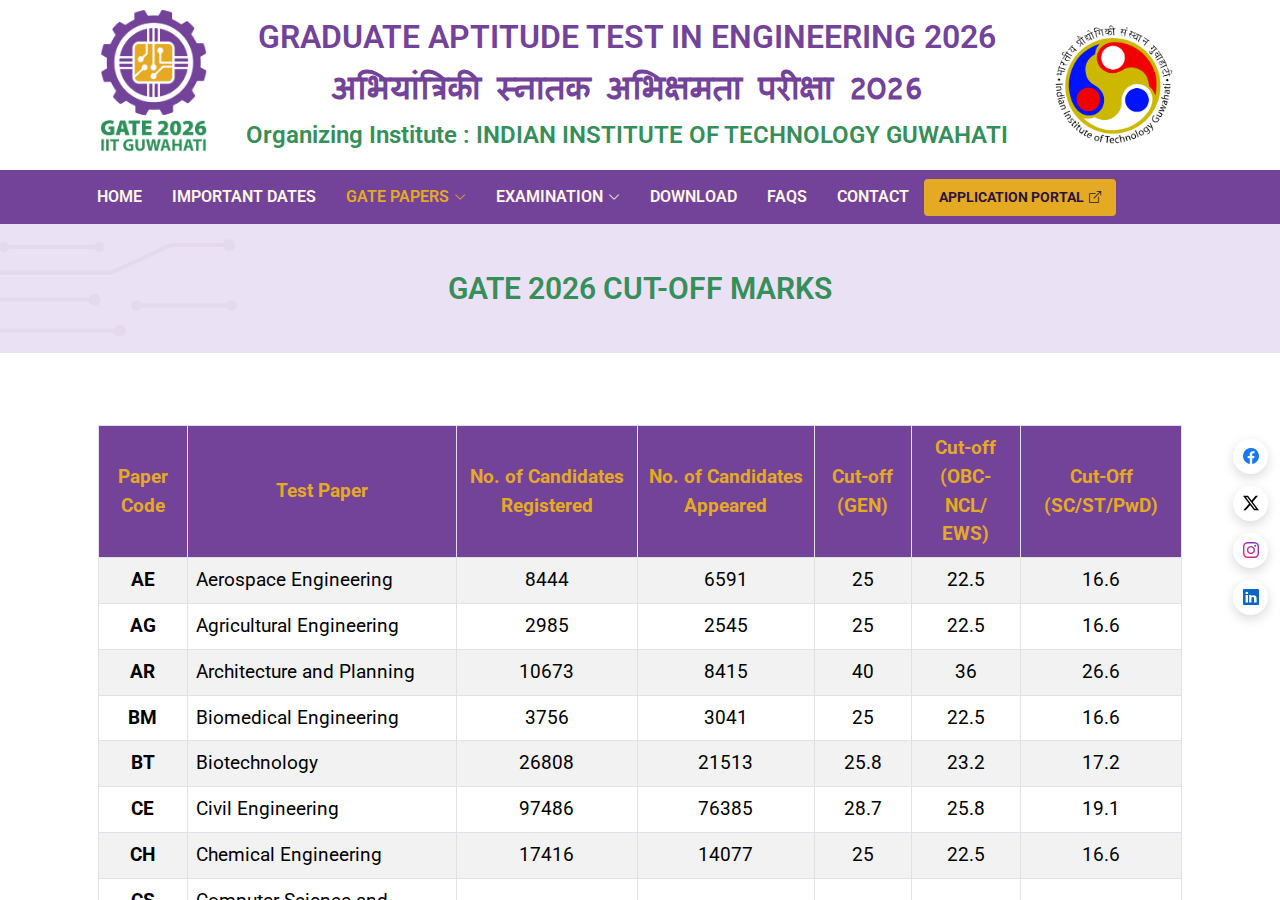
IIT Guwahati today, 31 October 2026, released the GATE 2026 branch-wise cutoff and passing marks online at gate2026.iitg.ac.in. Candidates can access their score status through the GOAPS login using their enrollment ID and password. The institute also published the GATE topper’s list, including raw marks and scores.
This release is crucial for candidates aspiring for MTech admission or PSU recruitment, as the cutoff marks determine eligibility for the GATE counselling process. The cutoff values vary annually based on factors such as the number of qualified students, the difficulty of the exam paper, and past trends.
Understanding GATE Qualifying and Admission Cutoffs
The GATE cutoff is categorised into two types: qualifying cutoff and admission cutoff. The GATE qualifying cutoff 2026 represents the minimum mark required to pass the examination and receive a scorecard. A valid GATE scorecard makes candidates eligible for admission, recruitment, and GATE scholarships.
Conversely, the GATE admission cutoff is the score or marks typically needed to secure admission to specific institutions, such as IITs, NITs, and IIITs. This admission cutoff is consistently higher than the qualifying mark. For OBC-NCL and EWS categories, the cutoff is generally 90% of the general marks, while for SC/ST and PwD categories, it is approximately 67% of the general marks.
| Branch | General | OBC-NCL | SC/ST/PwD |
|---|---|---|---|
| AE Aerospace Engineering | 25 | 22.5 | 16.6 |
| AG Agricultural Engineering | 25 | 22.5 | 16.6 |
| AR Architecture and Planning | 40 | 36 | 26.6 |
| BM Biomedical Engineering | 25 | 22.5 | 16.6 |
| BT Biotechnology | 25.8 | 23.2 | 17.2 |
| CE Civil Engineering | 28.7 | 25.8 | 19.1 |
| CH Chemical Engineering | 25 | 22.5 | 16.6 |
| CS Computer Science and Information Technology | 30 | 27 | 20 |
| CY Chemistry | 25 | 22.5 | 16.6 |
| DA Data Science and Artificial Intelligence | 26.4 | 23.7 | 17.5 |
| EC Electronics and Communication Engineering | 26.4 | 23.7 | 17.5 |
| EE Electrical Engineering | 27.7 | 24.9 | 18.4 |
| ES Environmental Science and Engineering | 30 | 27 | 20 |
| EY Ecology and Evolution | 40 | 36 | 26.6 |
| GE Geomatics Engineering | 25 | 22.5 | 16.6 |
| GG-1 Geology and Geophysics (Geology) | 39.3 | 35.3 | 26.1 |
| GG-2 Geology and Geophysics (Geophysics) | 37.1 | 33.3 | 24.7 |
| IN Instrumentation Engineering | 39.8 | 35.8 | 26.5 |
| MA Mathematics | 34.7 | 31.2 | 23.1 |
| ME Mechanical Engineering | 25.2 | 22.6 | 16.7 |
| MN Mining Engineering | 29.5 | 26.5 | 19.6 |
| MT Metallurgical Engineering | 40 | 36 | 26.6 |
| NM Naval Architecture and Marine Engineering | 33.7 | 30.3 | 22.4 |
| PE Petroleum Engineering | 40 | 36 | 26.6 |
| PH Physics | 25.5 | 22.9 | 17 |
| PI Production and Industrial Engineering | 36 | 32.4 | 24 |
| ST Statistics | 30.4 | 27.3 | 20.2 |
| TF Textile Engineering and Fibre Science | 31.5 | 28.3 | 21 |
| XE Engineering Sciences | 35.2 | 31.6 | 23.4 |
| XH-C1 Humanities and Social Sciences (Economics) | 35.7 | 32.1 | 23.8 |
| XH-C2 Humanities and Social Sciences (English) | 40 | 36 | 26.6 |
| XH-C3 Humanities and Social Sciences (Linguistics) | 37.4 | 33.6 | 24.9 |
| XH-C4 Humanities and Social Sciences (Philosophy) | 38.3 | 34.4 | 25.5 |
| XH-C5 Humanities and Social Sciences (Psychology) | 39.3 | 35.3 | 26.1 |
| XH-C6 Humanities and Social Sciences (Sociology) | 40 | 36 | 26.6 |
| XL Life Sciences | 36.3 | 32.6 | 24.1 |
Admission Cutoff Expectations for Top Institutions
For admission to IITs, a GATE cutoff score of 700 to 800, corresponding to 65 to 75 raw marks, is generally required. NIT admissions through GATE typically consider scores between 600 and 750 marks as safe. IISc Bangalore MTech admission through GATE usually requires a score of 900 or higher. GATE marks are raw scores out of 100, while GATE scores are normalized values out of 1000. For instance, a GATE CSE raw mark of 65 or more translates to a GATE score above 800.
| Branch | Cutoff range |
|---|---|
| Computer Science (CSE) | 65 – 75 marks |
| Data Science and Artificial Intelligence (DA) | 60 – 70 marks |
| Electronics and Communication Engineering (ECE) | 70 – 80 marks |
| Mechanical Engineering (ME) | 36 – 45 marks |
| Electrical Engineering (EE) | 35- 40 marks |
| Civil Engineering (CE) | 35 – 40 marks |
| Branch | Cutoff range |
|---|---|
| Computer Science (CSE) | 45 to 55 marks |
| Data Science and Artificial Intelligence (DA) | 45 to 55 marks |
| Electronics and Communication (ECE) | 40 to 45 marks |
| Mechanical Engineering | 40 to 45 marks |
| Civil Engineering (CE) | 40 to 45 marks |
Exam Difficulty and Candidate Participation
Approximately 2 lakh students appeared for the Computer Science (CSE) paper in GATE 2026. The difficulty level for the CS paper was moderate, with an increase in numerical aptitude and problem-based questions. For Mechanical Engineering (ME), around 1.2 lakh students appeared, and the overall difficulty was moderately difficult, with higher weightage given to Manufacturing Engineering and Thermodynamics.
The GATE exam consists of 65 questions, totaling 100 marks. This includes 10 questions from General Aptitude and 55 questions from the chosen subject paper. The syllabus encompasses General Aptitude, Engineering Mathematics, and core subject topics specific to each paper. For CSE, the syllabus covers General Aptitude, Engineering Mathematics, Algorithms, Data Structures, Operating Systems, DBMS, Computer Networks, Theory of Computation, Compiler Design, and Digital Logic.
Next Steps for Eligible Candidates
Candidates who have secured marks equal to or above the qualifying cutoff are eligible for the GATE counselling process. This process will be conducted by COAP for admissions to IITs and IISc Bangalore, and by CCMT for NITs, IIITs, and other centrally funded institutions. Candidates are advised to keep their enrollment ID and password ready and apply to multiple institutes through COAP and CCMT.
| College / Target | General | OBC-NCL | SC/ST |
|---|---|---|---|
| Qualifying Cutoff (Marks/100) | 29.5 | 26.5 | 19.6 |
| IIT Bombay | 800 | 700 | 550 |
| IIT Delhi | 780 | 680 | 530 |
| IIT Madras | 770 | 670 | 520 |
| IIT Kanpur | 760 | 660 | 510 |
| IIT Kharagpur | 750 | 650 | 500 |
| IISc Bangalore | 790 | 690 | 540 |
| NIT Trichy | 650 | 570 | 420 |
| NIT Warangal | 640 | 560 | 410 |
| Top PSU (BARC) | 600 | 530 | 400 |
Further reading

📰 More Education News
- INI CET 2026 exam on November 1: documents required, entry rulesOct 31, 2026 • Nishit Kumar
- Karnataka SSLC Exam 1 and 2 dates out for 2027: what changes for aspirantsOct 31, 2026 • Nishit Kumar
- ISO 2026-27 exam dates announced: Level 1 on October 30, November 19, December 3Oct 31, 2026 • Nishit Kumar
- TIFR GS result 2026 declared on January 30, interview schedules releasedOct 31, 2026 • Nishit Kumar