GATE 2027 Environmental Science and Engineering syllabus released by IIT Madras
In short
- IIT Madras released the GATE 2027 Environmental Science and Engineering (ES) syllabus on gate2027.iitm.ac.in.
- The GATE ES exam is a 3-hour Computer-Based Test with 65 questions for a total of 100 marks.
- The syllabus includes sections like Environmental Chemistry, Water & Wastewater Treatment, and Air & Noise Pollution.
- General Aptitude carries 15 marks, while the Environmental Science & Engineering section accounts for 85 marks.
- Negative marking applies only to Multiple Choice Questions (MCQs) in the GATE ES exam.
IIT Madras has released the detailed syllabus for the Graduate Aptitude Test in Engineering (GATE) 2027 Environmental Science and Engineering (ES) paper. The detailed syllabus, along with information on the exam pattern, recommended books, and vital topics, is now available on the official GATE 2027 website, gate2027.iitm.ac.in.
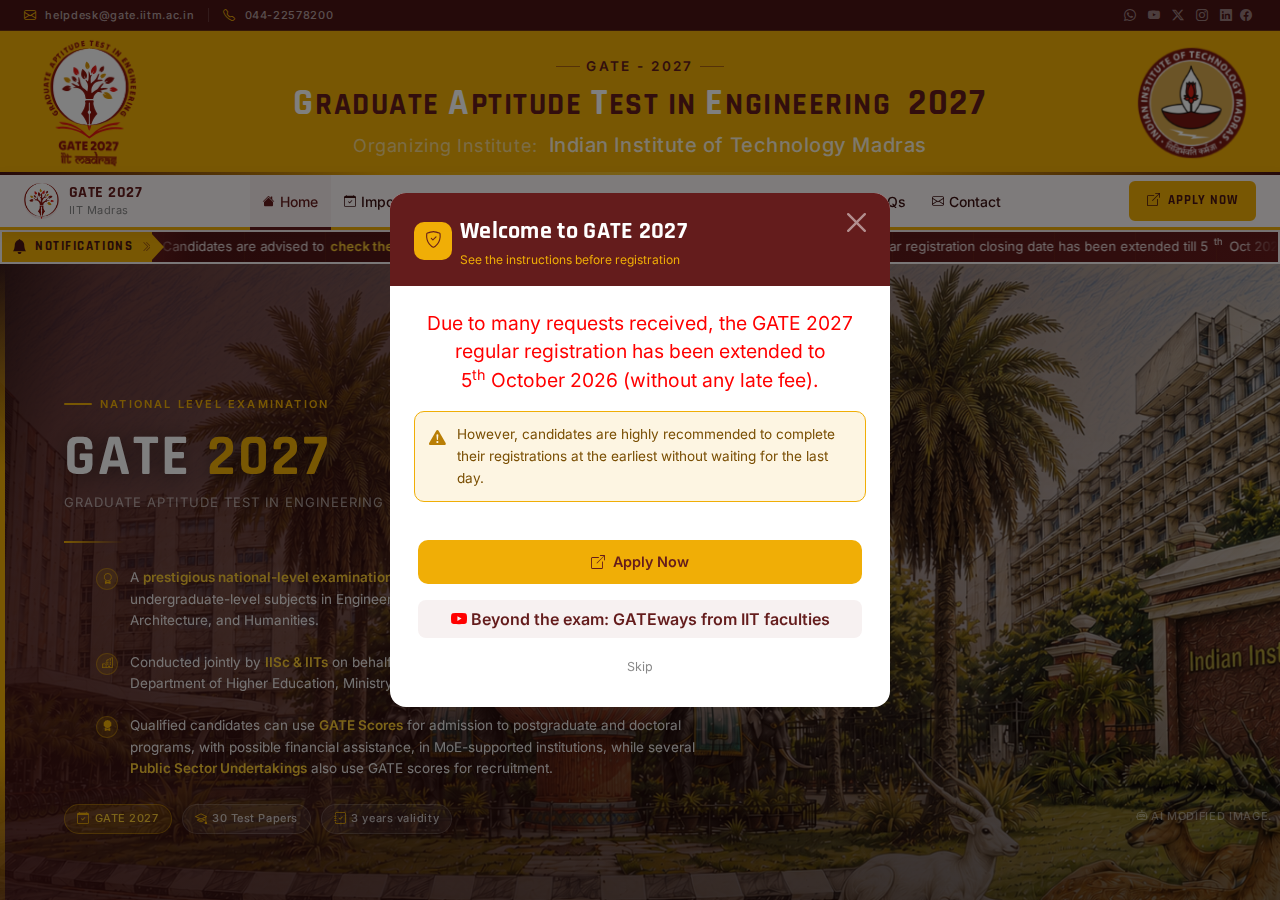
The release aims to assist candidates preparing for the GATE Environmental Engineering (ES) paper in the upcoming 2027 examination. GATE 2027 will encompass a total of 30 test papers, with the Environmental Science and Engineering paper being a Computer-Based Test (CBT) designed to assess candidates’ understanding across various environmental disciplines.
GATE 2027 Environmental Science and Engineering Exam Pattern
The GATE 2027 Environmental Science and Engineering (ES) examination will be a three-hour Computer-Based Test (CBT) comprising 65 questions for a total of 100 marks. The question types will include Multiple Choice Questions (MCQ), Multiple Select Questions (MSQ), and Numerical Answer Type (NAT) questions. General Aptitude (GA) is a mandatory section common to all 30 GATE 2027 papers, carrying 15 marks, with the remaining 85 marks allocated to the Environmental Science & Engineering section.
Negative marking will be applied only to MCQs, with a deduction of 1/3 mark for a 1-mark wrong answer and 2/3 mark for a 2-mark wrong answer. There will be no negative marking for MSQ and NAT questions. Candidates are permitted to appear in either one or up to two test papers, and all test papers will be conducted in English. The official website, gate2027.iitm.ac.in, provides further details on the examination structure.
| Particular | Details |
|---|---|
| Exam Mode | Computer-Based Test (CBT) |
| Duration | 3 Hours |
| Total Questions | 65 |
| Total Marks | 100 |
| Question Types | MCQ, MSQ & NAT |
| Sections | General Aptitude and Environmental Science & Engineering |
| General Aptitude | 15 Marks |
| Environmental Science & Engineering | 85 Marks |
| Negative Marking | Applicable only for MCQs (1/3 for 1-mark and 2/3 for 2-mark questions) |
Detailed Syllabus for Environmental Science and Engineering
The GATE 2027 Environmental Science and Engineering syllabus is structured into several key sections, covering a broad spectrum of environmental topics. These include Mathematics Foundation, Environmental Chemistry, Environmental Microbiology, Water Resources and Environmental Hydraulics, Water & Wastewater Treatment and Management, Air and Noise Pollution, Solid and Hazardous Waste Management, Global and Regional Environmental Issues, and Environmental Management and Sustainable Development. The General Aptitude syllabus covers English, Reading comprehension, Quantitative aptitude, and Analytical and spatial aptitude.
Furthermore, the Engineering Mathematics syllabus, a common component in most GATE papers and typically carrying 12–14 marks, includes Linear Algebra, Calculus, Numerical Methods, and Probability and Statistics. The Environmental Chemistry section specifically details Fundamentals of Environmental Chemistry, Principles of Water Chemistry, Soil Chemistry, and Atmospheric Chemistry. Candidates are advised to familiarize themselves with the paper code, as it is required during the application and examination processes. GATE 2027 now features a total of 29 courses, following the addition of Geomatics Engineering (GE) and Naval Architecture and Marine Engineering (NM) in 2025.
Preparation Guidance and Previous Year Papers
Previous year papers are considered an important resource for effective GATE 2027 preparation, per IIT Madras. Practicing these papers after completing the syllabus and reviewing the exam pattern can help candidates understand question types, difficulty levels, and overall approach. This practice is also noted to improve conceptual clarity, build confidence, and allow for evaluation of preparation under exam-like conditions.
Beginners are advised to download the official syllabus, understand the exam pattern, build strong fundamentals in mathematics and core engineering subjects, and regularly practice previous year questions and mock tests. If candidates wish to appear in a second paper, they can add the respective paper in their original application. The GATE examination usually consists of around 30 test papers covering major engineering, science, and interdisciplinary subjects.
Further reading

📰 More Education News
- Ph.D. in Cloud Computing admissions 2026 open in Rajasthan; NIMS University offers part-time courseSep 27, 2026 • Nishit Kumar
- VITEEE 2026: Pay ₹5,900 counselling fee to participate in choice fillingSep 27, 2026 • Nishit Kumar
- GATE 2027 registration extended: apply with late fees by October 12Sep 27, 2026 • Nishit Kumar
- NMAT 2026 exam scheduling deadline is October 22Sep 27, 2026 • Nishit Kumar