JNVST Class 6 entrance exam dates announced for 2025-26; apply for Class 9 and 11 by September 30
In short
- Applications for Jawahar Navodaya Vidyalaya (JNV) Class 9 and 11 lateral entry admissions close on September 30, 2026.
- The Jawahar Navodaya Vidyalaya Selection Test (JNVST) for Class 6 Phase-1 will be held on January 18, 2025, and Phase-2 on April 12, 2025.
- JNVs are co-educational residential schools offering free education, including boarding and lodging, from Class 6 to 12.
- A monthly fee of Rs 600 is collected from students of Classes 9 to 12 towards Vidyalaya Vikas Nidhi, with exemptions for certain categories.
- Currently, 665 JNVs are functional across 27 states and eight Union Territories, with 75% of seats reserved for rural students.
The Navodaya Vidyalaya Samiti (NVS) has announced the admission process for Jawahar Navodaya Vidyalayas (JNVs) for the 2025-26 academic year, covering admissions to Classes 6, 9, and 11. Applications for lateral entry to Class 9 and 11 are open until September 30, 2026, while the entrance examination for Class 6 admissions is scheduled for early 2025.
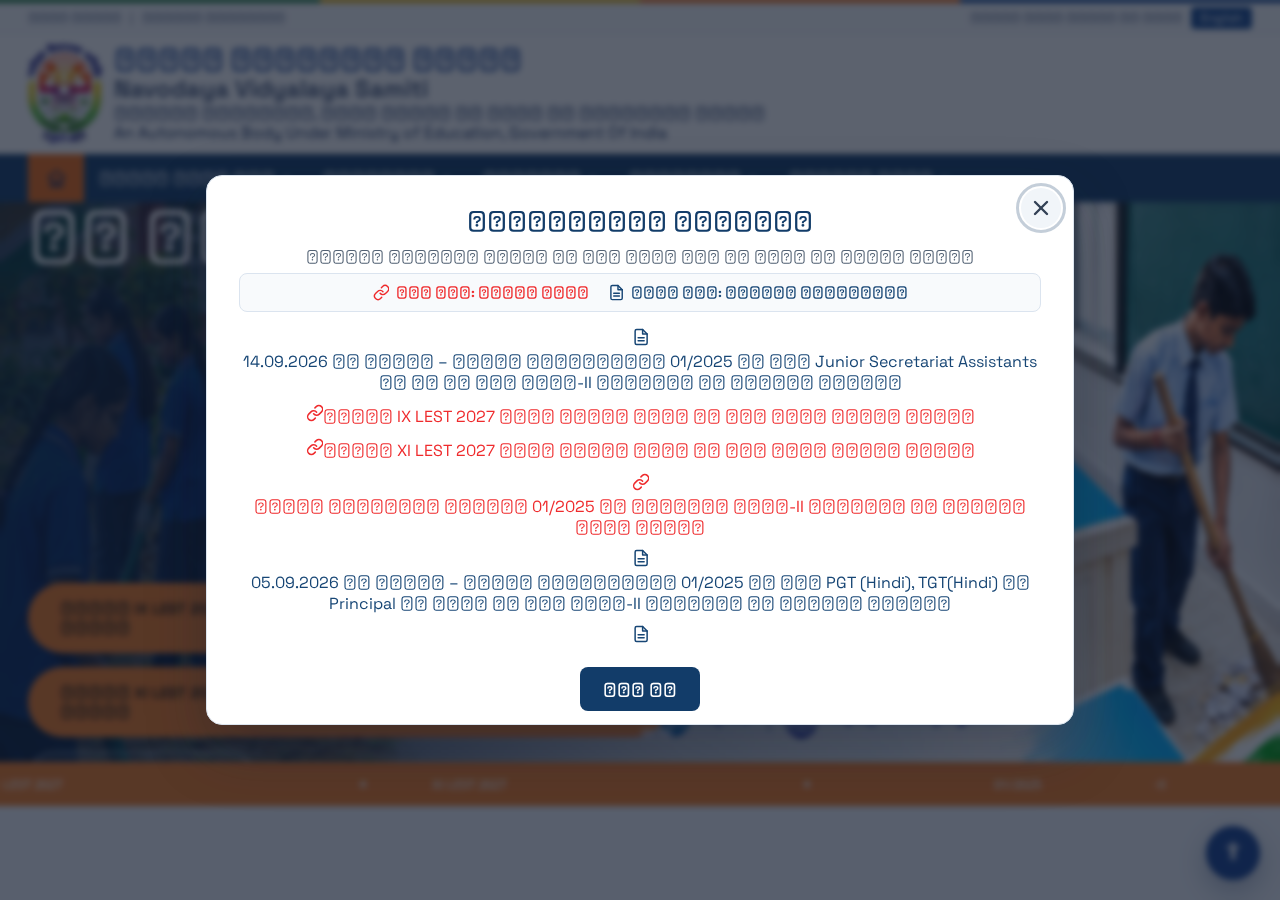
JNVs, fully financed and administered by the Government of India through the NVS, aim to provide quality modern education to talented children, predominantly from rural areas, across 27 states and eight Union Territories. These schools are affiliated with the Central Board of Secondary Education (CBSE) and offer education from Class 6 to 12.
Admission Process and Key Dates
Admission to Class 6 in JNVs is primarily conducted through the Jawahar Navodaya Vidyalaya Selection Test (JNVST). For the 2025-26 session, the JNVST Class 6 entrance exam will be held in two phases: Phase-1 on January 18, 2025, and Phase-2 on April 12, 2025. The examination is conducted offline using an OMR answer sheet.
Students are also admitted through lateral entry for Classes 9 and 11 to fill vacant seats. The application window for these lateral entries is currently open and will close on September 30, 2026. Interested candidates can apply via the official portal, navodaya.gov.in.
Eligibility Criteria for JNV Admissions
Specific age and academic criteria apply for admissions to different classes. For Class 6 admission, students must be aged between 10 and 12 years, born between May 1, 2013, and July 31, 2015 (both dates included). Candidates who passed Class 5 before the 2025-26 session or are repeater candidates are not eligible.
For Class 9 lateral entry, students must be studying in Class 8 at a recognized school and born between May 1, 2009, and July 31, 2011. For Class 11 lateral entry, candidates must have studied Class 10 during the 2023-24 academic year in a government-recognized school where a JNV operates, with their date of birth between June 1, 2007, and July 31, 2009.
JNVST Class 6 Exam Pattern and Structure
The JNVST for Class 6 assesses students’ mental ability, arithmetic, and language skills. The exam duration is 2 hours, from 11:30 AM to 1:30 PM, with an additional 40 minutes provided for students with disabilities. There is no negative marking in the JNVST for Class 6.
| Section | Questions | Marks | Time |
|---|---|---|---|
| Mental Ability Test | 40 | 50 | 60 minutes |
| Arithmetic Test | 20 | 25 | 30 minutes |
| Language Test | 20 | 25 | 30 minutes |
| Total | 80 | 100 | 2 hours (11:30 AM – 1:30 PM) |
Fee Structure and Reservations
Education in JNVs is free, encompassing boarding, lodging, uniform, and textbooks. However, a fee of Rs 600 per month is collected from students of Classes 9 to 12 towards the Vidyalaya Vikas Nidhi (VVN). Students from SC/ST categories, Divyang students, girls, and those whose family income is below the poverty line (BPL) are exempted from this monthly VVN amount.
Wards of Government employees, other than the exempted categories, are charged Rs 1500 per month or the actual children education allowance received by the parent per month, whichever is less, with a minimum of Rs 600 per student per month. A significant 75% of seats in JNVs are reserved for eligible students from rural areas. Reservations are also provided for SC, ST, OBC, and Children with Benchmark Disabilities (PwBD) as per Government of India norms, and adequate representation is ensured for girl students.
JNV Network and National Integration Initiatives
Currently, 665 JNVs are functional across 27 states and eight Union Territories, with the aim to establish one JNV in each district in a phased manner. The distribution varies across regions; for instance, Arunachal Pradesh has 20 JNVs, Assam has 30, and Chandigarh has one.
| State/UT | Number of JNVs |
|---|---|
| Arunachal Pradesh | 20 |
| Kerala | 14 |
| Chandigarh | 1 |
| Uttarakhand | 13 |
| Assam | 30 |
| Telangana | 15 |
| Nagaland | 11 |
| Sikkim | 4 |
To promote national integration, 30% of students in Class 9 from a Hindi-speaking area spend one academic year in a Vidyalaya in a non-Hindi speaking area, and vice versa. The medium of instruction in JNVs is the mother tongue or regional language up to Class 8, transitioning to English for Mathematics and Science, and Hindi/English for Social Science thereafter.
Required Documents for Admission
Candidates applying for JNV admissions are required to submit various documents. For Class 6 admission, a student’s photograph, student’s signature, parent’s signature, and the JNVST 2024 certificate are needed in JPG/JPEG format within specified file sizes.
| Document Name | Format | File Size |
|---|---|---|
| Student’s Photograph | JPG/JPEG | 10-100 KB |
| Student’s Signature | JPG/JPEG | 10-100 KB |
| Parent’s Signature | JPG/JPEG | 10-100 KB |
| JNVST 2024 certificate | JPG/JPEG | 50-300 KB |
For Class 9th and 11th lateral entry, a more extensive list of hard copy documents is required, including birth certificates, eligibility proof, rural quota certificates, residence certificates, study detail certificates from previous schools, medical certificates, and category/disability certificates where applicable. Digital copies of student’s photograph and signatures are also required for these applications.
| Document Name | Format | File Size |
|---|---|---|
| Birth certificate | Copy of birth certificate | Hard Copy |
| Eligibility proof | As per NVS norms and conditions | Hard Copy |
| Rural quota | Certificate from district administration confirming studies in a rural area school in Class 10. | Hard Copy |
| Residence certificate | Copy of Aadhaar card | Hard Copy |
| Study detail certificate | Study detail certificate from the previous school | Hard Copy |
| Medical certificate | Medical certificate | Hard Copy |
| Category certificate | Category certificate | Hard Copy |
| Disability certificate | Disability certificate (if applicable) | Hard Copy |
| Student’s Photograph | JPG/JPEG | 10-100 KB |
| Student’s Signature | JPG/JPEG | 10-100 KB |
| Parent’s Signature | JPG/JPEG | 50-300 KB |

Further reading
📰 More Education News
- TS LAWCET, PGLCET 2026 Phase 3 seat allotment postponed to September 27Sep 25, 2026 • Nishit Kumar
- AP OAMDC Phase 2 web option entry deadline extended to September 25Sep 25, 2026 • Nishit Kumar
- UP Police Constable PET 2025 schedule released: tests begin October 1Sep 25, 2026 • Nishit Kumar
- IHM Hajipur: Apply for 2026 Diploma admission; fee notice availableSep 25, 2026 • Nishit Kumar