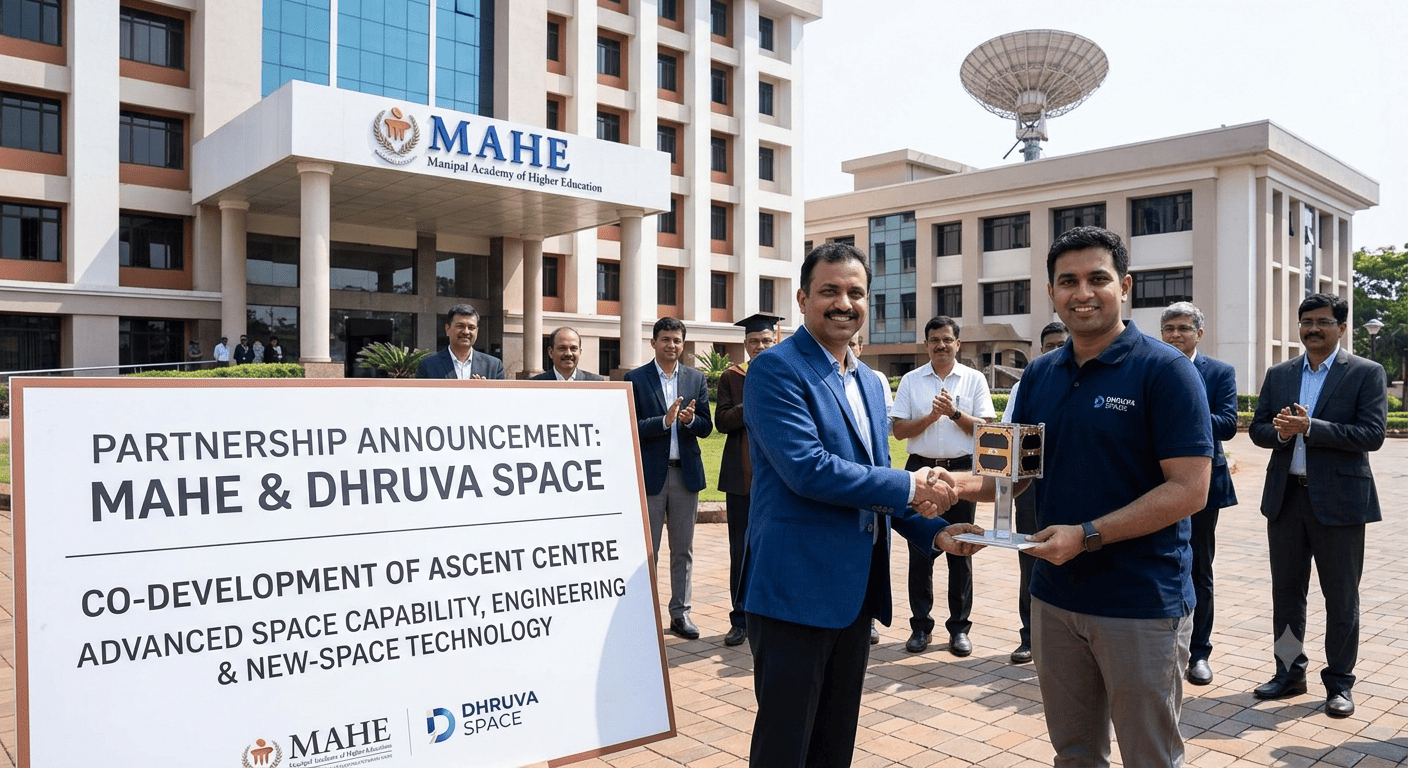
MAHE and Dhruva Space Partner to Launch ASCENT Space Technology Centre
In a major step forward for India’s private space sector, the Manipal Academy of Higher Education (MAHE) has signed a strategic partnership with Dhruva Space, a leading full-stack space engineering company. The two organizations will work together to build a new space technology facility called the ASCENT Centre.
ASCENT stands for Advanced Space Capability, Engineering and New-Space Technology. The center will be located at MAHE’s main campus in Manipal, Karnataka. It is officially scheduled to open its doors by late 2026.
Bridging the Gap Between Classrooms and Space
The main goal of this collaboration is to connect university education with the fast-growing space industry. Instead of just reading about satellites in textbooks, students and researchers will get to design, build, and test real space hardware.
By bringing MAHE’s academic strengths together with Dhruva Space’s engineering experience, the ASCENT Centre hopes to create “mission-ready” talent for India. This means students will graduate with the practical skills needed to work immediately in the modern space ecosystem.
World-Class Infrastructure for Building Satellites
To make sure students learn on industry-grade equipment, the ASCENT Centre will house advanced engineering facilities. The campus facility will feature:
-
A Class 10,000 Cleanroom: A highly filtered, dust-free laboratory environment essential for assembling sensitive satellite parts without contamination.
-
A Helmholtz Cage: A specialized device used to create controlled magnetic fields, letting engineers test how a satellite will orient itself in space.
-
An Air-Bearing Table: A system that simulates the near-frictionless movement of space, allowing teams to test spacecraft dynamics and control systems on the ground.
These tools will give students an end-to-end experience in the life cycle of a space mission—from the first drawing board design to testing, launch prep, and monitoring the satellite once it is in orbit.
Ambitious Goals: From Small Satellites to Deep Space
The alliance has already laid out a clear roadmap for the next decade. The center is not just for practice; it will be launching functional projects into space.
-
By 2028: The center aims to design and launch at least three “CubeSats” (small, box-shaped research satellites ranging from 1U to 6U in size).
-
By 2030: Teams plan to deploy a “swarm constellation” of femto-satellites (very small satellites working together). The center also plans to build a fully operational Space Situational Awareness (SSA) Centre to track space debris and monitor orbital traffic.
-
By 2035: In the long term, ASCENT has set its sights beyond Earth’s orbit, aiming to launch at least one interplanetary technology demonstration mission to support deep-space exploration.
Focus Areas of Research
Beyond building satellites, the facility will serve as a hub for advanced research. Scientists and students at the center will focus on next-generation fields such as space-based Internet of Things (IoT) connectivity, microgravity research, and autonomous spacecraft technologies. They will also work on integrating Artificial Intelligence (AI) and Machine Learning (ML) to make satellites smarter and more self-reliant while in space.
Leaders from both organizations have expressed great excitement about the project. MAHE officials highlighted that the partnership gives students an extraordinary opportunity to work on real satellite missions and solve practical engineering challenges. Meanwhile, representatives from the space program noted that ASCENT will create a scalable model for how industries and universities should collaborate, ensuring India stays highly competitive in the global space race.

📰 More Education News
- Bihar STET 2026: Download admit card from Oct 18; exams start Oct 25Oct 16, 2026 • Nishit Kumar
- NIFT 2027 registration begins: apply by 16 November for UG, PG coursesOct 16, 2026 • Nishit Kumar
- Pune Law: Apply for direct admission now, no entrance exam neededOct 16, 2026 • Nishit Kumar
- Moral education to be part of school syllabus from next academic session in Himachal PradeshOct 16, 2026 • Nishit Kumar