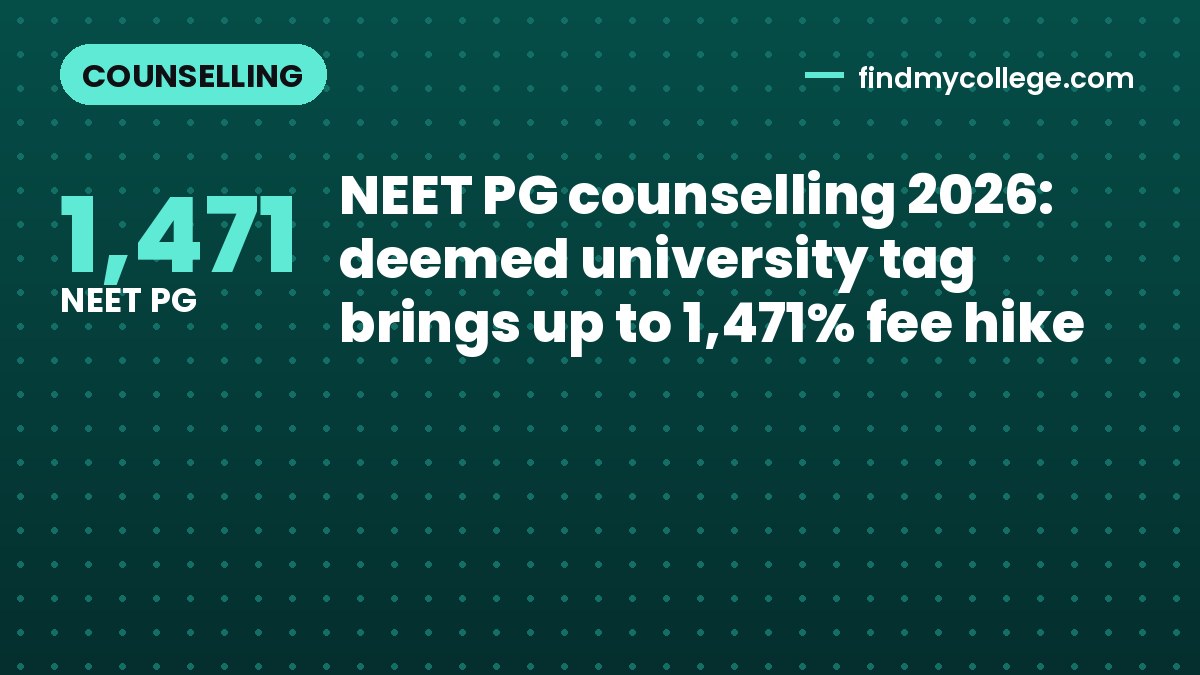
NEET PG counselling 2026: deemed university tag brings up to 1,471% fee hike
In short
- The first seat allotment for MCC NEET PG counselling 2026 is scheduled for October 24, 2026.
- Four Tamil Nadu medical colleges, recently granted deemed-university status, have increased PG medical course fees by as much as 1,471%.
- DY Patil University’s medical college in Navi Mumbai recorded a 24% single-year hike for its MD Radiodiagnosis fee, reaching Rs 2.61 crore overall.
- Twelve out of 54 deemed university medical schools participating in counselling will charge over Rs 2 crore in tuition for three-year MD/MS programmes.
- The Supreme Court in May 2025 mandated pre-counselling fee disclosure and a centralised fee regulation mechanism under the National Medical Commission.
The ongoing Medical Counselling Commission (MCC) NEET PG counselling 2026 has brought to light significant fee increases at private medical colleges and deemed universities across India. Four medical colleges in Tamil Nadu, which recently received deemed-to-be university tags from the centre, have raised their fees for postgraduate medical courses by up to 1,471% in certain specialisations.
This development comes as the first seat allotment for MCC NEET PG counselling 2026 is scheduled for October 24, 2026, impacting thousands of candidates seeking admission to MD/MS programmes. The fee hikes have reignited demands for greater government oversight on the fee structures of deemed medical colleges, a concern previously addressed by the Supreme Court.
Significant Fee Hikes at Deemed Universities
An analysis of fee structures reveals that the MD Radiodiagnosis course at DY Patil University’s medical college in Navi Mumbai, Maharashtra, is now the costliest PG course, with an overall programme cost of Rs 2.61 crore. This represents a 24% single-year hike. Across the country, 12 out of 54 medical schools under deemed universities participating in MCC NEET PG counselling 2026 are set to charge over Rs 2 crore in overall tuition fees for their three-year MD/MS programmes.
The fee figures, which cover cumulative tuition fees for the three-year course and major one-time admission amounts but exclude hostel and mess fees, demonstrate that most colleges apply a uniform annual amount, while some put in place annual increases ranging from 2.5% to 10%. Fees for the 15% non-resident Indian (NRI)-quota seats are consistently higher across institutes.
Tamil Nadu Colleges See Substantial Increases
The four Tamil Nadu medical colleges granted deemed-university status this year have released fee structures indicating annual tuition fees between Rs 25 lakh and Rs 55 lakh for clinical branches. For pre- and para-clinical streams, annual fees range from zero to Rs 15 lakh. These figures represent a substantial increase compared to the annual fees determined by the Tamil Nadu fee fixation committee for government-quota seats in private self-financed medical colleges, which were Rs 3.5 lakh for clinical and Rs 3 lakh for non-clinical specialisations.
For management quota seats at these Tamil Nadu institutes, the cost has been set at Rs 16 lakh for clinical and Rs 5 lakh for non-clinical specialisations. In August, a jump in MBBS fees at newly-labelled deemed universities in the southern state was also reported. The Madras High Court in June 2017 had directed the UGC and HRD ministry to establish a committee to regulate fees for medical courses offered by deemed universities.
| Stream | Annual Tuition Fee (INR) |
|---|---|
| Clinical branches | 25 lakh to 55 lakh |
| Pre- and para-clinical streams | 0 to 15 lakh |
| Stream | Annual Fee (INR) |
|---|---|
| Clinical government-quota seats | 3.5 lakh |
| Non-clinical government-quota seats | 3 lakh |
| Specialisation Category | Cost (INR) |
|---|---|
| Clinical | 16 lakh |
| Non-clinical | 5 lakh |
Supreme Court Directives and Seat Blocking Concerns
The Supreme Court has previously addressed widespread seat blocking in postgraduate medical admissions, noting systemic flaws, lack of transparency, and weak policy enforcement. In May 2025, the Supreme Court mandated pre-counselling fee disclosure by all private and deemed universities for NEET-PG, detailing tuition, hostel, caution deposit, and miscellaneous charges. The court also directed the National Medical Commission (NMC) to establish a centralised fee regulation mechanism.
Justices J B Pardiwala and R Mahadevan of the Supreme Court bench stated, “Seat blocking is not merely an isolated wrongdoing – it reflects deeper systemic flaws rooted in fragmented governance, lack of transparency, and weak policy enforcement.” The court also called for strict penalties for seat blocking, including forfeiture of security deposits, disqualification from future NEET-PG examinations for repeat offenders, and blacklisting of complicit colleges. It also suggested implementing Aadhaar-based seat tracking to prevent multiple seat holdings and misrepresentation. The NMC approved 966 new PG medical seats in private deemed universities for the academic year 2025-26.
Historical Context of Fee Hikes and Vacant Seats
The issue of high fees and vacant seats in private medical colleges is not new. In Karnataka, PG medical course fees were slated to increase by 15% at private medical colleges from the 2019 academic year, with hefty fees reportedly ranging from Rs 1 crore to Rs 10 crore for PG medical courses. Between 2014 and 2018, at least 2,027 PG medical seats were left unfilled in Karnataka, including 306 seats in 2018 and 1,129 in 2017, often attributed to prohibitive fees and falling demand for non-clinical specialisations.
Until 2015, colleges in Karnataka had agreed to a 10% hike in PG medical seat fees. In 2017, new guidelines for PG medical admissions stipulated that 50% of the intake would be under the Convenor quota and 50% under the Management quota. The Management quota was further divided into 25% General Merit, 15% foreign/NRI/NRI sponsored, and 10% institutional preference. Minority institutions are required to admit at least 70% of seats from the minority community to retain their status. The Supreme Court in May 2016 ruled that the State can regulate admission, fix fees, and lay down other regulatory mechanisms.
| College | Course | Annual Fee (INR) |
|---|---|---|
| KS Hegde medical college, Mangalore | MD general medicine | 24 lakhs |
| KS Hegde medical college, Mangalore | MS ophthalmology | 24 lakhs |
| KS Hegde medical college, Mangalore | MD Radiology | 28 lakhs |
| KS Hegde medical college, Mangalore | MS Orthopedics | 28 lakhs |
| Amrita medical college, Kochi | Various MD and MS courses | 25 to 28 lakhs |
| Year | Vacant Seats |
|---|---|
| 2014-2018 (cumulative) | 2,027 |
| 2018 | 306 |
| 2017 | 1,129 |
Further reading

📰 More Education News
- DGMA recruitment 2026: apply online for 30 MSA posts by 12 NovemberOct 24, 2026 • Nishit Kumar
- UP TGT: Download admit card for June 3 & 4 examsOct 24, 2026 • Nishit Kumar
- UP TGT Physical Education Exam 2026 syllabus and pattern announced by UPESSCOct 24, 2026 • Nishit Kumar
- UPESSC principal syllabus 2026 released for aided degree colleges, 111 vacanciesOct 24, 2026 • Nishit Kumar