UPES RET 2027: Apply now for PhD admissions
In short
- Applications are now open for UPES PhD Admissions 2027 through the Research Entrance Test (RET).
- Admissions for the PhD program at UPES are conducted twice annually, in January and July.
- Full-time PhD scholars at UPES are eligible for a 75% waiver on the program semester fee and a monthly fellowship of up to ₹30,000.
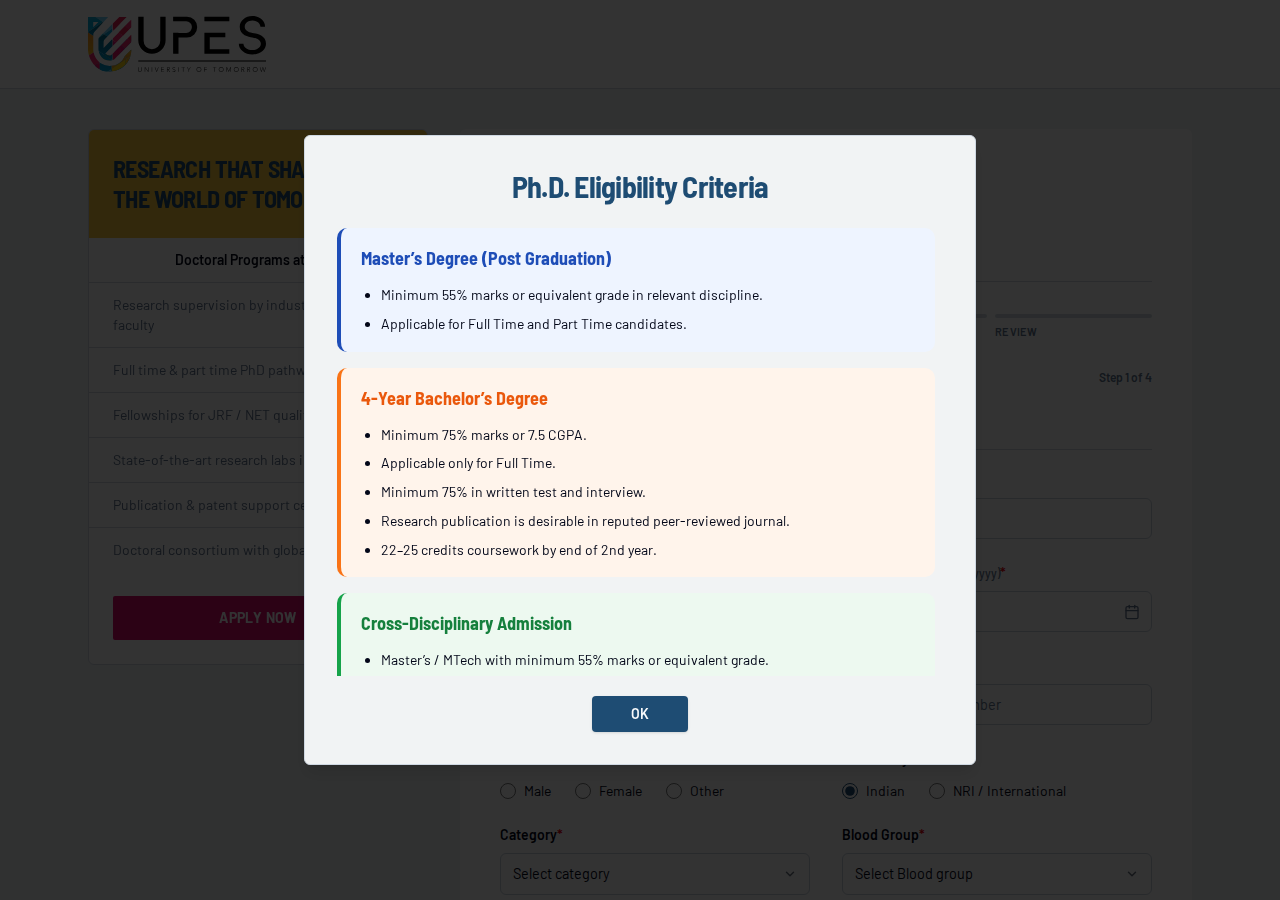
- Basic eligibility requires a Master's degree with a minimum of 55% marks, or 50% for reserved categories as per UGC norms.
- Candidates with valid UGC-NET/CSIR-NET/GATE/SLET/JRF scores are generally exempt from the university's entrance test.
UPES, located in Dehradun, Uttarakhand, has opened applications for its PhD Admissions 2027. Prospective candidates seeking admission to PhD programs will be evaluated through the Research Entrance Test (RET).
Admissions to the PhD program at UPES are conducted biannually, in January and July. The university offers PhD programs across various disciplines, including Engineering, Computer Science, Law, Health Sciences, Management, Design, and Liberal Studies.
Eligibility and Admission Process for PhD Programs
The basic eligibility criteria for both Full-Time and Part-Time PhD programs at UPES require a Master’s degree or an equivalent professional degree in a relevant field. Candidates must have secured a minimum of 55% marks in their Master’s degree, with a relaxation to 50% for reserved categories, in accordance with UGC norms. For Part-Time PhD applicants, an additional mandatory No-Objection Certificate (NOC) from their current employer is required.
The admission process involves an Entrance Test, which can be either the RET or a University Test, followed by an Interview or Viva-Voce. Candidates holding valid scores from national-level examinations such as UGC-NET, CSIR-NET, GATE, SLET, or JRF are generally exempt from appearing in the University Entrance Test.
| Aspect | Full-Time PhD (Typical) | Part-Time PhD (For Working Professionals) |
|---|---|---|
| Duration | Minimum 3 years, Maximum 6 years (including Course Work) | Minimum 4 years, Maximum 8 years (including Course Work) |
| Basic Eligibility | Master’s degree (or equivalent professional degree) in a relevant field with a minimum of 55% marks (50% for reserved categories, as per UGC norms). | Same as Full-Time; additionally, a No-Objection Certificate (NOC) from the current employer is mandatory. |
Financial Support and Research Opportunities
UPES provides financial incentives for its full-time PhD scholars. These include a 75% waiver on the program semester fee. In addition, selected full-time scholars may receive a monthly fellowship, or stipend, of up to ₹30,000. The approximate tuition fee for UPES is 1 lakh per semester.
Beyond institutional support, government-funded scholarships and fellowships are also available to PhD candidates. These include the Junior Research Fellowship (JRF) with a monthly stipend of ₹31,000 and the Senior Research Fellowship (SRF) with a monthly stipend of ₹35,000, both accompanied by House Rent Allowance (HRA). Project-based grants from bodies like the Department of Science and Technology (DST), Department of Biotechnology (DBT), and Council of Scientific & Industrial Research (CSIR) offer Research Assistantships (RAs) at various government institutes.
Dehradun as a Research Hub
Dehradun, often referred to as the ‘Education Hub of Uttarakhand’, offers a conducive environment for PhD studies. The city hosts a mix of government institutions, specialized research centers, and private universities. Nationally important research bodies such as the Forest Research Institute (FRI), the Wildlife Institute of India (WII), and the Indian Institute of Remote Sensing (IIRS) are located in Dehradun, providing opportunities for interdisciplinary research, particularly in fields like Environmental Science, Forestry, and Geology.
Private universities in Dehradun, including UPES, are noted for providing latest infrastructure, flexible PhD formats, and interdisciplinary research centers. UPES itself hosts specialized research centres such as the Centre for Data-Science and Artificial Intelligence (C-DSAI) and the Centre for Inter-Disciplinary Research and Innovation (CIDRI), fostering a research-intensive environment.
Further reading

📰 More Education News
- University of Patanjali odd semester exam 2026-27 date-sheet released, exams begin December 7Nov 19, 2026 • Nishit Kumar
- Kannur University readmission applications invited for various programs; apply by November 21Nov 19, 2026 • Nishit Kumar
- PG NEET 2026 counselling: KEA opens second round option entry link todayNov 19, 2026 • Nishit Kumar
- UGC NET December 2026 exam schedule released: test from 14 DecemberNov 19, 2026 • Nishit Kumar