NIT vs. IIIT vs. Private B.Tech (2026): Fees, Placements & ROI Compared
With over 1.2 million aspirants appearing for JEE Main in 2026, choosing between India’s 31 NITs, 26 IIITs, and thousands of private B.Tech colleges is a pivotal career decision. Selecting the right path requires balancing financial investment with long-term career outcomes. NITs offer exceptional ROI through subsidized four-year fees of ₹5–10 lakh and average packages of ₹8–18 LPA across core engineering fields. Specialized IIITs carry higher tuition (₹8–27 lakh) but deliver market-leading IT and CS placements averaging ₹15–28 LPA. Top private colleges provide flexible, industry-aligned alternatives with total fees up to ₹28 lakh. Ultimately, securing a seat in these premier government-backed institutions depends on JEE Main ranks alongside a minimum 75% Class 12 aggregate.
| Parameter | NITs (National Institutes of Technology) | IIITs (Indian Institutes of Information Technology) | Top Private B.Tech Colleges |
|---|---|---|---|
| Governing Body/Type | Government (Institute of National Importance) | Government (5 INIs) & Public-Private Partnership (21 PPP) | Private Universities/Trusts |
| Number of Institutes (2026) | 31 | 26 | Thousands (e.g., 3485+ B.Tech colleges in India) |
| Establishment Era | Mid-20th Century (as RECs), later upgraded | Late 1990s – Early 2000s | Varied, many established post-liberalization |
| Primary Academic Focus | Broad Engineering, Science, Architecture, Management | Information Technology, Computer Science, and Allied Fields | Varied, often industry-oriented, interdisciplinary |
| Funding Model | Centrally Funded by the Government of India | Ministry of Education (5) & PPP Model (21) | Self-funded (tuition fees, endowments) |
| Admission Mode | JEE Main (through JoSAA/CSAB counselling) | JEE Main (through JoSAA/CSAB counselling) | JEE Main (some), State CETs, Institute-specific exams (e.g., BITSAT, VITEEE), Direct |
| Curriculum & Flexibility | Standardized, less flexible, diverse engineering disciplines | Specialized, research-integrated, IT-centric programs | Highly flexible, industry-oriented, global collaborations |
| Research Emphasis | Strong in diverse engineering and science fields | Very strong in Information Technology and Computer Science research | Varies, some have strong industry R&D and innovation focus |
| Student Diversity | High (All India Quota, Home State Quota, cultural diversity) | Moderate (attracts IT-focused aspirants from across India) | Varies, often regional or national depending on reputation |
| Overall Reputation (General) | Premier engineering institutes after IITs, widely recognized | Top colleges after IITs and NITs, strong in IT/CS | Quality varies, top ones compete with NITs in academics and placements |
| Average B.Tech Fees (Total 4-Year, 2026) | ₹6.5-10 lakh (approximate) | ₹8.5-15 lakh (approximate) | ₹6-26 lakh (approximate) |
| Placement Focus (General) | Broad engineering sectors, IT, Core Engineering | IT, Software Development, Data Science, AI/ML, Core IT | Varied, strong industry connections, often good for IT/CS |
| Infrastructure & Facilities | Well-established, traditional, good labs | Modern, tech-focused, advanced IT infrastructure | Modern, often modern, global standard facilities |
| Alumni Network | Vast and diverse across industries | Strong in the IT and tech startup ecosystem | Varies; top colleges have strong industry-specific networks |
Each institution type offers distinct advantages for B.Tech aspirants. Students should evaluate their academic goals, financial considerations, and career aspirations to choose the best fit.
NIT vs IIIT vs Private B.Tech: Placement Comparison (Average & Highest Packages 2026)
B.Tech placements are a critical factor for students choosing between NITs, IIITs, and private colleges. While precise average and highest package data for the 2026 batch is still being compiled, general trends from previous years indicate distinct placement strengths across these institute types.
| Placement Aspect | Top NITs (e.g., NIT Trichy, NIT Surathkal) | Top IIITs (e.g., IIIT Hyderabad, IIIT Bangalore) | Top Private Colleges (e.g., BITS Pilani, VIT Vellore) |
|---|---|---|---|
| Overall Placement Outlook | High, consistent across diverse engineering branches. | Very high, especially strong in Information Technology and Computer Science. | Varies; top private colleges offer strong placements, often competing with NITs. |
| Average Package Trend | Competitive, offering good Return on Investment (ROI) for graduates. | Very strong, often higher in IT/CS roles due to specialized focus. | Competitive, with premier private institutions matching or exceeding mid-tier NITs/IIITs. |
| Highest Package Trend | Excellent, with top offers from diverse sectors. | Exceptional, particularly in specialized tech and product-based roles. | Strong, with top companies offering high packages at leading institutions. |
| Placement Focus | Broad engineering disciplines, including core and IT sectors. | Primarily Information Technology and allied engineering subjects. | Industry-oriented courses, flexible structures, and interdisciplinary learning. |
| Key Recruiters | Tech companies, PSUs, manufacturing, and consulting firms. | Top tech giants, product-based companies, and innovative startups. | Mix of MNCs, startups, and some core engineering firms, depending on specialization. |
| Industry Reputation | Widely recognized for high-quality engineering education and skilled graduates. | Strong in IT/CS innovation, noted for research and specialized talent. | Varies; top institutions have excellent industry reputation and tie-ups. |
| Alumni Network | Vast and established across various industries, offering strong connections. | Strong within the IT and tech ecosystem, facilitating career growth. | Growing, with industry-specific connections and mentorship opportunities. |
| Internship Opportunities | Good industry tie-ups, offering practical exposure and pre-placement offers. | Strong research-integrated and tech internships, often leading to full-time roles. | Industry projects, global collaborations, and diverse internship experiences. |
Students should evaluate these placement characteristics against their career aspirations, noting IIITs’ specialized IT focus and NITs’ broader engineering opportunities.
NIT vs IIIT vs Private B.Tech: Fees Comparison (2026)
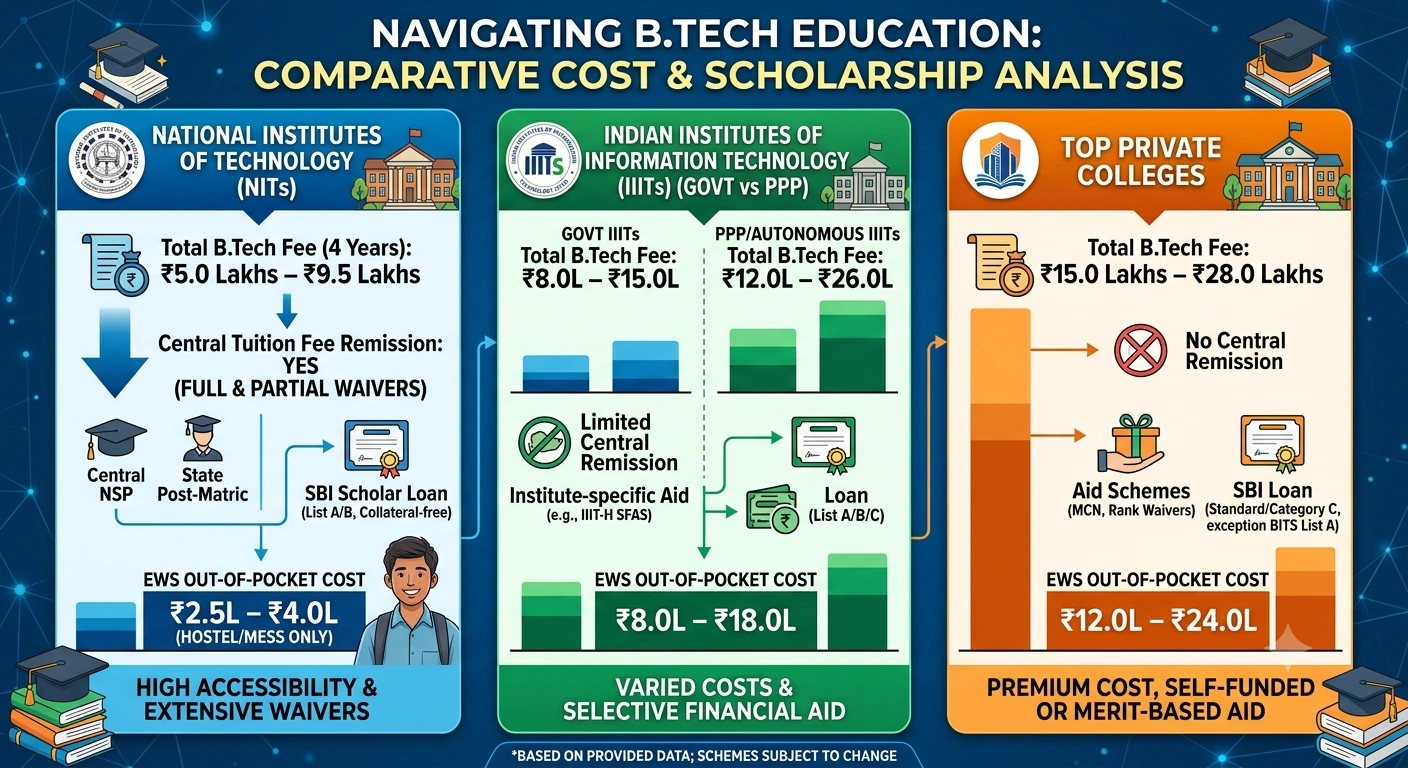
Evaluating the true financial commitment for a 4-year B.Tech degree requires analyzing tuition costs, government fee waivers, and bank loan privileges across institute types.
| Parameter | NITs | IIITs (Govt vs. PPP) | Top Private Colleges |
| Total B.Tech Fee (4 Years) | ₹5.0 Lakhs – ₹9.5 Lakhs | ₹8.0L – ₹15.0L (Govt) / ₹12.0L – ₹26.0L (PPP/Autonomous) | ₹15.0 Lakhs – ₹28.0 Lakhs |
| Central Tuition Fee Remission | Yes: Full & Partial waivers available | Limited: Available in Govt IIITs; absent in most PPP IIITs | No: Self-funded; state/trust schemes apply selectively |
| Primary Scholarship Schemes | Central Fee Remission Scheme, National Scholarship Portal (NSP), State Post-Matric | Central NSP, Post-Matric, Institute-specific aid (e.g., IIIT-H SFAS) | Merit-cum-Means (MCN), Entrance Rank Waivers (e.g., BITS MCN, VITEEE) |
| SBI Scholar Loan Category | List A / B (Collateral-free up to ₹30L–₹40L) | List A / B (Top IIITs) / List C (New PPP IIITs) | List A (BITS Pilani) / Category C / Standard Loan |
| Estimated Out-of-Pocket Cost (EWS) | ₹2.5L – ₹4.0L (Hostel/Mess only) | ₹8.0L – ₹18.0L | ₹12.0L – ₹24.0L |
Scholarship Facilities & Fee Remission Options
-
NITs (Most Generous Financial Aid): Central government policies mandate income-based tuition waivers.
-
100% Tuition Waiver: Automatically granted to SC, ST, PwD, and General/OBC/EWS candidates with family income below ₹1 LPA.
-
2/3rd Tuition Waiver: Granted to General/OBC/EWS candidates with annual family income between ₹1 LPA and ₹5 LPA.
-
Net Outlay: Low-income students only pay hostel and mess charges (~₹2.5–₹4.0 Lakhs total over 4 years).
-
-
IIITs (Split Framework):
-
5 Central Govt IIITs: Follow standard central fee remission policies, keeping overall costs lower.
-
21 PPP IIITs & Autonomous Campuses: Do not offer central fee remission for EWS/OBC students. Financial aid is restricted to SC/ST Post-Matric schemes or specific institutional funds (e.g., IIIT Allahabad/Hyderabad special financial assistance funds).
-
-
Top Private Colleges (Merit-Driven):
-
Lack state tuition waivers, but offer internal Merit-cum-Means (MCN) scholarships (e.g., BITS Pilani grants up to 80–100% tuition waivers for students with annual family income under ₹12–15 LPA).
-
Exam-rank incentives (e.g., top rankers in exams like VITEEE or SRMJEEE receive up to 100% tuition exemptions).
-
Education Loan Facilities & Bank Prioritization
Major nationalized banks (such as SBI via the Scholar Loan Scheme and Canara Bank via Vidya Turant) categorize engineering colleges to determine collateral requirements and interest rates.
-
Premier Government Priority (List A / B – SBI): All 31 NITs, top IIITs (Hyderabad, Allahabad, Bangalore), and BITS Pilani qualify for pre-approved, collateral-free loans up to ₹30–₹40 Lakhs. These feature the lowest interest rates (~8.05%–8.65%), zero processing fees, and a 15-year repayment window starting after graduation.
-
PPP IIITs & Standard Private Institutes (List C / Standard Loans): Newer PPP IIITs and tier-2 private colleges fall under standard student loan schemes. Unsecured loan limits are typically capped at ₹7.5 Lakhs to ₹10 Lakhs, requiring third-party guarantors or tangible collateral for higher amounts, alongside slightly higher interest rates (~9.5%–11.5%).
Financial Outlook
NITs offer the best financial accessibility due to government-backed tuition waivers and top-tier loan prioritization, allowing students from lower-income backgrounds to graduate with minimal debt. Top autonomous IIITs and premier private institutions like BITS Pilani carry higher tuition fees, but their Category A bank listings make securing full collateral-free loans straightforward for admitted students. PPP IIITs and mid-tier private colleges require the most careful planning, as high fee structures are rarely offset by central waiver schemes.
NIT vs IIIT vs Private B.Tech: Detailed ROI Analysis
Evaluating Return on Investment (ROI) goes beyond initial package figures—it calculates how quickly a student recovers four years of educational tuition and living expenses. First-year salary ROI is calculated as:

4-Year Financial & Return Breakdown
Category-Wise ROI Dynamics
-
NITs (Maximum Capital Efficiency): Government subsidies keep total costs low (~₹6.36–6.52 Lakhs at NIT Trichy) while yielding average packages of ~₹14.35 LPA. This translates to a first-year ROI often exceeding 200%, making NITs the safest financial bet.
-
IIITs (High Investment, High Tech Yield): IIITs—particularly PPP models and autonomous campuses like IIIT Hyderabad or IIIT Bangalore—charge market-driven fees ranging from ₹18–26 Lakhs. However, because placements lean heavily toward top-tier software product roles (averaging ₹20–32 LPA), graduates typically break even within 8 to 12 months.
-
Top Private Colleges (Variable Spread): Tier-1 private institutions like BITS Pilani carry high total fees (~₹25–28 Lakhs) but offset this with strong corporate networks (~₹18–22 LPA average). Conversely, mid-tier private colleges charging ₹10–15 Lakhs with average packages of ₹4–6 LPA yield lower ROI and extended loan repayment cycles.
Key Takeaway for Applicants
-
Loan Risk Mitigation: Subsidized NIT fees drastically reduce student debt, allowing flexibility to pursue higher studies or startups without immediate repayment pressure.
-
Specialization Premium: For aspirants exclusively targeting software engineering, AI, or quantitative development, the higher upfront cost of top-tier IIITs is justified by high starting salary ceilings.
NIT vs IIIT vs Private B.Tech: NIRF Rankings 2025 & Industry Reputation
NITs, IIITs, and top private B.Tech colleges are highly sought after by over 1.5 million JEE Main aspirants annually. These institutions are evaluated on factors like NIRF rankings, academic focus, and industry reputation, which significantly influence career prospects.
| Parameter | NITs (Representative) | IIITs (Representative) | Top Private Colleges (Representative) |
|---|---|---|---|
| Overall NIRF Engineering Rank (2023) | NIT Tiruchirappalli (Rank 9) | IIIT Hyderabad (Top IIIT, NIRF 2025 debut) | VIT Vellore (Rank 11) |
| Industry Reputation | Widely recognized, strong across diverse engineering sectors. | Highly regarded for IT, Computer Science, and allied tech fields. | Quality varies; top institutions compete with NITs in specific domains. |
| Academic Focus | Broad engineering disciplines, science, management, and architecture. | Specialized in Information Technology, Computer Science, and communication. | Flexible course structures, interdisciplinary learning, modern specializations. |
| Research Emphasis | Good research output across various engineering and science departments. | Noted for advanced research in IT, AI, ML, and data science. | Varies significantly; top private colleges invest heavily in research. |
| Government Funding Status | Fully Government (Institute of National Importance). | 5 fully Government (INI), 21 Public-Private Partnership (PPP) model. | Private (Self-funded by universities or trusts). |
| Student Rating (B.Tech CSE) | NIT Surathkal (4.5 out of 5) | IIIT Bangalore (4.7 out of 5) | BITS Pilani (Strong student and industry perception). |
| Alumni Network | Vast and diverse, with alumni in various industries globally. | Strong network predominantly within the tech and IT industry. | Growing and influential, particularly in top-tier private institutions. |
| Admission Mode | JEE Main (JoSAA/CSAB counselling). | JEE Main (JoSAA/CSAB), some via UGEE (IIIT Hyderabad). | JEE Main, State CETs, or institute-specific entrance exams (e.g., VITEEE, BITSAT). |
The NIRF 2023 rankings show NIT Tiruchirappalli and VIT Vellore in close proximity, while IIIT Hyderabad debuted as the top IIIT in NIRF 2025, the competitive among these institutions.
B.Tech Specializations & Academic Focus: NITs (Broad) vs IIITs (IT-Centric) vs Private Colleges
NITs offer a broad spectrum of engineering, management, science, and architecture programs, covering diverse technical disciplines. In contrast, IIITs specialize primarily in Information Technology and Computer Science, with a focused, research-driven curriculum.
| Aspect | NITs | IIITs | Top Private Colleges |
|---|---|---|---|
| Core Academic Focus | Broad-based engineering, management, science, and architecture programs. | Specialized in Information Technology (IT) and Computer Science (CS) and allied subjects. | Industry-oriented engineering with a focus on market relevance. |
| B.Tech Specialization Breadth | Wide range of engineering disciplines (e.g., Chemical, Civil, Mechanical, Production, Metallurgical, Architecture). | Concentrated on CSE, ECE, Information Technology, Communication Skills, AI, Cybersecurity, Data Systems. Some offer Mechanical Engineering dual degrees. | Focus on popular and market-driven engineering branches like CSE, ECE, IT, AI, and Robotics. |
| Curriculum Nature | Emphasizes academic and theoretical foundations; often includes a generic first year (e.g., NIT Rourkela). | Features a focused, research-driven, and interdisciplinary tech-based curriculum (e.g., IIIT Allahabad IT curriculum). | Designed for industry exposure and practical skill development; offers flexible course structures. |
| Pedagogical Emphasis | Strong academic rigor and foundational knowledge across diverse fields. | Research-driven and interdisciplinary learning; specialized training in IT and CS. | Skill development, practical application, and placement readiness. |
| Program Structure | Offers undergraduate, postgraduate, and doctorate-level courses across various domains. | Includes B.Tech, dual degree, and research-integrated programs in IT and allied areas. | Primarily B.Tech programs with a strong focus on career readiness and global internships. |
| Educational Goal | To provide full higher education across diverse fields and build overall development. | To develop highly skilled manpower in IT, CS, and related technologies through specialized training. | To deliver industry-ready engineers equipped with practical skills for immediate employment. |
| Interdisciplinary Approach | Limited interdisciplinary options within core engineering branches. | Strong emphasis on interdisciplinary tech-based projects and research. | Often incorporates interdisciplinary learning and global internships for broader exposure. |
| Research Focus | Research opportunities available across various engineering and science disciplines. | High emphasis on research-integrated programs and innovation in IT/CS fields. | Research often tied to industry problems and practical applications. |
Students prioritizing core engineering branches often prefer NITs, while those focused on specialized IT and CS careers find IIITs more suitable.
Campus Life & Infrastructure: NITs vs IIITs vs Private B.Tech Colleges
India’s 31 NITs and 26 IIITs, along with numerous private B.Tech colleges, offer diverse campus environments for engineering students. NITs typically feature larger, well-established campuses with extensive facilities, while IIITs focus on modern, IT-centric infrastructure, and top private colleges often provide modern amenities.
| Aspect | NITs (National Institutes of Technology) | IIITs (Indian Institutes of Information Technology) | Top Private B.Tech Colleges |
|---|---|---|---|
| Campus Size & Environment | Generally large (100-500+ acres), green, and well-established campuses. Offer a traditional university feel. | Typically smaller (20-100 acres), compact, and modern campuses. Focused on academic blocks and tech infrastructure. | Varies significantly; top private colleges often have large, modern, and aesthetically planned campuses (e.g., VIT Vellore). |
| Academic Infrastructure | Diverse labs for all engineering branches (Civil, Mechanical, Electrical, CSE, etc.). Well-equipped central libraries and workshops. | Highly specialized labs for Computer Science, IT, Electronics, and Communication Engineering. Strong focus on advanced computing resources. | Modern, often industry-standard labs and research centers, particularly in popular branches like CSE and ECE. Digital libraries are common. |
| Hostel & Residential Life | Extensive hostel facilities, often mandatory for first-year students. Diverse student body builds cultural exchange. | Hostels are usually mandatory, promoting a close-knit, tech-focused community. Accommodation is modern but often compact. | Varied options, from basic to luxurious, often with modern amenities. Some offer apartment-style living; hostel fees vary widely (₹50,000 – ₹1.5 lakh/year). |
| Student Clubs & Activities | Broad range of technical, cultural, sports, and social clubs. Active participation in inter-NIT and national festivals. | Strong emphasis on technical clubs, coding competitions, hackathons, and IT-related events. Cultural activities are present but less diverse. | Wide array of clubs and societies, often with strong industry links and corporate-sponsored events. Global collaborations for student exchange programs. |
| Student Diversity | High geographical and cultural diversity due to all-India admission and 50% state quota. | High academic diversity with students focused on IT and related fields. Geographical diversity varies by institute type (Govt vs. PPP). | Varies; top private colleges often attract students from across India and internationally, while others may be more regional. |
| Sports & Recreation | full sports complexes, playgrounds, and indoor facilities for various sports. Emphasis on physical fitness. | Limited outdoor sports facilities compared to NITs due to smaller campus sizes. Focus on indoor games and fitness centers. | Many top private colleges invest heavily in modern sports facilities, including Olympic-sized pools and multi-sport arenas. |
| Research Environment | Established research centers across various engineering disciplines. Opportunities for interdisciplinary research projects. | Strong research focus in IT, AI, Machine Learning, Data Science, and Cybersecurity. Faculty often involved in advanced tech research. | Research opportunities vary; top private colleges often have dedicated research parks and industry-sponsored projects, especially in emerging technologies. |
| Funding & Maintenance | Centrally funded by the Government of India, ensuring stable funding for infrastructure development and maintenance. | 5 IIITs are fully government-funded, while 21 operate on a Public-Private Partnership (PPP) model, impacting resource allocation. | Self-funded through student fees and private investments, leading to varied infrastructure quality. Top institutions invest significantly. |
The distinct campus environments reflect the founding principles and funding models of each institution type, offering students different experiences in terms of scale, specialization, and resource allocation.
Final Verdict — Which is Best for Your Career Goals?
Choosing a B.Tech college in 2026 impacts career goals significantly. Top IIITs offer average packages above ₹15 LPA for IT roles. Top NITs provide ₹8-18 LPA for broader engineering disciplines. IIITs are ideal for students targeting careers in software development, AI, data science, and cybersecurity. IIIT Hyderabad’s CSE graduates, for example, achieved an average package of ₹31.49 LPA in 2023. NITs offer a strong foundation in traditional engineering, with average packages from low-ranked NITs at ₹5-8 LPA for core branches. Private colleges present diverse options, but placement figures vary widely from ₹4-9 LPA for freshers. The fee structure also influences career ROI. Average B.Tech CSE fees at IIITs can reach ₹8.5 lakh, higher than NITs at ₹6.5 lakh. However, top IIITs like Hyderabad and Delhi report highest packages up to ₹1 crore per annum, justifying the investment for specific IT roles. After 2-3 years of experience, individual skills and performance often outweigh the initial college brand in salary growth, with experienced B.Tech IT professionals earning up to ₹25 LPA.
Key Takeaways
- Top IIITs like IIIT Hyderabad deliver average B.Tech packages exceeding ₹15 LPA (2026 batch), specializing in IT and CSE careers.
- NITs offer strong career prospects across diverse engineering fields, with average packages ranging from ₹8-18 LPA for top institutes.
- Eligibility for NITs and IIITs requires a minimum of 75% in Class 12 (General category) or 65% (SC/ST category) along with JEE Main scores.
Evaluate your preferred B.Tech specialization and financial plan, then check the specific admission criteria for your target NIT, IIIT, or private college on their official websites for the 2026-2027 academic session.
Frequently Asked Questions (FAQs)
What are the minimum Class 12 marks required for NIT vs IIIT admission?
NITs and IIITs require 75% aggregate for general category and 65% for SC/ST in Class 12. This applies to JEE Main qualifiers aiming for admission in 2026.
Which is cheaper: NIT, IIIT, or private B.Tech?
NITs are the most affordable with fees like ₹6.5 lakh (NIT Trichy CSE) vs IIITs at ₹8.5 lakh (IIIT Bangalore CSE) and private colleges up to ₹26.32 lakh (IIIT Hyderabad).
Do IIITs have better placements than NITs?
Top IIITs like IIIT Bangalore (₹28.47 LPA average) and IIIT Hyderabad (₹25.2 LPA) outperform most NITs, though elite NITs like Surathkal (₹18.7 LPA) remain competitive. (NIRF 2025 data)
How to get into NIT vs IIIT vs private colleges?
NITs and IIITs admit via JEE Main ranks with centralized counseling, while private colleges often use direct admission or own entrance exams. NIT cutoffs typically start at 5000 rank for top branches.
Which IIITs rank higher than NITs in 2026?
IIIT Hyderabad (NIRF 2025 Rank #3) and IIIT Bangalore (#5) surpass most NITs, though 7 NITs including Trichy (#8) and Surathkal (#10) remain in the top 10 engineering institutes.
What B.Tech specializations are better in IIITs vs NITs?
IIITs specialize in IT, CSE, and dual-degree ECE programs, while NITs offer broader options including mechanical, civil, and architecture. IIITDM Kancheepuram leads in IT-focused research (2026 AISHE report).
Disclaimer: The information provided in this article is sourced from official websites, NIRF rankings, and publicly available data. Fees, placement figures, and other details may vary. Please verify with the official institution website for the most current information.