VIT vs SRM 2026: Fees, Placements & Which Private Campus Wins
Admission alerts for this course will appear here as official notifications are published.
Deciding between VIT (Vellore Institute of Technology) and SRM Institute of Science and Technology for your engineering aspirations in 2026 is a common dilemma for Indian students and parents. While VIT often appeals to those seeking a more rigorous academic environment with diverse opportunities, SRM can be a strong contender for students prioritising specific specialisations and a potentially more relaxed campus life. Both are prominent private institutions, but their nuances in curriculum, campus culture, and career outcomes can significantly impact your future.
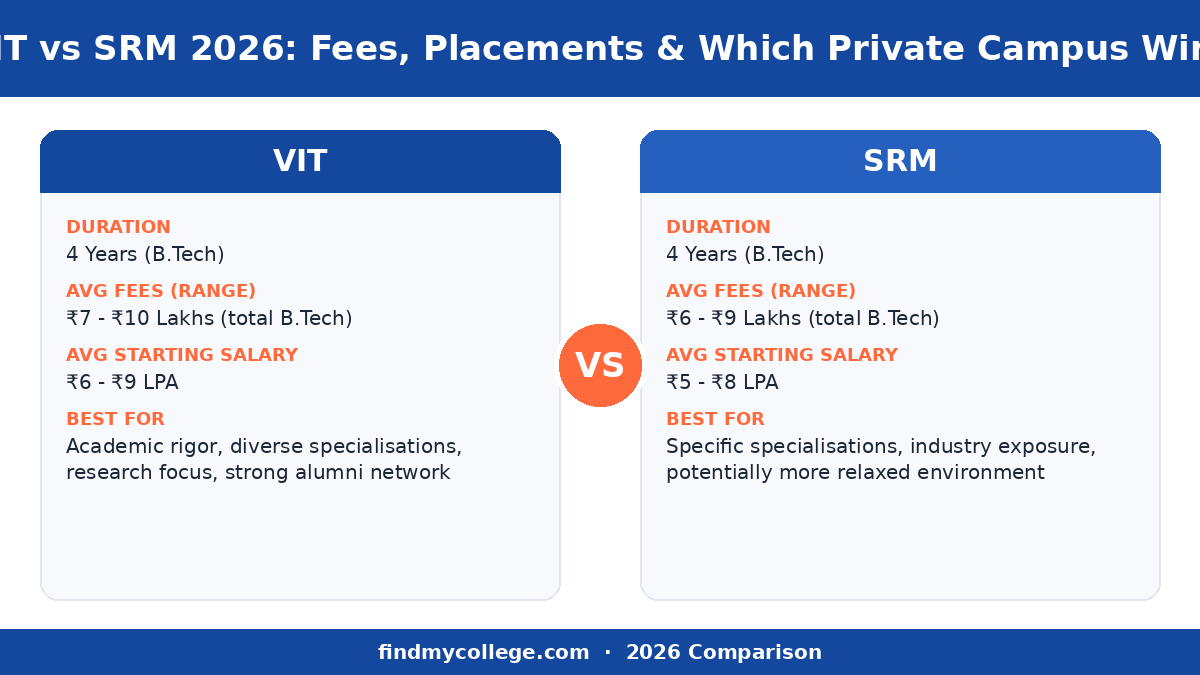
VIT vs SRM: Quick Comparison (2026)
| Duration | Eligibility | Admission / Entrance | Avg Fees (range) | Top Careers | Avg Starting Salary | Best For | |
|---|---|---|---|---|---|---|---|
| VIT (Vellore/Chennai) | 4 Years (B.Tech) | 10+2 with Physics, Chemistry, Maths/Biology (min 55-60%) | VITEEE (mandatory) | ₹7 – ₹10 Lakhs (total B.Tech) | Software Dev, Data Analyst, Core Engineering, Research | ₹6 – ₹9 LPA | Academic rigor, diverse specialisations, research focus, strong alumni network |
| SRM (Kattankulathur/NCR/AP) | 4 Years (B.Tech) | 10+2 with Physics, Chemistry, Maths/Biology (min 50-55%) | SRMJEE (mandatory) | ₹6 – ₹9 Lakhs (total B.Tech) | Software Dev, IT Services, Core Engineering, Management Trainee | ₹5 – ₹8 LPA | Specific specialisations, industry exposure, potentially more relaxed environment |
Curriculum & focus
VIT is known for its highly flexible curriculum, often referred to as the Fully Flexible Credit System (FFCS), allowing students significant choice in courses and faculty. This system encourages interdisciplinary learning and caters to individual interests, though it can also be perceived as complex to navigate. The focus is often on theoretical depth and research exposure. SRM, while also offering a broad range of engineering disciplines, tends to have a more structured curriculum. Its focus often leans towards industry-relevant skills and practical application, with a strong emphasis on specific specialisations within CSE and IT. Verdict: VIT offers greater academic flexibility; SRM provides a more structured, industry-aligned path.
Difficulty & workload
The academic workload at VIT is generally considered more demanding due to its continuous evaluation system, frequent assessments, and the flexibility that requires proactive planning. Maintaining a high GPA often necessitates consistent effort. SRM, while still rigorous, is often perceived to have a slightly less intense academic pressure compared to VIT, particularly in terms of the sheer volume of assessments. However, this can vary significantly by department and faculty. Verdict: VIT typically presents a higher academic workload and demands more self-discipline.
Fees & ROI
Both VIT and SRM are private institutions with substantial fee structures. Generally, VIT’s fees for popular branches like CSE can be slightly higher than SRM’s, though both fall within a similar range. The Return on Investment (ROI) is a critical factor. While both colleges attract decent placements, the perception of ROI often hinges on the individual package secured. Given the high fees, a significant placement is crucial for a favourable ROI from either institution. Verdict: Fees are comparable, but a higher average placement at VIT can sometimes tip the ROI in its favour for top performers.
Placements & salary
VIT has historically maintained a strong placement record, particularly for its Vellore campus, with a high percentage of students getting placed in IT, software, and core engineering sectors. The average starting salaries are generally competitive, with top packages reaching significant figures. SRM also boasts a robust placement cell, especially for its Kattankulathur campus, and has shown improving placement statistics in recent years, particularly in CSE/IT. While the average packages might be marginally lower than VIT’s top tier, SRM still attracts a wide array of recruiters. Verdict: VIT often has a slight edge in average and top placements, but SRM is rapidly catching up, especially in specific branches.
Higher studies & abroad scope
Both VIT and SRM provide platforms for students aspiring for higher studies, both in India and abroad. VIT, with its emphasis on research and a more flexible curriculum, can sometimes offer a stronger foundation for students aiming for Master’s or PhD programs, especially if they leverage the research opportunities available. Its strong alumni network also aids in international applications. SRM also has collaborations with international universities and supports students in their pursuit of higher education, though perhaps with a slightly less pronounced research focus. Verdict: VIT might offer a marginally better springboard for research-oriented higher studies abroad due to its academic structure.
Government-job scope
For students aspiring for government jobs (UPSC, SSC, PSUs), the choice between VIT and SRM is less about the institution itself and more about individual preparation. Neither college specifically tailors its curriculum for government exams, which require dedicated self-study. However, the strong foundational engineering knowledge gained at both institutions can be beneficial. Students from both VIT and SRM have successfully cleared various government examinations, demonstrating that personal effort is the primary determinant. Verdict: Neither college offers a distinct advantage; success in government jobs depends entirely on individual preparation.
What students actually say (community insights)
- Many students perceive VIT Vellore as having a stronger overall brand and better networking opportunities compared to SRM, particularly for CSE.
- There’s a common sentiment that SRM Kattankulathur’s CSE/IT placements have shown significant improvement recently, with some even claiming they are comparable to or better than VIT’s for the current year (2026).
- A recurring concern about VIT is the sheer volume of students, which some believe can dilute individual attention and increase competition for top placements.
- Some students feel that getting into SRM might be slightly easier than VIT, leading to a perception of a broader range of student quality, though the top performers are equally competitive.
- The high fees at both institutions are a frequent point of discussion, with many questioning the ROI unless a substantial placement package is secured.
- For specific regional campuses like VIT-AP vs SRM-AP, students often debate the relative advantages, with VIT-AP sometimes cited for better academic support for high-GPA students.
Which one should you choose?
Choose VIT if: You thrive in a flexible academic environment, are self-motivated to explore diverse subjects, aim for a strong research foundation, and are prepared for a demanding academic schedule. VIT’s extensive alumni network and brand recognition can be a significant advantage for career progression and higher studies.
Choose SRM if: You prefer a more structured curriculum with a strong focus on specific industry-relevant specialisations, value a potentially less intense academic pressure, and are looking for good placement opportunities within the IT and core sectors. SRM’s regional campuses can also be a strong local option.
Ultimately, the decision hinges on your personal learning style, career aspirations, and comfort with the campus environment. Both institutions offer quality engineering education, but their approaches and strengths differ.
Frequently Asked Questions
Is VIT or SRM considered a Tier 1 college?
Neither VIT nor SRM are typically classified as Tier 1 colleges in the same league as IITs or NITs. They are generally considered leading private engineering institutions, often falling into a ‘Tier 2’ category, offering competitive education and placements.
Which campus is better: VIT Vellore or VIT Chennai?
VIT Vellore is generally considered the flagship campus with a larger infrastructure, more established faculty, and a broader range of opportunities. VIT Chennai is a newer campus but is rapidly growing and offers similar academic standards, often preferred by students closer to Chennai.
Which campus is better: SRM Kattankulathur or SRM NCR/AP?
SRM Kattankulathur (KTR) is the main and most established campus, generally offering better placements and a wider range of facilities. The NCR and AP campuses are newer and still developing, though they provide good regional options.
Do VIT and SRM accept JEE Main scores?
No, both VIT and SRM conduct their own mandatory entrance examinations: VITEEE for VIT and SRMJEE for SRM. JEE Main scores are not directly used for admission to their B.Tech programs.
Is it difficult to get into VIT or SRM?
Admission to popular branches like CSE in both VIT and SRM can be competitive, requiring a good rank in their respective entrance exams. While not as difficult as IITs, securing a top branch often means performing well in VITEEE or SRMJEE.
Are there good scholarship opportunities at VIT and SRM?
Both VIT and SRM offer various scholarships based on merit (entrance exam rank, academic performance) and financial need. It’s advisable to check their official websites for the latest scholarship schemes and eligibility criteria.
What is the student-faculty ratio like at these colleges?
Given the large student intake at both VIT and SRM, the student-faculty ratio can be higher than in smaller institutions. However, both colleges strive to maintain a reasonable ratio and provide adequate faculty support, especially in core departments.
Can I switch branches after joining VIT or SRM?
Branch changes are generally possible in both VIT and SRM, but they are highly competitive and depend on your academic performance (GPA) in the first year and the availability of seats in the desired branch. It’s not guaranteed and requires maintaining a very high CGPA.