
B.Sc Occupational Therapy Salary in India 2026
Nishit Kumar is a senior EdTech industry leader with over a decade of experience in building and scaling education platforms, shaping their product, content, and growth strategy. At…
Latest update: B.Sc in Occupational Therapy 2026 admissions & dates updated. Read more ›
Welcome to the comprehensive guide on B.Sc in Occupational Therapy Salary in India for 2026. This page aims to provide prospective students and their parents with a detailed understanding of the earning potential, career growth, and various factors influencing salaries in this rewarding medical stream. Occupational Therapy is a dynamic healthcare profession focused on helping individuals achieve independence in all aspects of their lives.
What is the average B.Sc in Occupational Therapy Salary in India?
The average starting salary for a B.Sc in Occupational Therapy graduate in India typically ranges from ₹2.5 Lakhs to ₹4.5 Lakhs per annum. This figure can significantly increase with experience, specialization, and the type of healthcare setting.
Occupational therapists play a crucial role in rehabilitation, working with individuals across all age groups who have physical, mental, developmental, or emotional conditions. Their expertise is in demand in various settings, contributing to a stable and growing career path.
What factors influence Occupational Therapy salaries in India?
Several key factors significantly influence the salary an Occupational Therapist can earn in India, including experience, educational qualifications, specialization, location, and the type of employer.
- Experience: Entry-level salaries are lower, but with 3-5 years of experience, a therapist can expect a substantial increase. Senior OTs with 10+ years of experience command the highest salaries.
- Educational Qualification: While a B.Sc is the foundational degree, pursuing a Master’s (M.Sc) or a Post Graduate Diploma in specialized areas can lead to higher pay scales and more senior roles.
- Specialization: Therapists specializing in high-demand areas like pediatric occupational therapy, neurological rehabilitation, or hand therapy often earn more due to their niche expertise.
- Location: Metropolitan cities like Mumbai, Delhi, Bangalore, and Chennai generally offer higher salaries compared to tier-2 or tier-3 cities, primarily due to higher demand and cost of living.
- Type of Employer: Government hospitals, private hospitals, rehabilitation centers, NGOs, special schools, and private clinics all have different pay structures. Private sector and corporate hospitals often offer competitive packages.
- Skills and Certifications: Additional certifications in specific therapeutic techniques or advanced skills can also boost earning potential.
B.Sc in Occupational Therapy Salary by Role and Experience (2026 Projections)
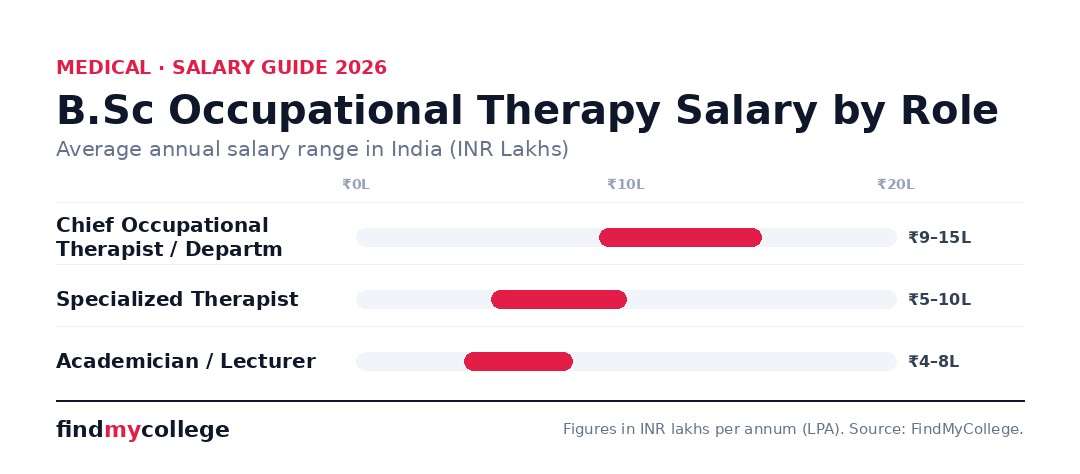
The salary for an Occupational Therapist varies significantly based on their specific role and years of experience. Here’s a projected breakdown for 2026:
| Role/Designation | Experience Level | Average Annual Salary Range (INR) |
|---|---|---|
| Junior Occupational Therapist | 0-2 Years | ₹2,50,000 – ₹4,00,000 |
| Occupational Therapist | 2-5 Years | ₹4,00,000 – ₹6,50,000 |
| Senior Occupational Therapist | 5-10 Years | ₹6,50,000 – ₹9,00,000 |
| Chief Occupational Therapist / Department Head | 10+ Years | ₹9,00,000 – ₹15,00,000+ |
| Specialized Therapist (e.g., Pediatric OT, Hand Therapist) | 3+ Years | ₹5,00,000 – ₹10,00,000+ |
| Academician / Lecturer | Entry to Senior Level | ₹4,00,000 – ₹8,00,000+ |
People Also Read




Which cities offer the highest salaries for Occupational Therapists in India?
Metropolitan and major tier-1 cities in India generally offer higher salaries for Occupational Therapists due to greater demand, more advanced healthcare facilities, and a higher cost of living.
- Mumbai: Often leads with higher pay scales, especially in private hospitals and specialized rehabilitation centers.
- Delhi NCR: A hub for healthcare, offering competitive salaries across various setups.
- Bangalore: Known for its advanced healthcare infrastructure and good pay for skilled professionals.
- Chennai: Another major medical hub with a strong demand for OTs.
- Hyderabad & Pune: Emerging as significant healthcare centers with growing opportunities.
While salaries might be lower in tier-2 cities, the cost of living is also considerably less, which can sometimes balance out the effective take-home pay.
What are the top recruiters for B.Sc Occupational Therapy graduates in India?
Graduates of B.Sc in Occupational Therapy are recruited by a diverse range of healthcare institutions and organizations across India.
- Hospitals: Both government (AIIMS, Safdarjung Hospital, etc.) and private multi-specialty hospitals (Apollo Hospitals, Fortis Healthcare, Max Healthcare, Manipal Hospitals, Narayana Health).
- Rehabilitation Centers: Specialized centers for neurological, orthopedic, and pediatric rehabilitation.
- Special Schools: Institutions catering to children with special needs, developmental delays, or learning disabilities.
- NGOs and Charitable Organizations: Working with underserved populations or specific disability groups.
- Geriatric Care Centers: Facilities focusing on the elderly population.
- Mental Health Institutions: Hospitals and clinics specializing in psychiatric care.
- Private Clinics: Many OTs establish their own private practice or work in established clinics.
- Academic Institutions: As lecturers or clinical instructors in colleges offering OT courses.
- Corporate Wellness Programs: Though less common, some companies hire OTs for employee health and ergonomics.
Is B.Sc in Occupational Therapy worth it for jobs and salary in India?
Yes, B.Sc in Occupational Therapy is a highly worthwhile course for jobs and salary in India, offering a stable career with good growth potential and the immense satisfaction of helping others.
The demand for qualified occupational therapists is steadily increasing due to a growing awareness of rehabilitation, an aging population, and the rising prevalence of chronic diseases and disabilities. The profession offers not only financial stability but also a deeply rewarding experience through direct patient interaction and tangible impact on individuals’ lives. With opportunities for specialization and entrepreneurship (setting up private clinics), the career path is robust.
What are the career prospects after B.Sc in Occupational Therapy?
After completing a B.Sc in Occupational Therapy, graduates have excellent career prospects, with opportunities for direct employment, further education, and specialization.
Graduates can work as clinical occupational therapists in various settings. For those interested in advanced roles or academia, pursuing an M.Sc in Occupational Therapy or specialized certifications can open doors to senior positions, research, and teaching. Entrepreneurship, by establishing private clinics or offering home-based therapy services, is also a viable and increasingly popular career path.
How does B.Sc in Occupational Therapy salary compare to other medical allied health professions?
The salary for B.Sc in Occupational Therapy is generally competitive with, and often higher than, many other allied health professions, particularly after gaining some experience and specialization.
While entry-level salaries might be comparable to some other allied health fields like Physiotherapy or Optometry, the growth potential in Occupational Therapy, especially with specialization in niche areas, can lead to higher earnings. Professions like Medical Lab Technology or Radiology Technology might have slightly different pay scales, but OT offers a unique blend of direct patient interaction and holistic care, which is highly valued.
| Allied Health Profession (B.Sc Level) | Average Starting Salary Range (INR) | Average Mid-Career Salary Range (INR) |
|---|---|---|
| B.Sc Occupational Therapy | ₹2,50,000 – ₹4,50,000 | ₹5,00,000 – ₹8,00,000 |
| B.Sc Physiotherapy | ₹2,00,000 – ₹4,00,000 | ₹4,50,000 – ₹7,50,000 |
| B.Sc Optometry | ₹2,00,000 – ₹3,80,000 | ₹4,00,000 – ₹7,00,000 |
| B.Sc Medical Lab Technology (MLT) | ₹1,80,000 – ₹3,50,000 | ₹3,50,000 – ₹6,00,000 |
| B.Sc Radiology & Imaging Technology | ₹2,20,000 – ₹4,00,000 | ₹4,50,000 – ₹7,00,000 |
Explore more on FindMyCollege
Related pages for B.Sc in Occupational Therapy aspirants on findmycollege.com:
Frequently Asked Questions
What is the eligibility for B.Sc in Occupational Therapy?
To be eligible for B.Sc in Occupational Therapy, candidates typically need to have passed 10+2 with Physics, Chemistry, and Biology (PCB) as compulsory subjects, with a minimum aggregate of 45-50% marks from a recognized board. Some colleges may also require an entrance examination.
How long is the B.Sc in Occupational Therapy course?
The B.Sc in Occupational Therapy course is typically a 4-year undergraduate program, which includes a mandatory internship period (usually 6 months to 1 year) as part of the curriculum.
Can I pursue higher studies after B.Sc in Occupational Therapy?
Yes, after completing B.Sc in Occupational Therapy, you can pursue higher studies such as M.Sc in Occupational Therapy, Post Graduate Diplomas in specialized areas, or even Ph.D. programs for research and academic careers.
What is the scope of Occupational Therapy abroad?
The scope of Occupational Therapy abroad, particularly in countries like the USA, Canada, UK, Australia, and New Zealand, is excellent. These countries often have higher demand and better pay scales for qualified OTs, though licensing and registration requirements vary by country.
Are there government job opportunities for Occupational Therapists?
Yes, there are significant government job opportunities for Occupational Therapists in central and state government hospitals, rehabilitation centers, and institutions for persons with disabilities. These jobs often offer good benefits and job security.
What is the difference between Occupational Therapy and Physiotherapy?
While both are rehabilitation professions, Physiotherapy primarily focuses on restoring physical function, mobility, and reducing pain through exercises, manual therapy, and physical modalities. Occupational Therapy, on the other hand, focuses on helping individuals perform daily activities (occupations) by adapting tasks, environments, or teaching new ways to perform activities, addressing physical, cognitive, psychological, and sensory aspects.
Can Occupational Therapists open their own clinic?
Yes, experienced and registered Occupational Therapists can open their own private clinics or offer independent consultation and home-based therapy services. This allows for greater flexibility and potentially higher earning potential.
What entrance exams are required for B.Sc in Occupational Therapy?
While some colleges admit based on 10+2 merit, many reputable institutions require candidates to clear entrance exams. Common entrance exams include NEET (for some medical allied courses), CET (Common Entrance Test) conducted by state governments, or specific university-level entrance tests.