Civil Engineering Course Details: Admission, Syllabus and Careers
Nishit Kumar is a senior EdTech industry leader with over a decade of experience in building and scaling education platforms, shaping their product, content, and growth strategy. At…
Civil Engineering courses in India range from 3-year Diplomas and 4-year B.Tech degrees to 2-year M.Tech programmes and short-term software certifications. Average course fees range between ₹2.4 lakh and ₹10 lakh, with fresh graduate starting salaries between ₹4 LPA and ₹7 LPA.
With at least 3,537 colleges offering civil engineering and a planned US$ 1.4 trillion national infrastructure investment by 2025, choosing the right branch and institution is critical. Below is a complete guide to eligibility criteria, entrance exams, AICTE syllabus structures, course fees, top colleges, short-term software certifications, and career placement trends.
| Parameter | Details |
|---|---|
| Course Levels | Diploma, B.Tech / B.E., M.Tech, Ph.D., and Certifications |
| B.Tech Course Duration | 4 Years (8 Semesters, 160–164 Credits) |
| B.Tech Eligibility | Class 12 pass with Physics, Math, and Chemistry/Bio/CS with minimum 45% marks |
| Average Course Fee | ₹2.4 lakh – ₹10 lakh |
| Average Starting Salary | ₹4 LPA – ₹7 LPA |
| Top Entrance Exams | JEE Main, JEE Advanced, GATE |
| India Infrastructure Planned Investment | US$ 1.4 trillion by 2025 |
What is Civil Engineering
Civil engineering is a foundational engineering discipline dedicated to the planning, design, construction, maintenance, and management of physical infrastructure and built environments. It encompasses major public and private infrastructure projects including bridges, highways, dams, water supply networks, airports, railways, tunnels, residential complexes, and urban drainage systems.
The field integrates core principles of mechanics, structural design, fluid dynamics, soil mechanics, and environmental sustainability to ensure structures remain structurally sound, safe, cost-effective, and compliant with environmental regulations throughout their operational lifespans.
Civil Engineering Courses: Diploma, UG, and PG Options
Students can pursue civil engineering at various academic levels depending on their prior qualification and career goals:
- Diploma in Civil Engineering: A 3-year polytechnic programme available after Class 10 with a minimum of 50% aggregate marks, requiring Science, Mathematics, and English.
- B.Tech in Civil Engineering: A 4-year undergraduate degree requiring Class 12 with Physics and Mathematics along with Chemistry, Biotech, Biology, Electronics, or CS, with at least 45% aggregate marks.
- M.Tech in Civil Engineering: A 2-year postgraduate degree requiring a B.Tech degree in Civil Engineering or a related field with a minimum of 55% aggregate marks.
Specialisations in Civil Engineering: Structural to Environmental
Civil engineering offers multiple technical specialisations allowing engineers to develop deep domain expertise in specific design, analysis, and management areas.
| Specialisation | Core Focus | Key Tools / Applications | Career Role |
|---|---|---|---|
| Structural Engineering | Design, analysis, and safety of buildings, bridges, and dams | STAAD.Pro, ETABS, IS 800:2007 | Structural Engineer |
| Geotechnical Engineering | Soil/rock mechanics, foundation design, slope stability analysis | Soil testing, foundation engineering | Geotechnical Engineer |
| Environmental Engineering | Water/air pollution, waste management, EIA compliance | EIA regulations, water treatment design | Environmental Consultant |
| Transportation Engineering | Highways, railways, airports, traffic systems | Intelligent Transportation Systems (ITS), GIS | Transportation Engineer |
| Water Resources Engineering | Hydraulic design, irrigation, flood control, stormwater systems | Fluid mechanics, hydrologic modeling | Water Resources Engineer |
| Construction Engineering & Management | Project planning, estimation, execution, and cost control | BIM, Revit, PMP, Quantity Surveying | Construction Manager |
Civil Engineering Eligibility
Academic criteria vary by degree level across Indian institutions:
- Diploma: Completion of Class 10 with at least 50% aggregate marks, with mandatory coursework in Science, Mathematics, and English.
- B.Tech: Completion of Class 12 with Physics and Mathematics as core subjects alongside Chemistry, Biotech, Biology, Electronics, or Computer Science, scoring at least 45% aggregate marks.
- M.Tech: A B.Tech in Civil Engineering or an equivalent branch with at least 55% aggregate marks from a recognized university.
Civil Engineering Syllabus and Subjects
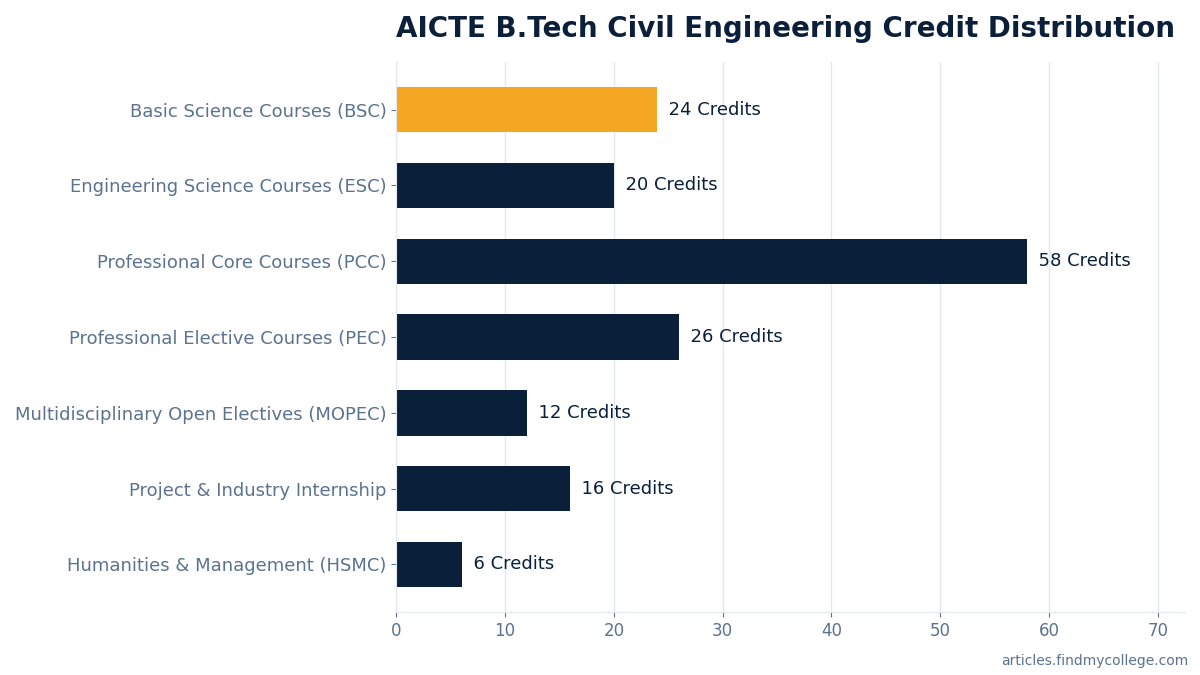
The standard B.Tech Civil Engineering curriculum structured by AICTE spans 4 years (8 semesters) requiring a total credit load of 160 to 164 credits. AICTE regulations also permit students to complete an additional 18 credits through MOOCs to earn an Honours or Minor Engineering degree.
Core subjects include Structural Design, Concrete Technology, Fluid Mechanics, Transportation Engineering, Surveying & Geomatics, Geotechnical Engineering, and Environmental Engineering. The credit distribution across subjects is outlined below:
| Category | Course Type Description | Credits Required |
|---|---|---|
| BSC | Basic Science Courses (Physics, Chemistry, Mathematics I & II, Biology) | 24 |
| ESC | Engineering Science Courses (Electrical Engg, Workshop, Graphics, Mechanics) | 20 |
| PCC | Professional Core Courses (Concrete Tech, Geotech, Surveying, Fluid Mechanics) | 58 |
| PEC | Professional Elective Specialisation Courses | 26 |
| HSMC | Humanities, Social Sciences, and Management Courses | 06 |
| MOPEC | Multidisciplinary Open Electives Courses | 12 |
| Project & Internship | Six-month Industry Internship and Project Work | 16 |
| IKS | Indian Knowledge System | 02 |
| Total Minimum Credits | Standard Undergraduate Degree Requirement | 164 |
Short-Term Certifications and Industry Software Skills
In addition to core academic degrees, completing short-term software certifications builds field-ready expertise that significantly improves employment prospects during campus recruitment and off-campus hiring drives.
| Certification / Skill | Duration | Key Tools Learned | Industry Value |
|---|---|---|---|
| Building Information Modeling (BIM) | 2 to 6 Months | Revit, Navisworks, Tekla | Standard requirement for large-scale global construction |
| Quantity Surveying & BBS | 3 to 6 Months | Excel, CAD, Bar Bending Schedules | Financial backbone of project cost estimation and tenders |
| STAAD.Pro / ETABS | 1 to 3 Months | STAAD.Pro, ETABS | Essential software for structural design and analysis |
| Remote Sensing & GIS | 1 to 3 Months | ArcGIS, QGIS, Satellite Imagery | Required for urban planning, land surveying, and mapping |
| Project Management Professional (PMP) | 3 to 6 Months | Scheduling, Risk Management, Leadership | Shifts engineers from field execution to strategic management |
| Environmental Impact Assessment (EIA) | 1 to 3 Months | Sustainability rules, compliance codes | Mandatory requirement for major infrastructure projects |
Civil Engineering Fees
| College | City | Ownership | Total course fee |
|---|---|---|---|
| Government Engineering College Rajkot | Rajkot | Government | ₹6,000 |
| Government Engineering College Modasa | Modasa | Government | ₹6,000 |
| Government Engineering College Patan | Patan | Government | ₹6,000 |
| Government Engineering College Bhavnagar | Bhavnagar | Government | ₹6,000 |
| Government Engineering College Bharuch | Bharuch | Government | ₹6,000 |
| Vishwakarma Government Engineering College | Ahmedabad | Government | ₹6,000 |
| Government Engineering College Bhuj | Bhuj | Government | ₹6,000 |
| Government Engineering College Valsad | Valsad | Government | ₹6,000 |
| Government Engineering College Banaskantha | Banaskantha | Government | ₹6,000 |
| Government Engineering College Godhra | Godhra | Government | ₹6,000 |
| College | City | Total course fee |
|---|---|---|
| Birla Institute of Technology Mesra | Ranchi | ₹1.99 lakh |
| Royal School of Engineering and Technology | Guwahati | ₹2.81 lakh |
| International Institute of Management and Technical Studies | Ahmedabad | ₹1.27 lakh |
| Khatu Shyam Institute of Management and Technology | Delhi | ₹50,499 |
| Harcourt Butler Technological University | Kanpur | ₹1.20 lakh |
| Wisdom School of Management Lucknow | Lucknow | ₹90,450 |
| Pacific Institute of Engineering and Management | Delhi | ₹55,500 |
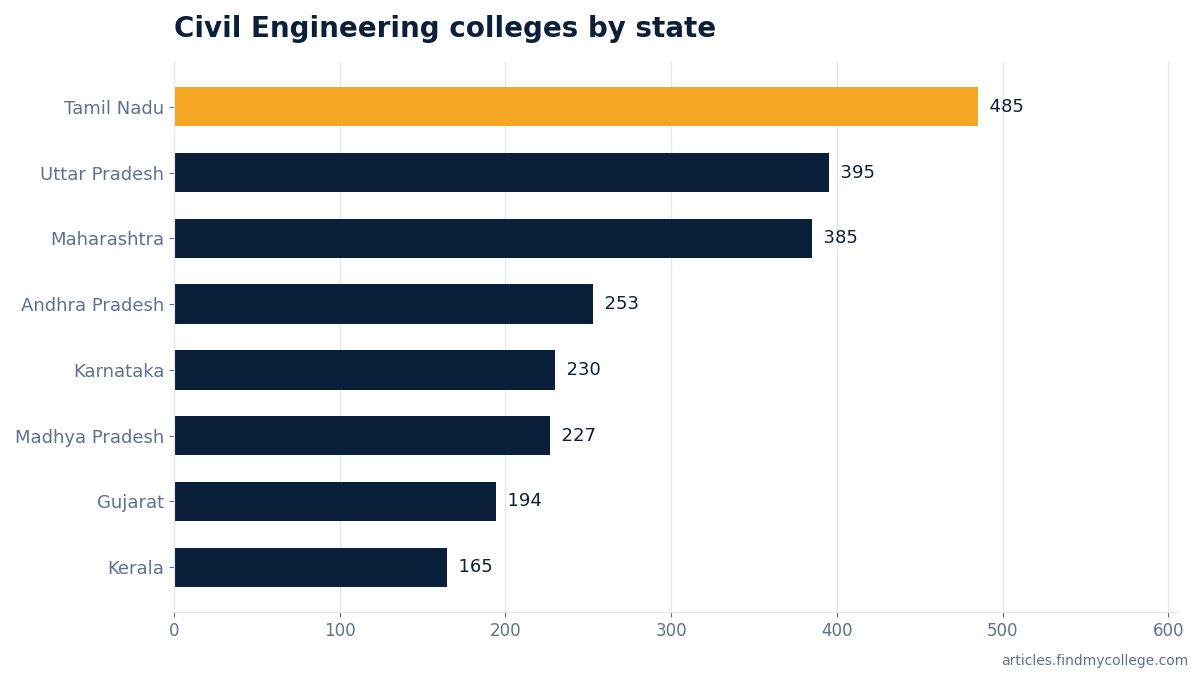
Civil Engineering is offered across 204 government institutions and 1,810 private institutions in India. Top states by college count include Tamil Nadu (485), Uttar Pradesh (395), Maharashtra (385), Andhra Pradesh (253), Karnataka (230), and Madhya Pradesh (227).
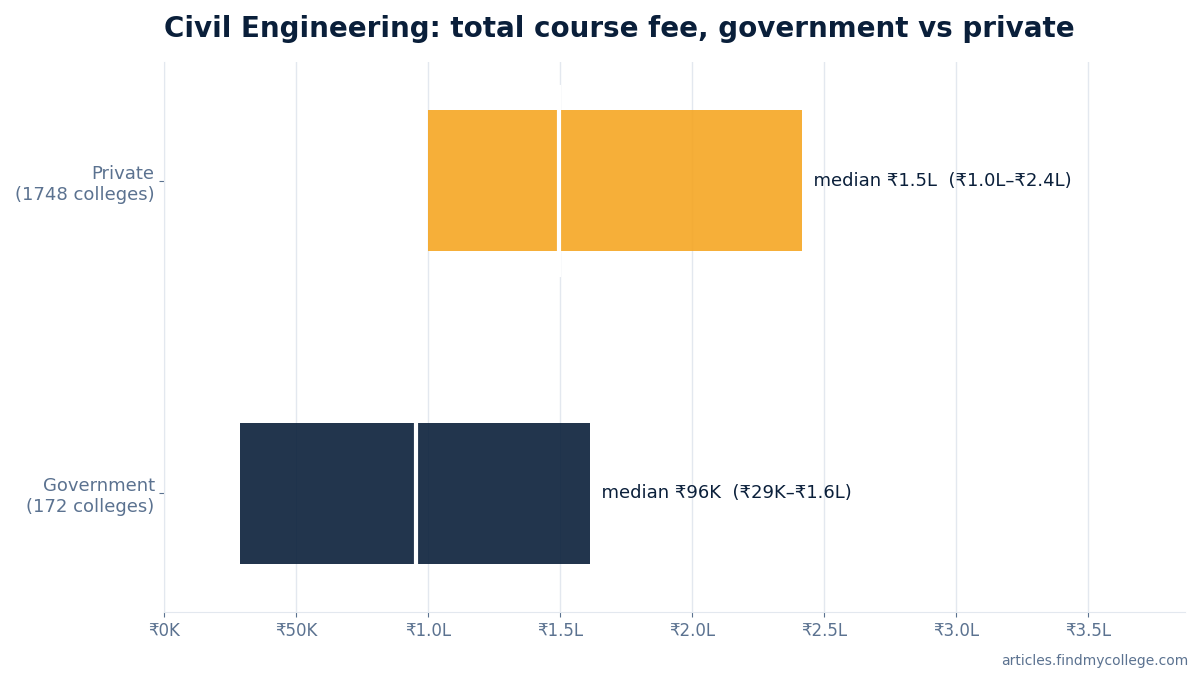
Government colleges feature a median total course fee of ₹95,502, with the middle half falling between ₹28,826 and ₹1.61 lakh across 172 colleges.
Top Civil Engineering Colleges
Civil engineering education is widely distributed across major Indian metropolitan hubs. Key cities offering significant academic density include Bangalore (96 colleges, fee range ₹42,440 – ₹12.04 lakh), Pune (88 colleges, fee range ₹52,509 – ₹13.10 lakh), Chennai (86 colleges, fee range ₹30,850 – ₹11.60 lakh), Hyderabad (85 colleges, fee range ₹44,700 – ₹31.34 lakh), and Bhopal (82 colleges, fee range ₹44,000 – ₹5.40 lakh).
| College | City | Ownership | Total course fee | NIRF rank |
|---|---|---|---|---|
| Indian Institute of Science | Bangalore | — | ₹56,600 | 1 (Overall, 2025) |
| Indian Institute of Technology Madras | Chennai | Government | ₹30,850 | 1 (Overall, 2025) |
| Indian Institute of Technology Bombay | Mumbai | Government | ₹70,200 | 3 (Overall, 2024) |
| Manipal University Manipal | Manipal | — | ₹59,000 | 3 (Overall, 2025) |
| Punjab Agricultural University | Ludhiana | — | ₹3.03 lakh | 3 (Overall, 2025) |
| Jamia Millia Islamia University | Delhi | Government | ₹35,625 | 4 (Overall, 2025) |
| Indian Institute of Technology Kanpur | Kanpur | Government | ₹52,200 | 5 (Overall, 2025) |
| Indian Institute of Technology Roorkee | Roorkee | — | ₹90,300 | 6 (Overall, 2025) |
| Indian Institute of Technology Kharagpur | Kharagpur | Government | ₹1.50 lakh | 6 (Overall, 2025) |
| Birla Institute of Technology and Science Pilani | Pilani | Private | ₹1.93 lakh | 7 (Overall, 2025) |
| College | City | Ownership | Total course fee | Average package |
|---|---|---|---|---|
| Sri Jayachamarajendra College of Engineering | Mysore | Private | ₹3.65 lakh | 8.24 LPA |
| Shri Govindram Seksaria Institute of Technology and Science | Indore | Private (aided) | ₹1.70 lakh | 7.21 LPA |
| Vidya Pratishthan’s Kamalnayan Bajaj Institute of Engineering and Technology Baramati | Pune | Private | ₹3.18 lakh | 7.2 LPA |
| BMS Institute of Technology and Management | Bangalore | Private | ₹6.00 lakh | 6.07 LPA |
| Pimpri Chinchwad College of Engineering | Pune | Private | ₹3.42 lakh | 6 LPA |
| Galgotias College of Engineering and Technology | Greater Noida | Private | ₹3.47 lakh | 5.76 LPA |
| Dayananda Sagar College of Engineering | Bangalore | Private | ₹3.35 lakh | 5.27 LPA |
| Aditya Institute of Technology and Management | Tekkali | Private | ₹75,000 | 5.15 LPA |
| Vidya Jyothi Institute of Technology | Hyderabad | Private | ₹4.40 lakh | 5.12 LPA |
| Jaipur Engineering College and Research Centre | Jaipur | Private | ₹84,000 | 4.96 LPA |
| City | Colleges | Fee range | Well-known options |
|---|---|---|---|
| Bangalore | 96 | ₹42,440 – ₹12.04 lakh | Alliance University, Indian Institute of Science |
| Pune | 88 | ₹52,509 – ₹13.10 lakh | MIT World Peace University, Symbiosis International University Pune |
| Chennai | 86 | ₹30,850 – ₹11.60 lakh | Indian Institute of Technology Madras, Saveetha Institute of Medical and Technical Sciences |
| Hyderabad | 85 | ₹44,700 – ₹31.34 lakh | Indian Institute of Technology Hyderabad, International Institute of Information Technology Hyderabad |
| Bhopal | 82 | ₹44,000 – ₹5.40 lakh | Maulana Azad National Institute of Technology, Lakshmi Narain College of Technology & Science Bhopal |
| Jaipur | 60 | ₹70,000 – ₹6.08 lakh | Manipal University Jaipur, Kautilya Institute of Technology and Engineering and School of Management |
| Lucknow | 53 | ₹39,816 – ₹6.66 lakh | University of Lucknow, Integral University |
| Coimbatore | 53 | ₹23,120 – ₹10.50 lakh | Amrita Vishwa Vidyapeetham, P.S.G College of Technology |
Civil Engineering Career Scope and Salary
- Popular Job Roles: Structural Engineer, Site Engineer, Geotechnical Engineer, Construction Engineer, and Water Resources Engineer.
- Leading Employers: Larsen & Toubro, Schlumberger, Power Grid Corporation of India, Indian Railways, and Public Works Department (PWD).
- Salary Expectations: Average starting salaries range from ₹4 LPA to ₹7 LPA, with a median average placement package of 3.51 LPA across 177 colleges.
India’s infrastructure sector has planned investments of US$ 1.4 trillion by 2025. Certifications such as PMP help transition civil engineers from field execution to leadership and executive roles.
How to Apply for Civil Engineering Admission in 2026: Step by Step
- Check Academic Eligibility: Confirm completion of Class 10 with 50% aggregate marks for Diploma, Class 12 with Physics, Mathematics, and 45% marks for B.Tech, or a B.Tech degree with 55% marks for M.Tech.
- Register and Sit for Entrance Exams: Apply and qualify for top national entrance exams such as JEE Main and JEE Advanced for undergraduate B.Tech, or GATE for postgraduate M.Tech admissions.
- Select Program Level and Specialisation: Choose between a 3-year Diploma, 4-year B.Tech, or 2-year M.Tech, and pick core specialisations such as Structural, Geotechnical, Environmental, or Transportation Engineering.
- Complete Admission and Fee Payment: Secure enrollment by paying the course fee, which averages between ₹2.4 lakh and ₹10 lakh depending on the institution and degree level.
| What to do | Where | Link |
|---|---|---|
| Compare colleges, fees and cutoffs | Civil Engineering colleges in India | findmycollege.com |
Candidates must meet academic eligibility criteria and entrance requirements for their chosen degree level. Average civil engineering course fees range from ₹2.4 lakh to ₹10 lakh depending on the institution and program.
FAQs
Which course is best in civil engineering?
What are the courses of civil engineering?
Civil engineering options include 3-year Diplomas after Class 10, 4-year B.Tech degrees, 2-year M.Tech programmes, Ph.D.
Is BTech 3 years or 4 years?
B.Tech in Civil Engineering is a 4-year undergraduate degree course requiring a total of 160 to 164 credits according to the AICTE model curriculum.
Civil engg course fees
The average civil engineering course fee in India ranges between ₹2.4 lakh and ₹10 lakh across diploma, undergraduate, and postgraduate levels, depending on the institution and level.
Is Civil Engineering good for salary?
Yes, starting salaries for fresh civil engineering graduates range between ₹4 LPA and ₹7 LPA, with significant salary growth as engineers gain experience or upskill with certifications like PMP and BIM.
What are the top entrance exams for civil engineering?
Top entrance exams for civil engineering courses in India include JEE Main, JEE Advanced, and GATE.