CLAT 2027 Notification Update: Consortium Confirms No Changes to Exam Pattern and Syllabus
The Consortium of National Law Universities (NLUs) has officially announced that there will be no changes to the exam pattern or syllabus for the Common Law Admission Test (CLAT) 2027. The decision brings great relief to thousands of law aspirants across India who are preparing for undergraduate (UG) and postgraduate (PG) law admissions.
The official update was finalized following the annual Governing Body meeting of the Consortium. By maintaining the existing format, the authority aims to ensure stability, consistency, and a fair preparation environment for candidates aiming for seats in 26 premier National Law Universities and over 60 affiliated law institutions.
What the Consortium Announced
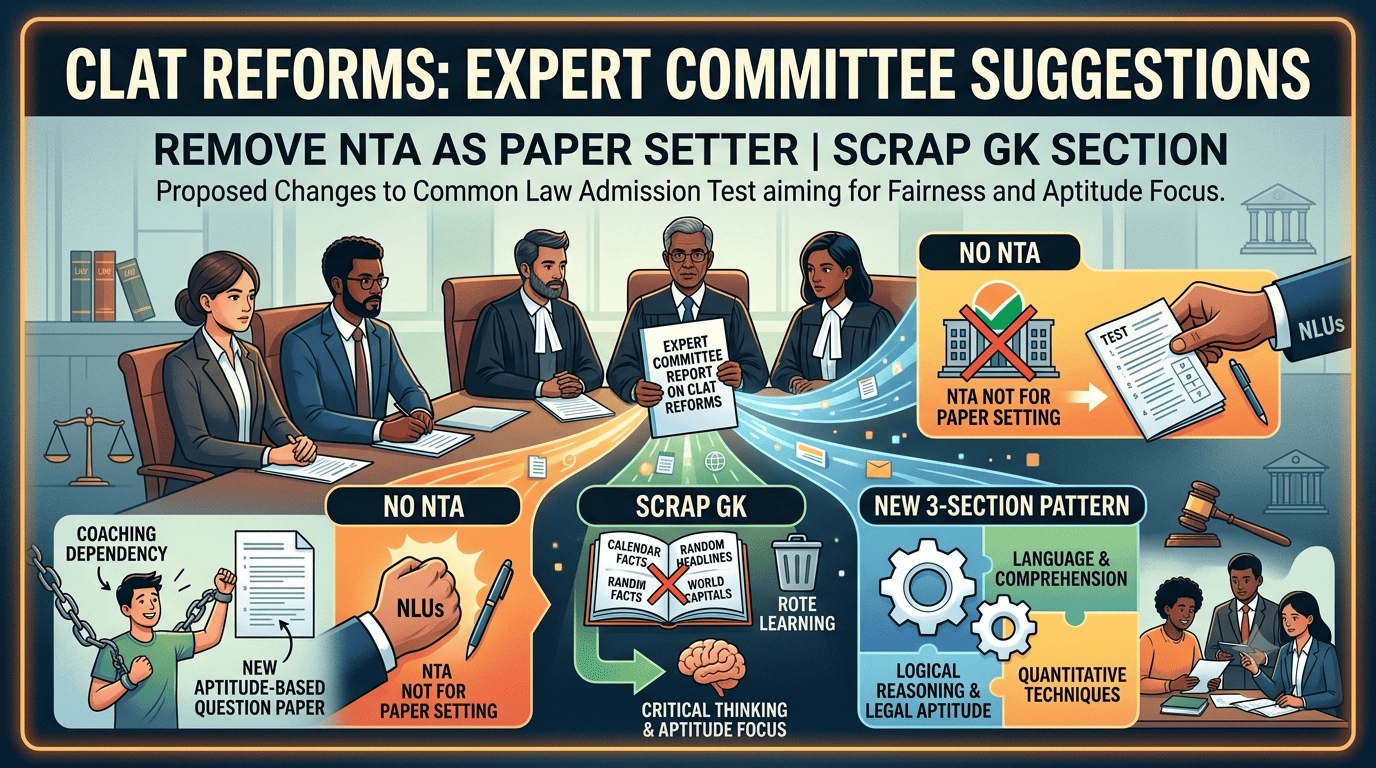
The Consortium confirmed that both CLAT UG 2027 and CLAT PG 2027 will strictly follow the pattern used in recent years. Alongside this decision, the Consortium published the CLAT Expert Committee Report 2026 on its official website (consortiumofnlus.ac.in).
The Consortium has invited feedback on this expert report from candidates, educators, legal experts, and the general public. The public feedback window remains open until August 31, 2026. While the feedback and long-term recommendations of the committee may be considered for future editions like CLAT 2028, the structure for CLAT 2027 remains fixed and unchanged.
CLAT UG 2027: Detailed Exam Pattern and Marking Scheme
For undergraduate candidates seeking admission to five-year integrated LL.B. programs (such as B.A. LL.B., B.B.A. LL.B., and B.Com. LL.B.), the paper will test reading comprehension, critical reasoning, and analytical skills.
The exam will be held in offline mode (pen-and-paper) for a duration of 2 hours (120 minutes). The question paper will consist of 120 multiple-choice questions (MCQs), with each question carrying 1 mark.
Marking Scheme:
-
Correct Answer: +1 mark
-
Incorrect Answer: -0.25 marks (Negative marking)
-
Unattempted Questions: 0 marks
Section-Wise Distribution:
The UG examination will feature five distinct sections, all based on reading passages of roughly 450 words:
-
Current Affairs including General Knowledge: 28–32 questions (approx. 25% of the paper) focusing on national and international events, constitutional developments, and economics.
-
Legal Reasoning: 28–32 questions (approx. 25% of the paper) testing the application of legal rules and principles to factual scenarios.
-
English Language: 22–26 questions (approx. 20% of the paper) assessing reading comprehension, vocabulary, and contextual grammar.
-
Logical Reasoning: 22–26 questions (approx. 20% of the paper) testing argument analysis, premises, inferences, and critical thinking.
-
Quantitative Techniques: 10–14 questions (approx. 10% of the paper) based on Class 10 level basic arithmetic, data interpretation, graphs, and numerical charts.
People Also Read

CLAT PG 2027 Overview
For law graduates applying for one-year LL.M. programs across National Law Universities, CLAT PG 2027 will also maintain its existing structure.
-
Format: 120 objective MCQs based on mandatory law subjects.
-
Duration: 2 hours (120 minutes) in offline pen-and-paper mode.
-
Syllabus Focus: Questions will be passage-based, extracted from major legal judgments, statutory provisions, and foundational concepts in Constitutional Law, Jurisprudence, Law of Torts, Law of Contracts, Criminal Law, Family Law, Public International Law, and Environmental Law.
Key Dates and Timeline for CLAT 2027
While the full official notification PDF containing city lists and fee structures is being finalized, the schedule follows the traditional CLAT timeline:
| Event | Expected Date |
| Notification & Information Brochure | Released / Updating Online |
| Online Application Start Date | August 1, 2026 |
| Last Date to Apply Online | Late October / Early November 2026 |
| Public Feedback Window on Report | Closes August 31, 2026 |
| Admit Card Release | November 2026 |
| CLAT 2027 Examination Date | December 6, 2026 (Sunday) |
What This Means for Law Aspirants?
The announcement that the syllabus and exam pattern will remain untouched comes as welcome news for aspirants. Students can continue their preparation using existing mock test series, previous years’ question papers, and standard practice materials without needing to adjust to new section types or marking schemes.
Since CLAT continues to be a heavily passage-based exam, experts recommend focusing on daily reading habits. Reading editorial pieces from national newspapers, improving reading speed, maintaining consistent notes on current affairs, and regularly practicing timed mock exams will remain the most effective strategies for securing top ranks in CLAT 2027.