Diploma in Labour Law: Duration, Eligibility and Career Scope
Nishit Kumar is a senior EdTech industry leader with over a decade of experience in building and scaling education platforms, shaping their product, content, and growth strategy. At…
Course fees range from ₹10,000 to ₹1,77,000 depending on the institution, with starting salary packages ranging from ₹3 LPA to ₹6 LPA for entry-level roles and up to ₹15 LPA to ₹30 LPA for senior corporate legal and compliance positions.
The following sections outline course eligibility, admission pathways, fee structures across government and private institutions, detailed paper-wise syllabus, top law colleges, distance learning options, and career prospects in industrial relations and corporate compliance.
| Parameter | Details |
|---|---|
| Course Duration | 1 Academic Year (2 Semesters) |
| Eligibility Criteria | Graduation degree in any stream (or 10+2 for select professional skill diplomas) |
| Course Fees (Government Colleges) | ₹10,000 – ₹20,000 |
| Course Fees (Private Institutions) | ₹15,000 – ₹1,77,000 |
| Examination Pattern | Yearly / Semester pattern with 4 Theory Papers (80 marks End-Term Exam + 20 marks Internal/Practical per paper) |
| Passing Marks Requirement | 40% in each individual paper and 50% in aggregate |
What is Diploma in Labour Law
The Diploma in Labour Laws & Labour Welfare is a 1-year program structured into 4 core papers. Candidates must secure a minimum of 40% in each paper and 50% in aggregate to pass.
Diploma in Labour Law Eligibility
For specialized skill-based certifications, such as the IISDT Professional Diploma in Labour Welfare, the minimum qualification is a 10+2 Grade certificate or equivalent.
Academic passing criteria vary by institution. For example, at Bharati Vidyapeeth Deemed University, students must secure a minimum of 40% marks in each individual paper and an aggregate of 50% to obtain the diploma. For online programs like IISDT, assessment is conducted via an online examination consisting of 60 Multiple Choice Questions across 6 modules, requiring a minimum 40% score to pass.
Diploma in Labour Law Admission Process
Admissions to the Diploma in Labour Law are conducted through merit-based selection, institutional entrance tests, or state-level law admissions. Candidates applying for full-time university programs submit their undergraduate marks, while private universities may conduct independent screening tests.
Flexible study modes exist for working professionals. Distance education programs, such as the Diploma in Law & Labour Welfare at Bharati Vidyapeeth Distance Education, conduct term-end written examinations at designated study centers.
People Also Read




Diploma in Labour Law Syllabus and Subjects
The standard 1-year curriculum for the Diploma in Labour Law is divided across 4 core theory papers covering industrial relations, social security, remuneration, and workplace conditions. For the 2026-2027 academic session, universities like SRTMUN have updated their Post Graduate Diploma in Labour Laws syllabus to transition from legacy labor statutes to modern regulatory frameworks, including the Code on Wages 2019.
Evaluation patterns generally combine university theory examinations with internal practical assignments. For instance, SRTMUN allocates 80 marks for the end-term theory examination and 20 marks for internal evaluation and practical coursework.
| Paper / Module | Core Subject Area | Key Statutes & Topics Covered |
|---|---|---|
| Paper I | Law Relating to Industrial Relations & Adjudication | Industrial Disputes Act 1947, Trade Unions Act 1926, Industrial Employment (Standing Orders) Act 1946, Bombay Industrial Relations Act 1946 |
| Paper II | Social Security Legislation | Employees’ Compensation Act 2010, EPF Act 1952, ESI Act 1948, Maternity Benefit Act 1961, Payment of Gratuity Act 1972 |
| Paper III | Law of Wages & Principles of Wage Fixation | Code on Wages 2019, Minimum Wages Act 1948, Payment of Wages Act 1936, Payment of Bonus Act 1965, Equal Remuneration Act 1976 |
| Paper IV | Legislation Affecting Conditions of Work | Factories Act 1948, Mines Act 1952, Contract Labour (R&A) Act 1970, Child Labour Act 1986, Shops & Establishments Act |
Diploma in Labour Law Fees
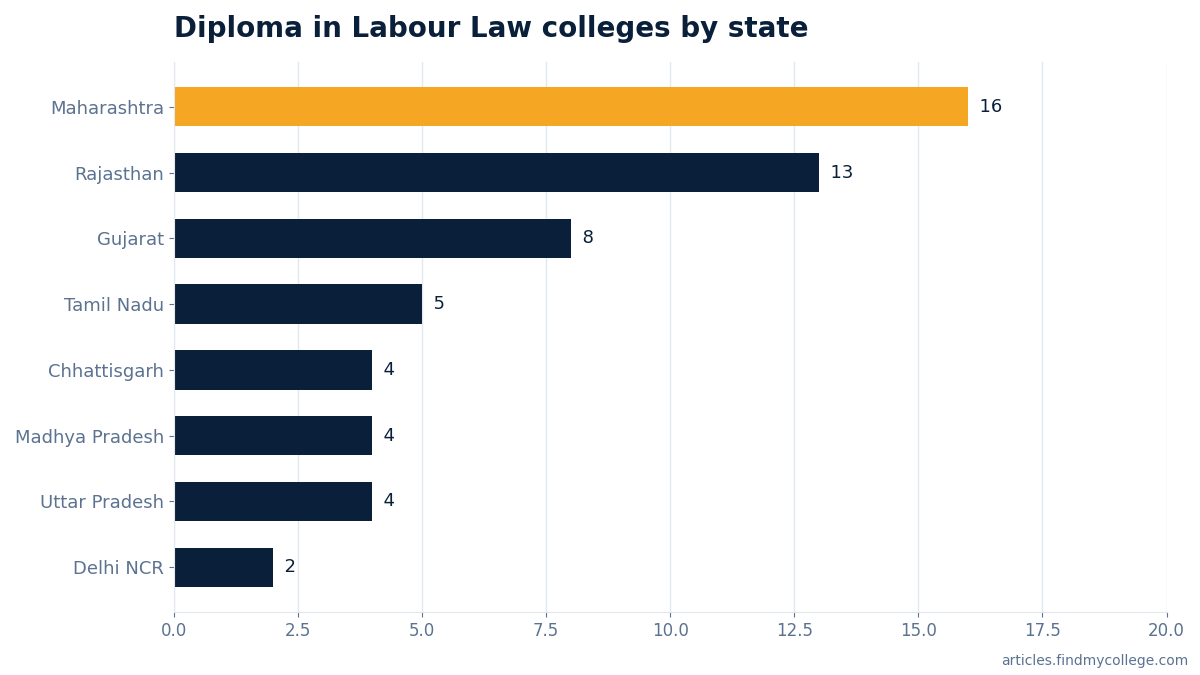
At least 63 colleges offer the Diploma in Labour Law in India, with private institutions having a median total course fee of ₹23,000. Course fees vary widely, starting from ₹6,400 at University of Madras to ₹1,77,000 at CT University Ludhiana.
| College | City | Ownership | Total course fee | NIRF rank |
|---|---|---|---|---|
| Faculty of Law Jamia Millia Islamia University | Nandurbar | Private | ₹26,600 | 5 (Law, 2023) |
| Jamia Millia Islamia University | Delhi | Government | ₹26,600 | 8 (Law, 2025) |
| Goswami Ganesh Dutt Sanatan Dharama College | Chandigarh | Private | ₹45,000 | 70 (Overall, 2025) |
| Goa University | North Goa | — | ₹10,000 | 101 (Overall, 2023) |
| Devi Ahilya Vishwavidyalaya | Indore | — | ₹30,332 | 101 (Overall, 2023) |
| Parul University | Vadodara | — | ₹1.09 lakh | 151 (Overall, 2023) |
| Rabindranath Tagore University | Bhopal | — | ₹20,500 | 151 (Overall, 2023) |
| College | City | Ownership | Total course fee |
|---|---|---|---|
| Mahatma Jyoti Rao Phoole University | Jaipur | Private (aided) | ₹32,000 |
| Goswami Ganesh Dutt Sanatan Dharama College | Chandigarh | Private | ₹45,000 |
| Raj Rishi Bhartrihari Matsya University | Alwar | Private | ₹1.02 lakh |
| Bharati Vidyapeeth New Law College | Pune | Private (aided) | ₹10,000 |
| D.P. Vipra Law College | Bilaspur | Private | ₹15,200 |
| Theni College of Arts and Science | Theni | Private | ₹12,000 |
| Biyani Girls College | Jaipur | Private | ₹30,000 |
| Ismail Saheb Mulla Law College | Satara | Private (aided) | ₹7,000 |
| BJS Rampuria Jain Law College | Bikaner | Private | ₹18,900 |
| Faculty of Law Jamia Millia Islamia University | Nandurbar | Private | ₹26,600 |
| City | Colleges | Fee range | Well-known options |
|---|---|---|---|
| Jaipur | 5 | ₹30,000 – ₹32,000 | University of Rajasthan, Mahatma Jyoti Rao Phoole University |
| Pune | 4 | ₹10,000 – ₹35,000 | Bharati Vidyapeeth New Law College, Bharati Vidyapeeth New Law College |
| Alwar | 2 | ₹60,000 – ₹1.02 lakh | Raj Rishi Bhartrihari Matsya University, SunRise University |
| Mumbai | 2 | ₹9,500 – ₹13,900 | Dr. Ambedkar College of Law, Xaviers Institute of Business Management Studies Mumbai |
| Delhi | 2 | ₹26,600 – ₹26,600 | Jamia Millia Islamia University, Shyam Institute of Management and Technology |
| Sidhpur | 2 | ₹15,000 – ₹15,000 | Gokul Global University, Gokul Law and Integrated Law College, Gokul Global University |
| Aurangabad | 2 | ₹18,500 – ₹18,500 | Mahatma Gandhi Mission University, Manikchand Pahade Law College |
| Bangalore | 2 | ₹13,900 – ₹13,900 | Xaviers Institute of Business Management Studies Bangalore, London American City College |
| College | City | Total course fee |
|---|---|---|
| University of Madras, Institute of Distance Education | Chennai | ₹6,400 |
| Parul University | Vadodara | ₹1.09 lakh |
| Xaviers Institute of Business Management Studies Mumbai | Mumbai | ₹13,900 |
| Wisdom School of Management Ghaziabad | Ghaziabad | ₹16,700 |
| Bharati Vidyapeeth Deemed University, School of Distance Education | Pune | ₹14,000 |
| Xaviers Institute of Business Management Studies Bangalore | Bangalore | ₹13,900 |
| Wisdom School of Management Lucknow | Lucknow | ₹16,700 |
Diploma in Labour Law Career Scope and Salary
Completing a Diploma in Labour Law opens avenues in corporate HR departments, manufacturing plants, legal consultancies, and government labor departments. Qualified Labour Welfare Officers meet statutory requirements under the Factories Act and are eligible for specialized roles in public sector undertakings (PSUs), Indian Railways, and state administrative bodies.
In the private sector, compliance officers and legal associates manage industrial relations, oversee factory inspections, draft employment contracts, and handle dispute adjudications before labor courts.
| Job Role | Entry-Level Salary (0-2 Years) | Experienced / Senior Salary (5+ Years) |
|---|---|---|
| Legal Associate (Labour Law) | ₹3 – ₹6 LPA | ₹8 – ₹12 LPA |
| Labor Law Consultant | ₹4 – ₹10 LPA | ₹12 – ₹20 LPA |
| HR Manager (Compliance & IR) | ₹6 – ₹12 LPA | ₹15 – ₹25 LPA |
| Compliance Officer | ₹4 – ₹8 LPA | ₹10 – ₹15 LPA |
| Labour Welfare Officer | ₹3 – ₹6 LPA | ₹8 – ₹12 LPA |
| Corporate Legal Counsel | ₹6 – ₹12 LPA | ₹15 – ₹30 LPA |
| Arbitrator & Mediator | ₹5 – ₹10 LPA | ₹12 – ₹20 LPA |
How to Apply for Diploma in Labour Law Admission in 2026: Step by Step
- Check Eligibility Criteria: Confirm eligibility, such as holding a Bachelor’s degree in any stream from a recognized university or a 10+2 qualification for specific professional diplomas.
- Select Institution and Study Mode: Choose between regular on-campus options (such as ILS Pune or SPPU), part-time courses (such as MGLI Ahmedabad), distance programs (such as Bharati Vidyapeeth), or online diploma certifications.
- Submit Online/Offline Application Form: Register on the university link, enter required details, upload scanned copies of documents, and submit the application fee.
- Appear for Entrance Exam or Merit Evaluation: Sit for entrance exams (such as MAH CET, SET, SNAP, AILET, or CLAT) where required, or participate in direct merit-based evaluation.
- Attend Counselling and Verification: Participate in the counselling or interview round where authorities verify documents before releasing the final admission list.
- Pay Admission Fees and Confirm Seat: Complete the course fee payment, ranging from ₹10,000 in government colleges up to ₹1,77,000 in private institutions, to finalize admission.
| What to do | Where | Link |
|---|---|---|
| Compare colleges, fees and cutoffs | Diploma in Labour Law colleges in India | findmycollege.com |
Candidates must review all details before submitting their application and present valid documents during counselling, as invalid submissions will lead to rejection of candidature.