
Food Science Technology Courses: Degree and Diploma Options
Nishit Kumar is a senior EdTech industry leader with over a decade of experience in building and scaling education platforms, shaping their product, content, and growth strategy. At…
Food Science Technology courses in India include 3-year Diplomas, 4-year BTech/BE degrees, and 2-year MTech programs, with total course fees ranging between INR 1,000 and INR 17 Lakh. Fresh graduates earn starting salaries of INR 2.5 LPA to INR 5 LPA, with an average salary of INR 3.9 LPA.
Prospective students can explore degree, diploma, and postgraduate course options along with detailed eligibility criteria, entrance exams, college options, fee structures, and career opportunities across India.
| Parameter | Details |
|---|---|
| Course Levels | Diploma, BTech, BE, MTech, ME, PhD, Certification |
| Course Duration | UG: 4 years | PG: 2 years | Diploma: 3 years | PhD: 3-5 years |
| UG Eligibility | Class 12 with Physics, Chemistry, and Mathematics (PCM) or Biology (PCB/PCMB) with 50%-75% marks |
| Entrance Exams | JEE Main, JEE Advanced, MHT CET, WBJEE, KCET, AP EAMCET, ICAR AIEEA, GATE, CUET, VITEEE, BITSAT, SRMJEEE |
| Average Course Fees | INR 1,000 to INR 17 Lakh |
| Average Starting Salary | INR 2.5 LPA – INR 5 LPA (Average: INR 3.9 LPA; Senior roles: INR 20 LPA – INR 30 LPA) |
Food Science Technology Courses in India: Options at a Glance
| Course Level | Duration | Minimum Qualification | Admission Basis |
|---|---|---|---|
| Diploma in Food Technology | 3 Years | Class 10 | Merit / State Entrance |
| BTech / BE in Food Technology | 4 Years | Class 12 (PCM / PCB / PCMB) | JEE Main, MHT CET, KCET, WBJEE, CUET, Private Exams |
| MTech / ME in Food Technology | 2 Years | Relevant BTech Degree | GATE, SRMJEEE PG, University Entrance |
| PhD in Food Technology | 3 – 5 Years | Relevant MTech Degree | Entrance Exam |
Food science technology academic pathways range from 3-year post-Class 10 diplomas to doctoral research degrees. BTech programs focus on food processing engineering, packaging, food safety, and quality standards.
| College | City | Ownership | Total course fee | NIRF rank |
|---|---|---|---|---|
| Delhi University | Delhi | Government | — | 5 (Overall, 2025) |
| Amrita Vishwa Vidyapeetham | Coimbatore | — | ₹4.00 lakh | 8 (Overall, 2025) |
| Govind Ballabh Pant University of Agriculture and Technology | Pantnagar | — | ₹1.17 lakh | 9 (Overall, 2025) |
| PSGR Krishnammal College for Women | Coimbatore | Private (aided) | — | 9 (Overall, 2025) |
| Vellore Institute of Technology Vellore | Vellore | — | ₹3.75 lakh | 14 (Overall, 2025) |
| K L University Guntur | Guntur | — | ₹5.56 lakh | 26 (Overall, 2025) |
| Lady Irwin College | Delhi | University | ₹1.42 lakh | 31 (Overall, 2025) |
| Lovely Professional University | Jalandhar | Private | ₹1.02 lakh | 31 (Overall, 2025) |
| University of Agricultural Sciences Dharwad | Dharwad | Government | ₹67,860 | 35 (Overall, 2025) |
| College | City | Ownership | Total course fee |
|---|---|---|---|
| University of Agricultural Sciences Dharwad | Dharwad | Government | ₹67,860 |
| Bhaskaracharya College of Applied Sciences | Delhi | Government | ₹69,775 |
| Calicut University | Calicut | Government | ₹1.32 lakh |
| Maulana Abul Kalam Azad University of Technology | Kolkata | Government | ₹2.00 lakh |
| I.K. Gujral Punjab Technical University Jalandhar | Jalandhar | Government | ₹2.03 lakh |
| College | City | Ownership | Total course fee |
|---|---|---|---|
| Uttaranchal University | Dehradun | Private | ₹2.88 lakh |
| Padmashree Group of Institutions | Bangalore | Private | ₹2.85 lakh |
| Hindustan College of Arts and Science Coimbatore | Coimbatore | Private | ₹1.20 lakh |
| Guru Nanak College of Engineering & Management | Dehradun | Private | ₹2.05 lakh |
| Dev Bhoomi Uttarakhand University | Dehradun | Private | ₹3.11 lakh |
| Sigma Group of Institutes | Vadodara | Private | ₹1.42 lakh |
| Khalsa College Amritsar | Amritsar | Private (aided) | ₹2.67 lakh |
| Rajagiri College of Management and Applied Sciences Kakkanad | Kochi | Private | ₹1.31 lakh |
| Roorkee College of Engineering | Roorkee | Private | ₹1.97 lakh |
| GM Institute of Technology | Davanagere | Private | ₹2.77 lakh |
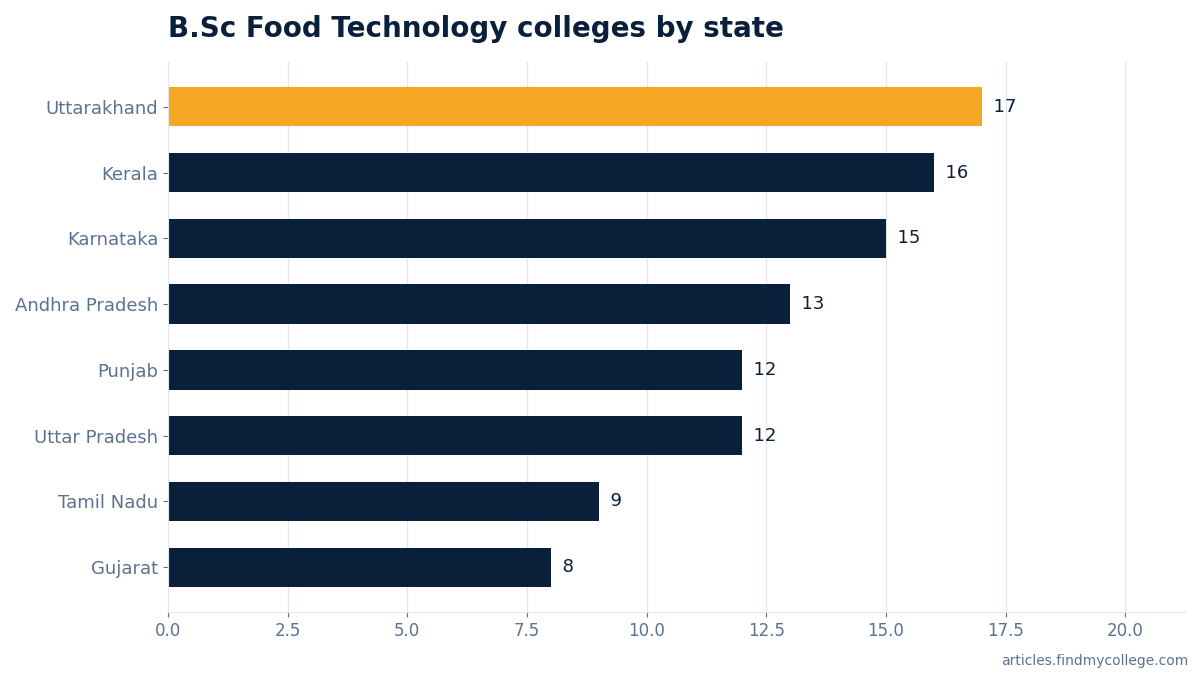
| City | Colleges | Fee range | Well-known options |
|---|---|---|---|
| Dehradun | 11 | ₹1.15 lakh – ₹3.93 lakh | Uttaranchal University, Graphic Era University |
| Bangalore | 8 | ₹2.53 lakh – ₹7.00 lakh | Padmashree Group of Institutions, Garden City University |
| Visakhapatnam | 5 | ₹1.50 lakh – ₹3.78 lakh | Andhra University, GITAM Visakhapatnam |
| Delhi | 5 | ₹69,775 – ₹1.42 lakh | Delhi University, Lady Irwin College |
| Malappuram | 4 | ₹1.27 lakh – ₹1.32 lakh | SAFI Institute of Advanced Study Vazhayoor, Assabah Arts and Science College |
| Hyderabad | 4 | ₹3.25 lakh – ₹5.05 lakh | Malla Reddy University, Guru Nanak University |
| Jalandhar | 4 | ₹1.02 lakh – ₹2.96 lakh | I.K. Gujral Punjab Technical University Jalandhar, DAV University |
| Allahabad | 4 | ₹3.73 lakh – ₹4.50 lakh | University of Allahabad, Prof. Rajendra Singh (Rajju Bhaiya) University, |
Eligibility and Duration
Diploma in Food Technology has a duration of 3 years and requires Class 10 qualification for entry. BTech in Food Technology spans 4 years of undergraduate study. Top government colleges for Food Technology require an average of 75% in PCM (65% for SC/ST/PwD) in Class 12, whereas private colleges require 50% to 60%. For PG courses like MTech/ME in Food Technology, candidates require a relevant BTech degree and qualifying entrance exams like GATE or SRMJEEE PG.
Fees
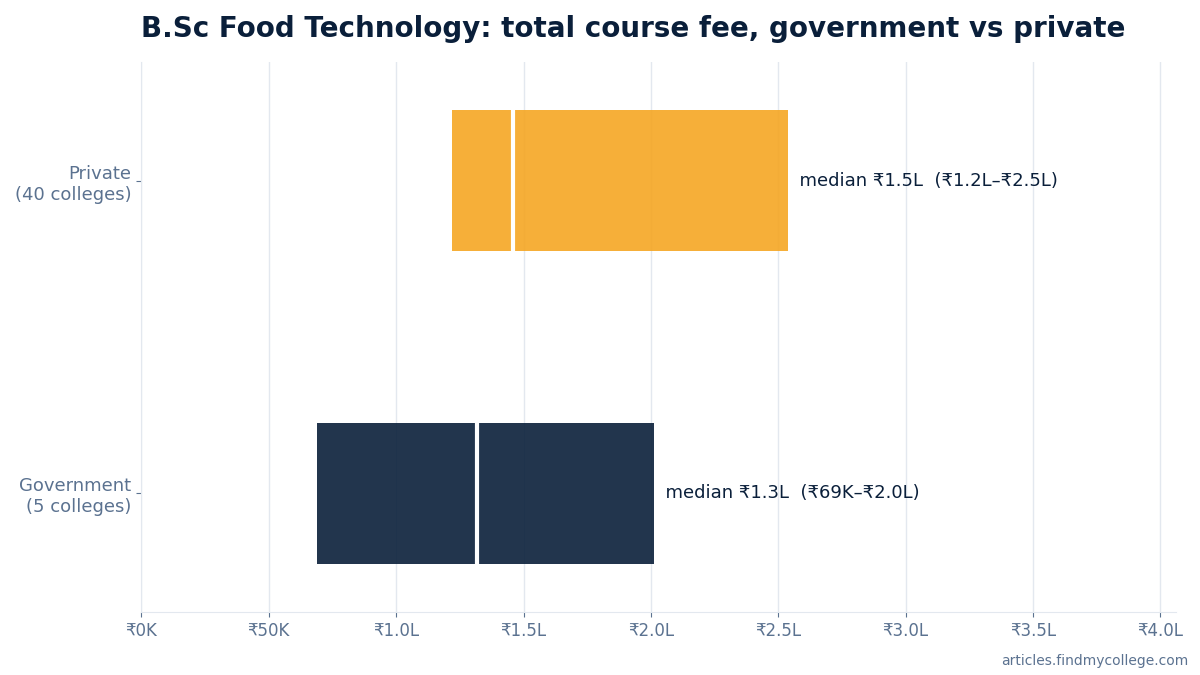
Course fees for food technology programs vary significantly based on ownership and institution type. Government colleges offering B.Sc Food Technology have a median total course fee of ₹1.32 lakh, with the middle half ranging between ₹68,817 and ₹2.01 lakh across colleges with fee data. Private colleges record a median total course fee of ₹1.46 lakh, with the middle half between ₹1.22 lakh and ₹2.54 lakh across reporting institutions. Total fees across all food science technology degree and diploma options range from INR 1,000 to INR 17 Lakh.
Career Options and Salary
Fresh graduates earn starting salaries of INR 2.5 LPA to INR 5 LPA, with an average salary of INR 3.9 LPA. Experienced professionals in senior roles can earn between INR 20 LPA and INR 30 LPA. The median average placement package across reporting B.Sc Food Technology colleges is 3.7 LPA.
Career roles after Food Technology include Food Technologist, QA Manager, Quality Check Officer, Packaging Specialist, Food Inspector, Product Development Scientist, and Regulatory Affairs Officer. Top recruiters of Food Technology graduates include Nestle India, PepsiCo, Britannia, ITC, Cadbury, Dabur, Licious, Hatsun, MTR Foods Ltd, and Godrej Industrial.
How to Choose
Selecting the right food technology option depends on prior academic background, budget, and long-term career aspirations. Candidates with PCM can aim for engineering degrees in premier government technical institutes via JEE Main or JEE Advanced. Students with PCB or PCMB subjects can explore wide-ranging B.Sc or BTech options across state and private universities.
Evaluating accreditation, infrastructure, fee structures, and campus placement records helps students select the program best suited to their goals.
How to Apply for B.Sc Food Technology Admission in 2026: Step by Step
- Check academic eligibility: Verify that you have passed Class 10 (for Diploma) or Class 12 with PCM or PCB/PCMB with at least 50%-60% marks (75% for IITs/NITs).
- Register for entrance exams: Apply for relevant national (JEE Main, ICAR AIEEA), state (MHT CET, KCET, WBJEE, AP EAMCET), or university-level exams (BITSAT, VITEEE, SRMJEEE).
- Appear for entrance examination: Take the designated entrance examination and secure qualifying cutoff marks for counselling.
- Fill college application & attend counselling: Apply on the respective state/national or university admission portals and participate in counselling sessions (e.g., TNEA, JoSAA) for seat allotment.
| What to do | Where | Link |
|---|---|---|
| Compare colleges, fees and cutoffs | B.Sc Food Technology colleges in India | findmycollege.com |
FAQs
Is maths compulsory for food technology?
Maths is not strictly mandatory everywhere. While BTech courses require Class 12 with Physics, Chemistry, and Mathematics (PCM), many universities also accept students with Biology (PCB or PCMB) with 50% to 60% aggregate marks.
What is the average salary for a food technologist in India?
The average salary for a food technologist in India is INR 3.9 LPA. Freshers start between INR 2.5 LPA and INR 5 LPA, while experienced professionals in senior roles can earn between INR 20 LPA and INR 30 LPA.
Which IIT offers food technology?
What are the top government colleges for food technology in India?
Is BTech food technology a good course?
Yes, BTech Food Technology is a practical engineering course with massive job demand in food manufacturing, packaging, and R&D. India’s growing food processing sector offers stable career choices and competitive pay.
How to start a career in food technology?
To start a career, clear Class 12 with PCM or PCB/PCMB, appear for entrance exams like JEE Main, MHT CET, or ICAR AIEEA, pursue a 4-year BTech or 3-year Diploma in Food Technology, and apply to top food production companies.