
Doctorate of Medicine in Pediatrics (MD Pediatrics) India 2026 Overview
Nishit Kumar is a senior EdTech industry leader with over a decade of experience in building and scaling education platforms, shaping their product, content, and growth strategy. At…
Latest update: Doctorate of Medicine in Pediatrics 2026 admissions & dates updated. Read more ›
Welcome to the comprehensive overview of the Doctorate of Medicine (MD) in Pediatrics program in India for the academic year 2026. This page is designed to provide prospective students and their parents with a detailed understanding of this specialized postgraduate medical degree, covering everything from eligibility and admission processes to career opportunities and financial considerations. MD Pediatrics is a crucial specialization focused on the medical care of infants, children, and adolescents, requiring a deep commitment to child health and well-being.
What is Doctorate of Medicine (MD) in Pediatrics?
The Doctorate of Medicine (MD) in Pediatrics is a three-year postgraduate medical degree in India that focuses on the health and medical care of infants, children, and adolescents. This specialization equips doctors with advanced knowledge and clinical skills to diagnose, treat, and prevent a wide range of diseases and conditions specific to the pediatric age group, from birth through to 18 years of age.
The curriculum encompasses various sub-specialties within pediatrics, including neonatology, pediatric intensive care, pediatric cardiology, neurology, nephrology, endocrinology, and infectious diseases. Graduates are trained to manage complex pediatric cases, perform diagnostic procedures, and provide comprehensive care, including immunizations, nutritional guidance, and developmental assessments.
What is the eligibility for Doctorate of Medicine in Pediatrics in India for 2026?
To be eligible for the MD Pediatrics program in India for 2026, candidates must possess a Bachelor of Medicine, Bachelor of Surgery (MBBS) degree from a university recognized by the Medical Council of India (MCI) or the National Medical Commission (NMC), and have completed a compulsory rotating internship of one year. Additionally, candidates must be registered with a State Medical Council or the NMC.
Specific eligibility criteria often include a minimum aggregate score in the MBBS examination, typically around 50% for General category candidates and 40-45% for SC/ST/OBC candidates. Foreign medical graduates must clear the Foreign Medical Graduate Examination (FMGE) conducted by the National Board of Examinations (NBE) and complete their internship in India to be eligible.
How do I get admission to MD Pediatrics in 2026? What is the admission process?
Admission to MD Pediatrics programs in India for 2026 is primarily through national-level entrance examinations, followed by counseling. The main entrance exam is the NEET-PG (National Eligibility cum Entrance Test for Postgraduate), conducted by the National Board of Examinations (NBE).
The admission process typically involves:
- NEET-PG Application: Candidates must register and apply for NEET-PG online, usually between October and November of the preceding year.
- NEET-PG Examination: The exam is generally conducted in January or February. It is a computer-based test (CBT) assessing knowledge from the MBBS curriculum.
- Result Declaration: NEET-PG results are usually declared by March.
- Counseling Registration: Qualified candidates must register for counseling conducted by the Medical Counseling Committee (MCC) for All India Quota (AIQ) seats (50% of government seats) and Deemed/Central Universities. State counseling authorities manage the remaining 50% State Quota seats and private college seats.
- Choice Filling & Locking: Candidates select their preferred colleges and specializations based on their NEET-PG rank.
- Seat Allotment: Seats are allotted based on rank, choices filled, and reservation policies.
- Reporting to College: Allotted candidates must report to the respective college within the stipulated time for document verification and admission formalities.
NEET-PG 2026 Tentative Dates & Pattern
| Event | Tentative Dates (2026) | Details |
|---|---|---|
| Application Period | Oct – Nov 2025 | Online registration and fee payment |
| Admit Card Release | Jan 2026 | Downloadable from NBE website |
| Examination Date | Feb 2026 | Single session, Computer Based Test (CBT) |
| Result Declaration | Mar 2026 | Published on NBE website |
| Counseling (MCC & State) | Apr – Jun 2026 | Multiple rounds of seat allotment |
NEET-PG Exam Pattern:
- Mode: Online (Computer Based Test)
- Duration: 3 hours 30 minutes
- Total Questions: 200 Multiple Choice Questions (MCQs)
- Subjects: Pre-Clinical, Para-Clinical, and Clinical subjects of MBBS curriculum
- Marking Scheme: +4 for correct answer, -1 for incorrect answer, 0 for unanswered
How much does Doctorate of Medicine in Pediatrics cost in India? (Fee Structure)
The cost of pursuing an MD Pediatrics degree in India varies significantly based on the type of institution (government, private, or deemed university) and the quota (All India Quota, State Quota, or Management Quota). Government colleges generally have the lowest fees, while private and deemed universities can be substantially more expensive.
MD Pediatrics Fee Ranges (Annual, Tentative 2026)
| Institution Type | Annual Fee Range (INR) | Additional Costs |
|---|---|---|
| Government Colleges | ₹10,000 – ₹1,50,000 | Hostel, Mess, Exam Fees (subsidized) |
| Private Colleges | ₹5,00,000 – ₹25,00,000 | Hostel, Mess, Exam Fees (higher) |
| Deemed Universities | ₹15,00,000 – ₹35,00,000 | Hostel, Mess, Exam Fees (highest) |
These figures are approximate and can vary. Many government colleges offer a stipend to MD residents, which can partially offset living expenses. Private colleges may also offer stipends, but they are generally lower than those in government institutions.
What is the syllabus for MD Pediatrics?
The MD Pediatrics syllabus is comprehensive, covering all aspects of child health and disease over three years. It combines theoretical knowledge with extensive practical and clinical training, including rotations in various pediatric sub-specialties.
Core Subjects & Areas of Study
- General Pediatrics: Growth & Development, Nutrition, Immunization, Fluid & Electrolyte Balance.
- Neonatology: Care of the newborn, prematurity, neonatal infections, respiratory distress syndrome.
- Pediatric Intensive Care (PICU): Management of critically ill children, ventilatory support, shock.
- Pediatric Cardiology: Congenital heart diseases, rheumatic fever, arrhythmias.
- Pediatric Neurology: Seizures, developmental delay, cerebral palsy, meningitis.
- Pediatric Nephrology: Renal diseases, urinary tract infections, acute kidney injury.
- Pediatric Gastroenterology & Hepatology: Diarrhea, malabsorption, liver diseases.
- Pediatric Pulmonology: Asthma, pneumonia, tuberculosis.
- Pediatric Endocrinology: Diabetes, thyroid disorders, growth disorders.
- Pediatric Hematology & Oncology: Anemia, leukemia, lymphomas.
- Pediatric Infectious Diseases: Viral, bacterial, fungal, and parasitic infections.
- Social & Preventive Pediatrics: Public health, child welfare, national health programs.
- Pediatric Surgery: Basic surgical principles and common pediatric surgical conditions.
- Genetics & Metabolic Disorders: Inborn errors of metabolism, genetic syndromes.
The curriculum also includes research methodology, biostatistics, medical ethics, and communication skills, preparing residents for both clinical practice and academic pursuits.
Is Doctorate of Medicine in Pediatrics worth it for jobs? What are the career prospects and salary?
Yes, pursuing an MD in Pediatrics is highly worth it for job prospects in India, as pediatricians are always in high demand. The specialization offers a stable and rewarding career path with diverse opportunities in both clinical practice and academia. Child healthcare is a fundamental need, ensuring a continuous requirement for skilled pediatricians.
Career Prospects & Roles:
- Consultant Pediatrician: Working in private hospitals, government hospitals, or setting up own clinic.
- Neonatologist: Specializing in the care of newborns, especially premature or critically ill infants.
- Pediatric Intensivist: Managing children in Pediatric Intensive Care Units (PICU).
- Academician/Professor: Teaching and research in medical colleges.
- Specialized Pediatrician: Further sub-specialization (e.g., Pediatric Cardiologist, Neurologist, Oncologist) after completing a DM/Fellowship.
- Public Health Specialist: Working with NGOs, government health programs focusing on child health.
Average Salary for MD Pediatrics Graduates (Annual, Tentative 2026)
| Role/Experience Level | Annual Salary Range (INR) | Key Factors Influencing Salary |
|---|---|---|
| Junior Resident (during MD) | ₹45,000 – ₹90,000 per month (stipend) | Institution type, city |
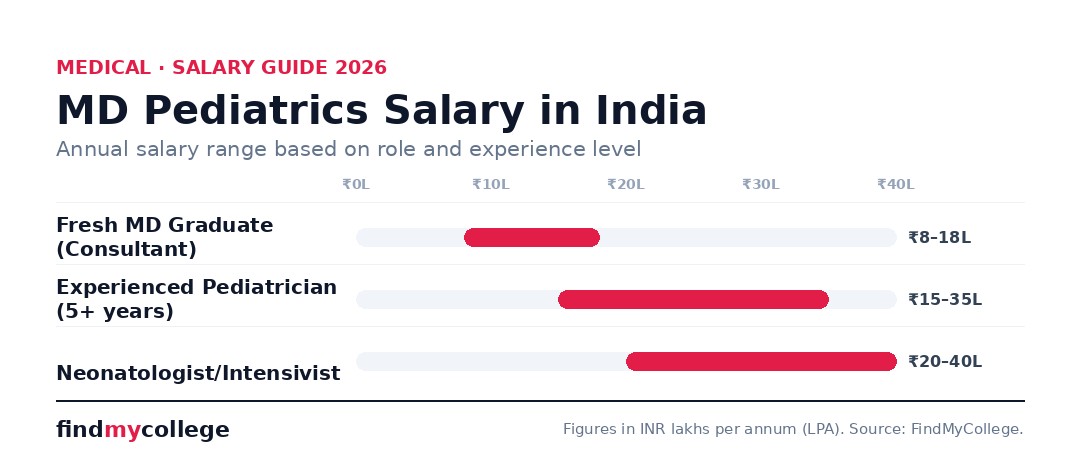
| Fresh MD Graduate (Consultant) | ₹8,00,000 – ₹18,00,000 | Hospital type (govt/private), location, city tier |
| Experienced Pediatrician (5+ years) | ₹15,00,000 – ₹35,00,000+ | Reputation, sub-specialization, private practice success |
| Neonatologist/Intensivist | ₹20,00,000 – ₹40,00,000+ | High demand, specialized skills |
Salaries can be significantly higher in metropolitan cities and for those with established private practices or super-specializations.
MD Pediatrics vs. DNB Pediatrics: Which is better?
Both MD Pediatrics and DNB (Diplomate of National Board) Pediatrics are recognized postgraduate medical qualifications in India, offering similar career prospects. The choice often depends on individual preferences, availability of seats, and the training environment.
Comparison: MD Pediatrics vs. DNB Pediatrics
| Feature | MD Pediatrics | DNB Pediatrics |
|---|---|---|
| Awarding Body | University (affiliated to MCI/NMC) | National Board of Examinations (NBE) |
| Training Institutions | Medical Colleges | Medical Colleges, Large Private Hospitals, Government Hospitals |
| Exam Pattern | University-specific (theory, practical, viva) | NBE-conducted (theory, practical, viva – standardized) |
| Research Focus | Often includes a thesis/dissertation | Emphasis on case presentations, less formal thesis requirement |
| Recognition | Universally recognized | Equivalently recognized by NMC for practice & teaching |
| Availability of Seats | Primarily in medical colleges | Wider range of hospitals, including non-teaching ones |
| Stipend | Generally higher in government MD seats | Varies, can be lower than government MD seats |
Historically, MD was often preferred due to its academic focus and direct affiliation with medical colleges. However, DNB programs, especially in well-established hospitals, offer excellent clinical exposure and are now equally recognized for all purposes, including teaching positions. The quality of training in both depends heavily on the specific institution.
What are the top colleges for MD Pediatrics in India?
India boasts numerous prestigious institutions offering MD Pediatrics, known for their excellent faculty, clinical exposure, and research facilities. Admission to these colleges is highly competitive, primarily through NEET-PG.
- All India Institute of Medical Sciences (AIIMS), New Delhi
- Postgraduate Institute of Medical Education and Research (PGIMER), Chandigarh
- Jawaharlal Institute of Postgraduate Medical Education and Research (JIPMER), Puducherry
- Maulana Azad Medical College (MAMC), New Delhi
- Seth GS Medical College, Mumbai
- King George’s Medical University (KGMU), Lucknow
- Christian Medical College (CMC), Vellore
- Armed Forces Medical College (AFMC), Pune
- Institute of Medical Sciences, Banaras Hindu University (IMS-BHU), Varanasi
- Grant Medical College, Mumbai
Many other state government medical colleges and well-established private medical colleges also offer high-quality MD Pediatrics programs.
Frequently Asked Questions
What is the duration of the MD Pediatrics course?
The MD Pediatrics course is a full-time, three-year postgraduate program after completing MBBS and a one-year compulsory rotating internship.
Are there any age limits for MD Pediatrics admission?
No, there is generally no upper age limit for MD Pediatrics admission in India. Eligibility is primarily based on educational qualifications and NEET-PG performance.
Can I pursue super-specialization after MD Pediatrics?
Yes, after completing MD Pediatrics, you can pursue super-specialization (DM – Doctorate of Medicine or Fellowship programs) in various pediatric sub-fields like Neonatology, Pediatric Cardiology, Pediatric Neurology, Pediatric Nephrology, Pediatric Oncology, etc. These are typically 3-year programs.
Is a stipend provided during MD Pediatrics?
Yes, most government medical colleges and many private/deemed universities provide a monthly stipend to MD residents. The amount varies significantly by institution and state, ranging from approximately ₹45,000 to ₹90,000 per month in government setups.
What are the key skills required to be a successful Pediatrician?
Key skills include excellent communication with children and parents, empathy, patience, strong diagnostic abilities, clinical acumen, decision-making under pressure, and a commitment to continuous learning.
What is the difference between MD Pediatrics and MS Pediatrics?
MD (Doctorate of Medicine) is a postgraduate degree in medical specializations, primarily non-surgical fields like Pediatrics, General Medicine, etc. MS (Master of Surgery) is a postgraduate degree in surgical specializations like General Surgery, Orthopedics, etc. Pediatrics is a medical (non-surgical) specialty, hence MD is the relevant degree.
Can foreign nationals apply for MD Pediatrics in India?
Foreign nationals can apply for MD Pediatrics in India, typically through the NEET-PG exam. They must fulfill all eligibility criteria, including an MBBS degree recognized by NMC and often clearing the FMGE if their primary medical qualification is from outside India, and completing an internship in India.