

Doctorate of Medicine in Pediatrics Salary in India 2026
Nishit Kumar is a senior EdTech industry leader with over a decade of experience in building and scaling education platforms, shaping their product, content, and growth strategy. At…
Latest update: Doctorate of Medicine in Pediatrics 2026 admissions & dates updated. Read more ›
Pursuing a Doctorate of Medicine (MD) in Pediatrics in India opens doors to a rewarding career, both professionally and financially. As of 2026, the salary for an MD Pediatrician is highly competitive, reflecting the specialized skills and critical role they play in child healthcare. This comprehensive guide delves into the various factors influencing an MD Pediatrics salary, career progression, and what aspiring pediatricians can expect in India.
What is the average starting salary for an MD Pediatrician in India in 2026?
The average starting salary for an MD Pediatrician in India in 2026 typically ranges from ₹8,00,000 to ₹15,00,000 per annum. This figure can vary significantly based on the type of hospital (government vs. private), location (metro vs. tier-2 cities), and the specific role undertaken.
Factors Influencing MD Pediatrics Salary
Several key factors dictate the earning potential of an MD Pediatrician in India. Understanding these can help aspiring doctors make informed career choices.
Experience Level
Experience is a primary determinant of salary in the medical field. Fresh graduates typically start at the lower end of the spectrum, while seasoned pediatricians with 5-10 years of experience can command significantly higher packages.
- 0-2 Years (Junior Resident/Consultant): ₹8,00,000 – ₹15,00,000 per annum
- 3-7 Years (Mid-Level Consultant): ₹15,00,000 – ₹25,00,000 per annum
- 8+ Years (Senior Consultant/HOD): ₹25,00,000 – ₹50,00,000+ per annum
Type of Employer (Government vs. Private Sector)
Salaries differ considerably between government and private healthcare sectors. Government hospitals often offer more job security, benefits, and fixed pay scales, while private hospitals and clinics may offer higher variable pay and performance-based incentives.
Government Sector Salaries
In government hospitals, MD Pediatricians are typically employed as Junior Residents, Senior Residents, or Assistant Professors, with salaries governed by central or state pay commissions.
- Junior Resident: ₹70,000 – ₹90,000 per month (during residency)
- Senior Resident: ₹90,000 – ₹1,20,000 per month
- Assistant Professor/Consultant: ₹1,20,000 – ₹2,50,000+ per month
Private Sector Salaries
Private hospitals, corporate chains, and individual clinics often offer higher remuneration, especially in metropolitan areas. The salary can also include a share of the revenue generated.
- Junior Consultant: ₹1,00,000 – ₹1,80,000 per month
- Senior Consultant: ₹1,80,000 – ₹3,50,000+ per month
- Private Practice/Clinic Owner: Can exceed ₹5,00,000 per month, depending on patient volume and reputation.
Geographical Location
Metropolitan cities and tier-1 cities generally offer higher salaries due to a greater demand for specialists, higher cost of living, and more established healthcare infrastructure.
| City Type | Average Annual Salary Range (MD Pediatrics) |
|---|---|
| Metro Cities (e.g., Mumbai, Delhi, Bangalore) | ₹12,00,000 – ₹35,00,000+ |
| Tier-1 Cities (e.g., Pune, Hyderabad, Chennai) | ₹10,00,000 – ₹28,00,000 |
| Tier-2 Cities (e.g., Jaipur, Lucknow, Kochi) | ₹8,00,000 – ₹20,00,000 |
Sub-specialization and Super-specialization
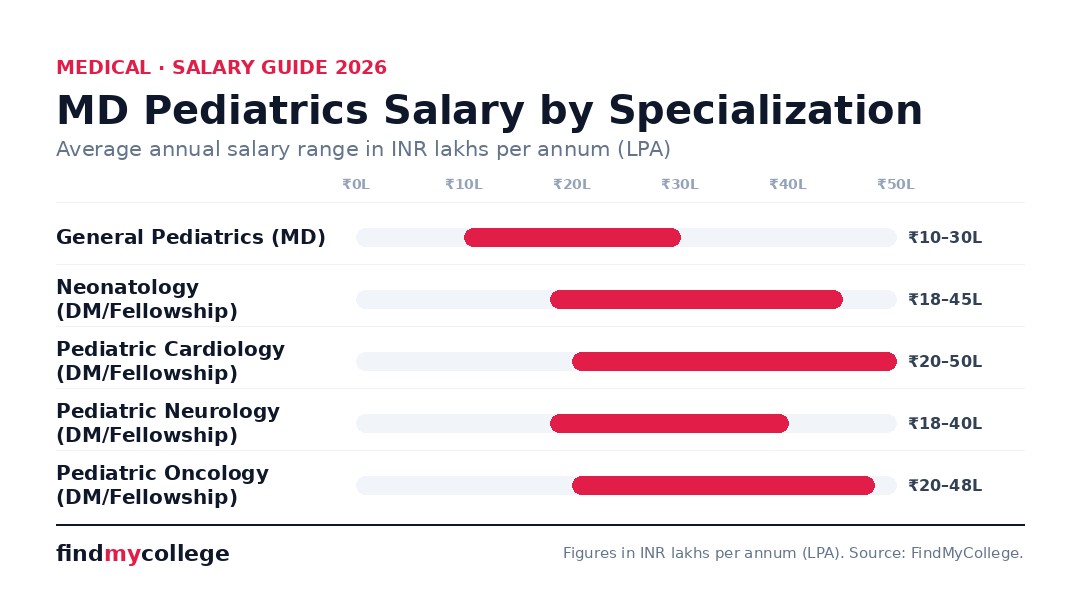
Pediatricians who pursue super-specializations (e.g., DM in Pediatric Cardiology, Pediatric Neurology, Neonatology, Pediatric Oncology) after their MD can command significantly higher salaries due to their niche expertise.
| Specialization | Average Annual Salary Range (Post-DM/Fellowship) |
|---|---|
| General Pediatrics (MD) | ₹10,00,000 – ₹30,00,000 |
| Neonatology (DM/Fellowship) | ₹18,00,000 – ₹45,00,000+ |
| Pediatric Cardiology (DM/Fellowship) | ₹20,00,000 – ₹50,00,000+ |
| Pediatric Neurology (DM/Fellowship) | ₹18,00,000 – ₹40,00,000+ |
| Pediatric Oncology (DM/Fellowship) | ₹20,00,000 – ₹48,00,000+ |
What are the top job roles and their salaries for MD Pediatricians in India?
MD Pediatricians can pursue various roles, each with its own salary structure and career progression path. The most common roles include General Pediatrician, Neonatologist, Pediatric Intensivist, and Academician.
General Pediatrician
These doctors provide primary care for children, managing common illnesses, vaccinations, and developmental assessments. They can work in hospitals, clinics, or establish private practices.
- Salary Range: ₹10,00,000 – ₹30,00,000 per annum
Neonatologist
Specializing in the care of newborn infants, especially premature or critically ill babies. This is a highly specialized and in-demand field.
- Salary Range: ₹18,00,000 – ₹45,00,000+ per annum
Pediatric Intensivist
Works in Pediatric Intensive Care Units (PICU), managing critically ill children. This role requires advanced skills and often involves high-pressure situations.
- Salary Range: ₹15,00,000 – ₹40,00,000+ per annum
Academician/Professor
Involves teaching medical students and residents, conducting research, and providing clinical care in teaching hospitals. Salaries are often combined with private practice or consulting.
- Salary Range: ₹12,00,000 – ₹35,00,000+ per annum (excluding private practice income)
Hospital Administrator (with clinical background)
Experienced pediatricians can transition into administrative roles, managing hospital departments or entire institutions. This often requires additional management qualifications.
- Salary Range: ₹20,00,000 – ₹60,00,000+ per annum
What is the career progression and growth potential for an MD Pediatrician?
The career progression for an MD Pediatrician is robust, offering continuous growth opportunities. After completing MD Pediatrics, doctors can choose to specialize further, move into leadership roles, or establish their own practice.
- Junior Resident → Senior Resident → Consultant Pediatrician → Senior Consultant/Head of Department (HOD) in hospitals.
- MD Pediatrics → DM/Fellowship in Super-specialty → Consultant in Super-specialty.
- Establishing Private Practice: Many pediatricians eventually open their own clinics, which offers significant earning potential and autonomy, albeit with initial investment and business risks.
- Research and Academia: Opportunities exist in medical colleges and research institutions for those interested in teaching and advancing medical knowledge.
Which are the top recruiters for MD Pediatricians in India?
Leading healthcare groups and government institutions are the primary recruiters for MD Pediatricians. These organizations offer competitive salaries and excellent growth prospects.
- Apollo Hospitals Group
- Fortis Healthcare
- Max Healthcare
- Manipal Hospitals
- AIIMS (All India Institute of Medical Sciences)
- Post Graduate Institute of Medical Education & Research (PGIMER)
- Government Medical Colleges and District Hospitals
- Rainbow Children’s Hospital
- Cloudnine Hospitals
- Columbia Asia Hospitals
Is pursuing MD Pediatrics worth it for jobs and salary in India?
Yes, pursuing MD Pediatrics is highly worth it for jobs and salary in India. The demand for skilled pediatricians remains consistently high due to India’s large young population and increasing awareness of child health. The specialization offers excellent job security, a respectable salary, and the profound satisfaction of contributing to the well-being of children.
How does MD Pediatrics salary compare to other MD specializations?
MD Pediatrics offers a competitive salary compared to many other MD specializations. While some surgical branches or highly niche medical fields might offer slightly higher peak earnings, Pediatrics provides a stable and respectable income with a good work-life balance compared to some other demanding specialties.
Generally, Pediatrics salaries are comparable to or slightly lower than those in General Medicine, Radiology, or Dermatology, but often higher than non-clinical branches like Anatomy or Physiology. Super-specializations in Pediatrics can rival the highest-paying medical fields.
What is the eligibility for Doctorate of Medicine in Pediatrics?
To be eligible for a Doctorate of Medicine (MD) in Pediatrics in India, candidates must possess an MBBS degree from a recognized medical college and complete a compulsory rotating internship. Admission is primarily through national-level entrance examinations.
- MBBS Degree: A Bachelor of Medicine, Bachelor of Surgery (MBBS) degree from a university recognized by the Medical Council of India (MCI) / National Medical Commission (NMC).
- Compulsory Rotating Internship: Completion of a one-year compulsory rotating internship after MBBS.
- Entrance Examination: Qualification in a national-level entrance exam such as NEET PG (National Eligibility cum Entrance Test for Post-Graduation). Some institutions may have their own entrance tests or interview processes for specific seats.
- Minimum Marks: Candidates usually need to secure a minimum qualifying percentile in NEET PG.
How much does Doctorate of Medicine in Pediatrics cost in India?
The cost of pursuing a Doctorate of Medicine (MD) in Pediatrics in India varies significantly between government and private medical colleges. Government colleges are considerably more affordable due to subsidies, while private institutions have higher fee structures.
Government Medical Colleges
The annual fees in government medical colleges can range from ₹10,000 to ₹1,50,000 per annum. This often includes a stipend paid to residents, which can partially or fully offset the fees and living expenses.
Private Medical Colleges
Private medical colleges charge much higher fees, typically ranging from ₹5,00,000 to ₹25,00,000 per annum. Deemed universities and colleges under management quotas may have even higher fees.
Additional costs include hostel fees, examination fees, study materials, and living expenses, which can add another ₹1,00,000 to ₹3,00,000 per annum.
Explore more on FindMyCollege
Related pages for Doctorate of Medicine in Pediatrics aspirants on findmycollege.com:
Frequently Asked Questions
What is the highest salary an MD Pediatrician can earn in India?
The highest salary for an MD Pediatrician, especially those with super-specializations, extensive experience (15+ years), and a strong reputation in metro cities or running a successful private practice, can exceed ₹50,00,000 to ₹1,00,00,000 per annum.
Do MD Pediatricians get a stipend during their residency?
Yes, MD Pediatricians typically receive a stipend during their three-year residency period. In government colleges, this can range from ₹70,000 to ₹90,000 per month, while private colleges may offer slightly less or more depending on the institution and location.
What are the typical working hours for an MD Pediatrician?
Working hours for an MD Pediatrician can be demanding, especially during residency, often involving long shifts, on-call duties, and emergency responses. As a consultant, hours can become more structured, but emergencies and patient load can still lead to extended workdays.
Is it difficult to find a job after MD Pediatrics in India?
No, it is generally not difficult to find a job after MD Pediatrics in India. There is a consistent demand for pediatricians across government and private sectors, especially in growing urban and semi-urban areas. Super-specialized pediatricians are even more in demand.
What are the prospects for an MD Pediatrician in rural areas of India?
Prospects in rural areas are significant. While salaries might be slightly lower than in metro cities, the demand for pediatricians is often very high, and doctors can establish a strong practice quickly due to less competition and a greater need for specialized care. Government initiatives also often incentivize doctors to work in rural settings.
Can an MD Pediatrician practice abroad?
Yes, an MD Pediatrician from India can practice abroad, but they typically need to clear specific licensing exams and fulfill residency requirements in the destination country (e.g., USMLE for USA, PLAB for UK, MCCEE for Canada). The process can be lengthy and challenging.