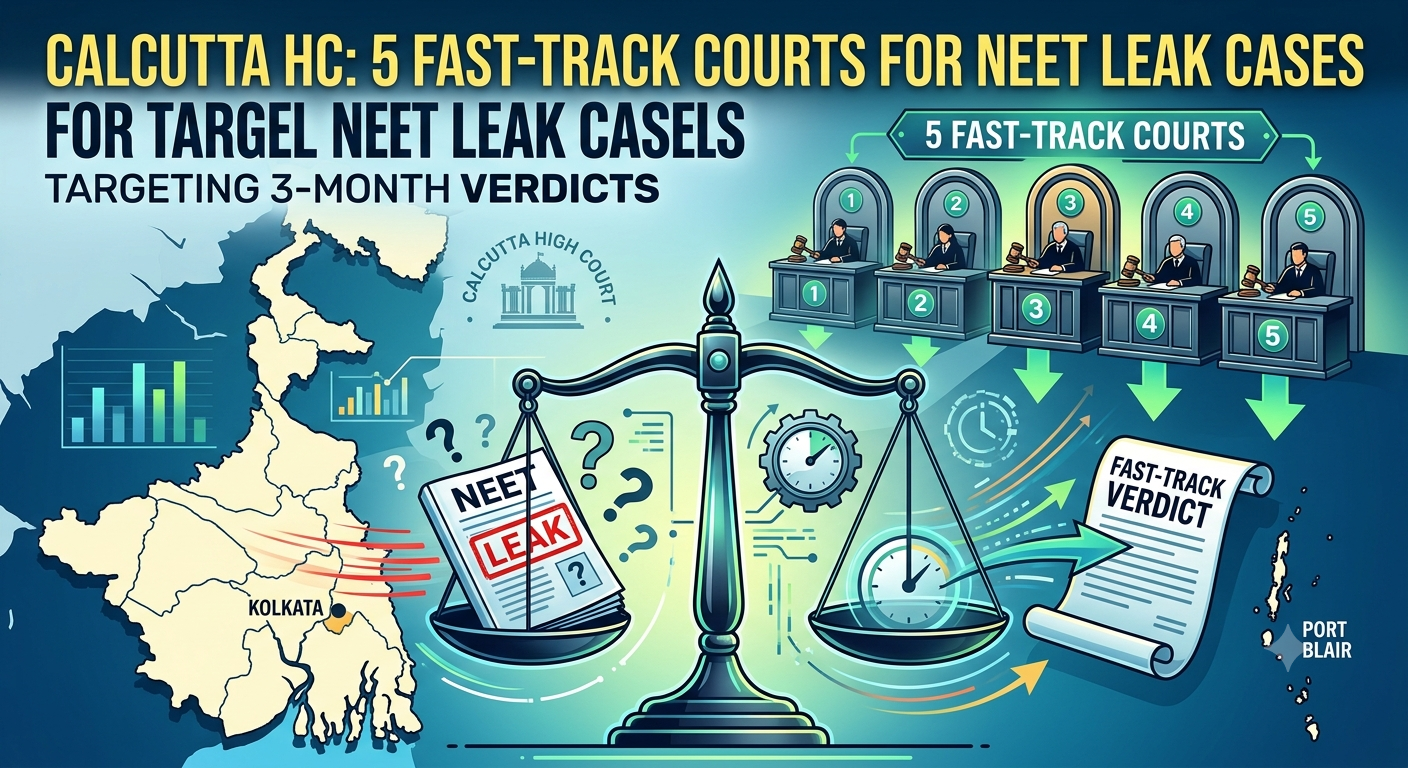
Calcutta HC Designates 5 Fast-Track Courts for NEET Paper Leak Cases: 3-Month Verdict Target Set
In a major step toward curbing examination malpractice and restoring faith in competitive testing, the Calcutta High Court has officially designated five special fast-track courts across West Bengal and the Andaman & Nicobar Islands to handle criminal proceedings related to the National Eligibility cum Entrance Test (NEET) paper leak controversy.
Issued via an administrative notification by the Registrar of the Calcutta High Court, the order mandates that these dedicated courts try cases strictly under the Public Examinations (Prevention of Unfair Means) Act, 2024. Under the new operational mandate, designated judges are expected to conduct accelerated hearings and deliver final verdicts preferably within three months from the date a charge sheet is filed by investigating authorities.
Detailed Breakdown of the 5 Designated Courts
The five specialized courts—three located in Kolkata and two in Port Blair—have been allocated clear, distinct jurisdictions based on the investigating authority and regional venue:
1. State-Level Investigations (West Bengal)
-
Bench-I, City Sessions Court, Calcutta: Designated as the primary court for trials and adjudication of cases investigated by West Bengal state police and local enforcement agencies.
2. Central Agency Investigations
-
Special CBI Court No. 2, City Sessions Court, Calcutta: Assigned exclusively to adjudicate high-profile cases probed by central agencies, including the Central Bureau of Investigation (CBI).
3. Judicial Inquiry & Cognizance
-
Additional Chief Judicial Magistrate (ACJM), 1st Court, Calcutta: Empowered to oversee pre-trial proceedings, judicial inquiries, taking of cognizance, and trial stages for specified regional matters.
4. Andaman & Nicobar Islands Jurisdiction
-
Additional District & Sessions Judge, Port Blair and Chief Judicial Magistrate (CJM), Port Blair: These two courts will handle fast-track trials for examination malpractice cases registered in the Union Territory, which falls under the territorial jurisdiction of the Calcutta High Court.
Judicial Clarification: The High Court explicitly noted that these special benches represent an extraordinary administrative arrangement and do not alter the permanent rank, status, or structural alignment of the presiding officers relative to the 88 existing fast-track courts in West Bengal.
Why Fast-Track Courts Were Necessary
Paper leak investigations involving organized syndicates present unique judicial hurdles. Prosecutions typically involve dozens of co-accused, complex paper trails, digital forensics, intercepted communications, and multi-state conspiracy angles.
Without specialized forums, standard trial courts face severe backlog issues, often causing criminal cases of this nature to stretch over years. Legal analysts emphasize that day-to-day continuous hearings before dedicated judges will streamline evidence management, prevent witness tampering, and ensure rapid disposal of cases involving organized crime rings.
Broader Legislative Context & Student Outrage
The High Court’s order follows intense public scrutiny and widespread student demonstrations across India over irregularities in high-stakes entrance exams. In response to growing national outrage, the Union Government tightened legal frameworks by enacting the Public Examinations (Prevention of Unfair Means) Act, treating question paper theft and institutional fraud as severe, organized offenses.
Prime Minister Narendra Modi had previously announced plans to institute fast-track courts nationwide to ensure time-bound prosecution in paper leak cases. The Calcutta High Court’s directive marks one of the most comprehensive judicial implementations of this policy to date.
By enforcing a strict three-month timeline post-chargesheet, the judiciary aims to send a strong deterrent message to paper leak cartels while offering reassurance to millions of medical aspirants relying on a fair, transparent entrance system.

📰 More Education News
- UCEED & CEED Scorecard 2026 Download Ends Today (31 July): Get Direct Download Links HereJul 31, 2026 • Aayush Kukreja
- SPPU Summer Session 2026 Results (Out): MBA, BBA, M.Sc. scorecards at unipune.ac.inJul 31, 2026 • Nishit Kumar
- AIIMS CRE-5 2026 Exam Concludes for Group B & C Posts; Details at aiimsexams.ac.inJul 31, 2026 • Nishit Kumar
- Indian Overseas Bank Apprentice Admit Card 2026 Released for Remote Proctored Exam; Online Test Scheduled for August 2Jul 31, 2026 • Simran