CBSE Class 12 Geography sample paper 2026-27 released: what changes for board exams
In short
- The CBSE Class 12 Geography Sample Question Paper 2026-27 with solutions is available on the official academic website.
- The theoretical paper carries 70 marks, while internal assessment accounts for 30 marks, making a total of 100 marks for the Geography exam.
- The theoretical paper is divided into two parts: Fundamentals of Human Geography and India: People and Economy, each carrying 35 marks.
- The exam pattern includes 20% Multiple Choice Questions, 30% competency-based questions, and 50% short and long answer questions.
- Students are advised to solve at least 5 to 7 full-length sample papers per subject for effective revision.
The Central Board of Secondary Education (CBSE) today released the Class 12 Geography Sample Question Paper 2026-27 along with its solutions. The sample paper is available on the CBSE Academic Website and other educational platforms, providing a resource for students preparing for the 2026-27 board examinations.
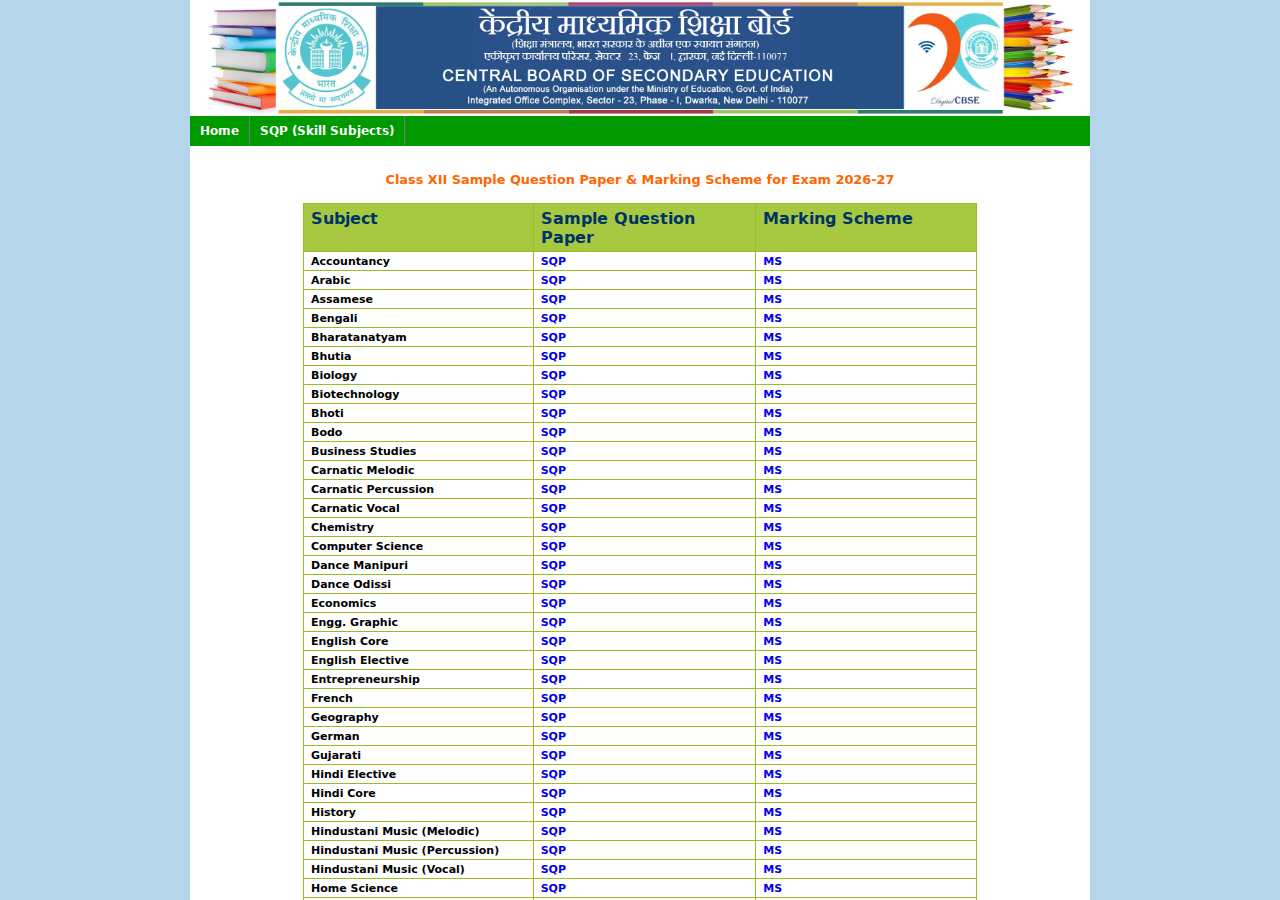
The release aims to help students understand the updated exam pattern, syllabus, and marking scheme for the upcoming academic year. This annual practice by CBSE ensures students are aligned with the latest design of the board examination paper.
Changes in Geography Exam Pattern and Marking Scheme
The Class 12 Geography exam for 2026-27 will have a total of 100 marks, with 70 marks allocated for the theoretical paper and 30 marks for internal assessment. The theoretical paper is further divided into two parts: Fundamentals of Human Geography and India: People and Economy, each carrying 35 marks. Within each part, 30 marks are allotted to core content and 5 marks to map work.
The sample papers are designed according to the latest syllabus, updated exam pattern, and revised marking scheme released by CBSE. Notable changes in this year’s model question papers include an increased focus on competency-based questions, more Multiple Choice Questions (MCQs), and the inclusion of analytical and evaluating-type questions across almost all subjects.
| Section | Marks |
|---|---|
| Theory | 70 |
| Practical Assessment | 30 |
| Total | 100 |
| Unit | Marks |
|---|---|
| Fundamentals of Human Geography | 35 |
| India: People and Economy | 35 |
| Total (Theory) | 70 |
Section-Wise Breakdown of the Geography Paper
The Geography theoretical paper will include various question types across different sections. Section A will comprise 20 Multiple Choice Questions, each carrying 1 mark. Section B will feature Very Short Answer Questions, with 3 questions of value 2 marks each. Section C will consist of Short Answer Questions, with 7 questions worth 3 marks each. Section D will include Long Answer Questions, with 4 questions worth 5 marks each. Section E will be dedicated to Source-based Questions, with 1 question having 3 sub-parts, each worth 1 mark. In addition, 30 marks are allocated for Map Work, involving location marking on outline maps of India and the world.
The overall exam pattern for CBSE Class 12 board exams 2026-27 generally includes 20% MCQs, 30% competency-based questions, and 50% short and long answer questions. This structure aims to provide a complete exam-like experience, covering objective, short answer, long answer, and case-based questions.
| Section | Marks | Description |
|---|---|---|
| Section A: Multiple Choice Questions | 20 | 20 MCQs covering all units with 1 mark each |
| Section B: Very Short Answer Questions | 6 | 3 questions worth 2 marks each |
| Section C: Short Answer Questions | 21 | 7 questions worth 3 marks each |
| Section D: Long Answer Questions | 20 | 4 questions worth 5 marks each |
| Section E: Source-based Questions | 3 | 1 question with 3 sub-parts (1 mark each) |
| Map Work | 30 | Location marking on outline maps of India and the world |
| Component | Weightage | Description |
|---|---|---|
| MCQs | 20% | Objective-type questions including single correct answers |
| Competency-Based Questions | 30% | Case-based, source-based, assertion-reason, and application-based questions |
| Short & Long Answer Questions | 50% | Descriptive type questions testing conceptual clarity and explanation |
Guidance for Student Preparation
To prepare effectively for the 2026-27 board exams, students are advised to download the official PDF with solutions from the CBSE Academic Website. It is recommended that students practice in timed conditions, particularly for map work and lengthy descriptive answers. Focusing on proper presentation, including neat diagrams, maps, and organised point-wise answers, is also suggested.
Students should refer to marking schemes to understand the expected level of detail in explanations and case study requirements. Mastering all units systematically will ensure balanced preparation across Human Geography concepts and India-specific topics. Practicing map accuracy using proper location marking techniques and clear labelling is crucial. In addition, using sample papers to strengthen analytical skills, by interpreting geographical data and explaining cause-effect relationships, is encouraged. Model papers, which are full-syllabus question papers designed to closely match actual exam papers in difficulty and question types, are also available.
Further reading

📰 More Education News
- OPJS University: Apply for MBA Sales Management 2026, fee 45,000 INRSep 24, 2026 • Nishit Kumar
- B.Pharma admissions 2026-27: Pay Shirpur college fees by DDSep 24, 2026 • Nishit Kumar
- MCA in Data Science and Machine Learning: Delhi NCR 2026 admissions and feesSep 24, 2026 • Nishit Kumar
- CBSE Class 12 Mathematics sample paper 2026-27 released: new exam pattern detailsSep 24, 2026 • Nishit Kumar