MAH MCA CET 2027 syllabus, exam pattern released; exam on March 27
In short
- The State CET Cell, Maharashtra, released the official MAH MCA CET 2027 syllabus and exam pattern on cetcell.mahacet.org.
- The MAH MCA CET 2027 exam is scheduled to be conducted on Saturday, March 27, 2027.
- The examination will be a 200-mark computer-based test with 100 multiple-choice questions.
- There will be no negative marking for incorrect answers in the MAH MCA CET 2027.
- The syllabus and exam pattern remain unchanged from the 2026 session.
The State CET Cell, Maharashtra, has released the official syllabus and exam pattern for the MAH MCA CET 2027, the entrance examination for admission into first-year Master of Computer Applications (MCA) programs across government, aided, and private institutes in Maharashtra. The details were published on the official portal, cetcell.mahacet.org.
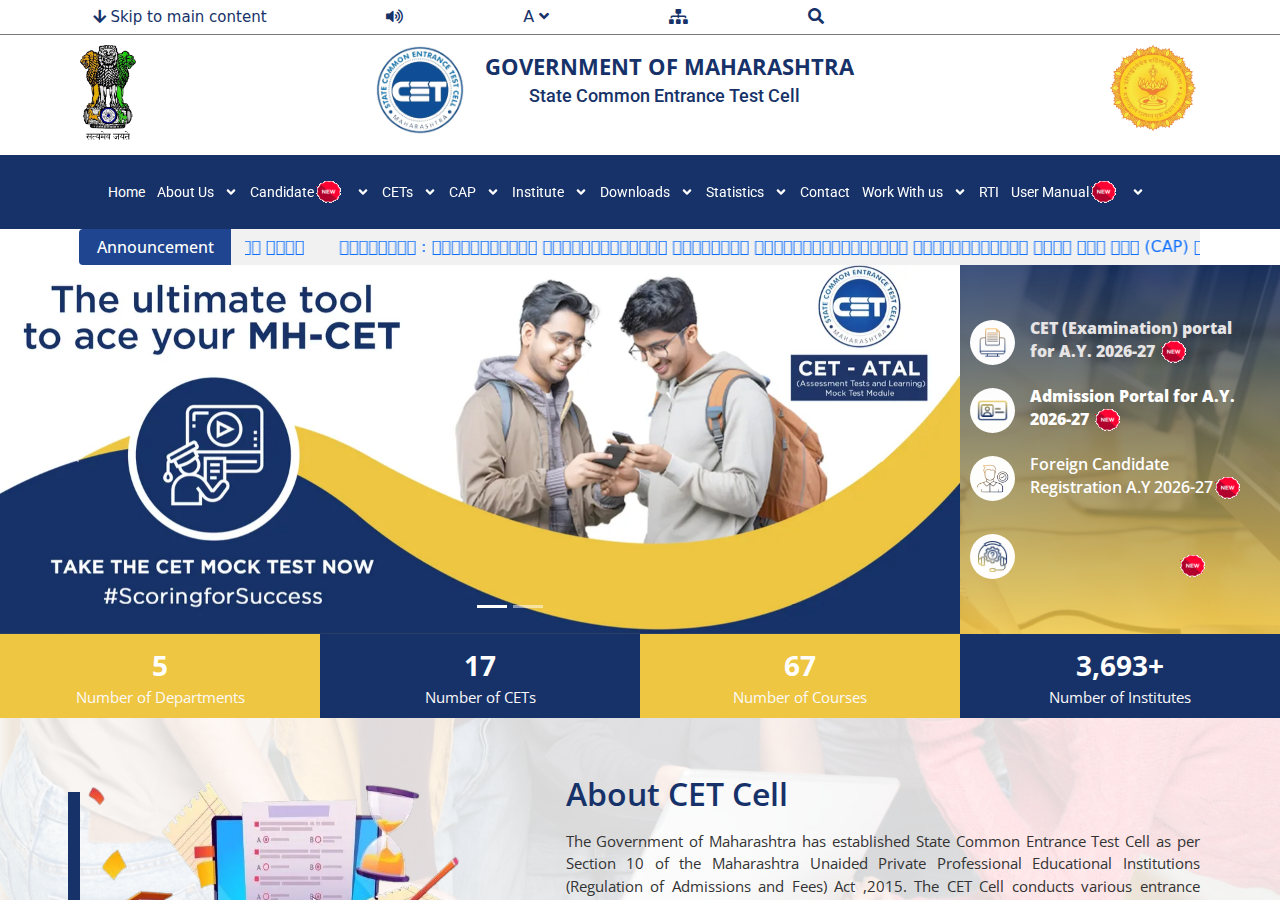
The MAH MCA CET 2027 exam is scheduled to be held on Saturday, March 27, 2027. The examination authority has confirmed that the structure and syllabus for the 2027 session are identical to those of the 2026 session, with no additions or deletions.
MAH MCA CET 2027 Exam Structure and Marking
The MAH MCA CET 2027 will be conducted as a computer-based test (CBT) with a total of 200 marks. The examination will consist of 100 multiple-choice questions, to be completed within a duration of 90 minutes. Candidates will be awarded +2 marks for every correct response, and notably, there will be no negative marking for incorrect answers.
The examination is divided into four core sections: Mathematics & Statistics, Logical / Abstract Reasoning, English Comprehension and Verbal Ability, and Computer Concepts. This structure mirrors the previous year’s pattern, providing continuity for aspirants.
| Particulars | Details |
|---|---|
| Total Marks and Duration | 200 marks across a 90-minute composite window |
| Marking Scheme | +2 marks for every correct response; no negative marking for incorrect answers |
| Core Sections | 4 sections: Mathematics & Statistics, Logical / Abstract Reasoning, English Comprehension and Verbal Ability, and Computer Concepts |
Detailed Syllabus for Mathematics & Statistics Section
The Mathematics & Statistics section will feature questions based on high school mathematics up to the Class 12 standard. The syllabus for this section is complete, encompassing various topics including Algebra, Co-ordinate Geometry, Differential Equations, Trigonometry, Probability and Statistics, and Arithmetic, Set Theory & Mensuration.
Specific sub-topics within Algebra include fundamental operations, quadratic equations, logarithms, and progressions. Co-ordinate Geometry covers equations of lines, circles, and conic sections. Differential Equations will test knowledge of first-order equations, while Trigonometry includes identities and properties of triangles. Probability and Statistics involves basic concepts, distributions, and correlation. Arithmetic, Set Theory & Mensuration includes ratios, percentages, and geometric calculations.
| Unit | Sub-Topics Covered |
|---|---|
| Algebra | Fundamental operations, expansion, factorization, quadratic equations, indices, logarithms, arithmetic, geometric, and harmonic progressions, binomial theorem, and permutations and combinations |
| Co-ordinate Geometry | Rectangular Cartesian co-ordinates, equations of a line, midpoint, intersections, equations of a circle, distance formulae, pair of straight lines, parabola, ellipse, hyperbola, and basic geometric transformations (translation, rotation, scaling) |
| Differential Equations | First-order differential equations and their solutions, linear differential equations with constant coefficients, and homogeneous linear differential equations |
| Trigonometry | Simple identities, trigonometric equations, properties and solutions of triangles, height and distance, and inverse functions |
| Probability and Statistics | Basic probability concepts, averages, dependent and independent events, frequency distributions, measures of dispersion, skewness and kurtosis, random variables and distribution functions, mathematical expectations, binomial, Poisson, and normal distributions, curve fitting, principle of least squares, and correlation and regression |
| Arithmetic, Set Theory & Mensuration | Ratios and proportions, time-work, distance-speed, percentages, sets, relations, mappings, areas of triangles, quadrilaterals, and circles, as well as volumes and surface areas of cubes, spheres, cylinders, and cones |
Further reading

📰 More Education News
- GUJCET 2027: Apply in December; exam expected after March 19Nov 18, 2026 • Nishit Kumar
- TOSS SSC and Inter supplementary results out; check by 30 NovemberNov 18, 2026 • Nishit Kumar
- Telangana NEET PG 2026 Phase 1 allotment released: report to colleges by November 19Nov 18, 2026 • Nishit Kumar
- AP NEET PG 2026 phase 1 management quota allotment released: report by November 20Nov 18, 2026 • Nishit Kumar