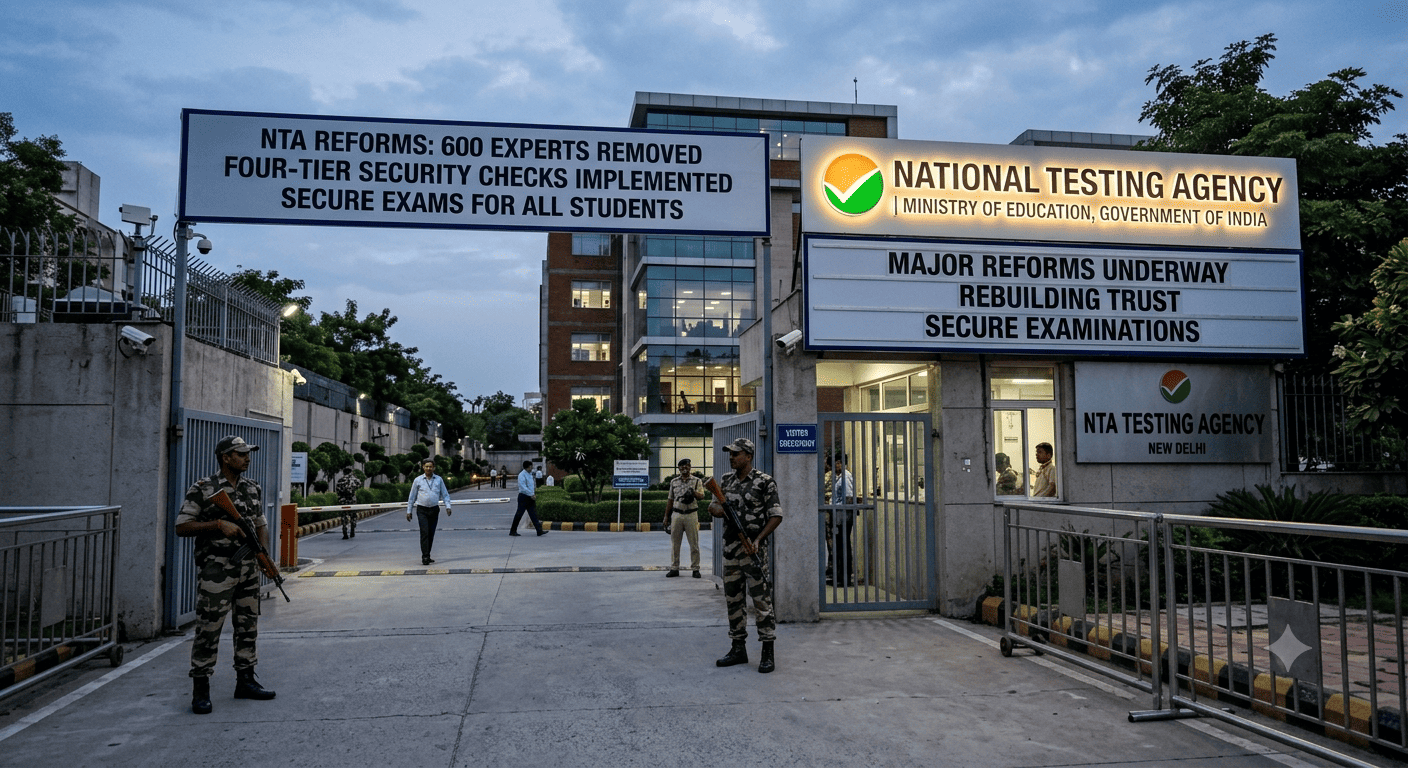
Massive Overhaul at NTA: 600 Experts Removed, Four-Tier Security Introduced to Restore Exam Integrity
In a major effort to rebuild public trust following paper leaks and exam errors, the Ministry of Education has launched a sweeping overhaul of the National Testing Agency (NTA).
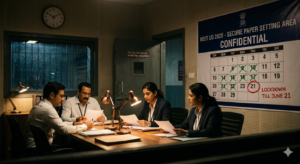
The government has removed 600 subject experts, introduced a strict four-tier question paper review system, and ordered NTA operations to move to a high-security facility guarded by armed paramilitary forces.
The decisions were taken during review meetings chaired by Union Education Minister Pralhad Joshi. The minister instructed officials to complete all security upgrades on a “war footing” to ensure future entrance and eligibility exams are completely error-free.
Massive Clean-Up of Exam Committees and Staff
The most significant action in this restructuring is the immediate removal of 600 subject experts involved in setting and reviewing question papers. Fresh specialists from top academic backgrounds and private-sector fields like cybersecurity, psychometrics, and test design are being brought in to replace them.
This decision comes after serious defects were found in national exams. Most recently, major factual, typographical, and translation errors in UGC-NET subjects—specifically English, Commerce, and Sociology—forced the NTA to cancel those papers and schedule fresh tests for thousands of candidates.
Beyond removing subject experts, the ministry confirmed that over 50 internal NTA staff members have been removed. To rebuild the core workforce, 20 to 25 new permanent officials will be inducted within weeks, alongside 10 new senior leaders, including a Chief Technology Officer, Chief Finance Officer, and General Manager for Test Security.
How the Four-Tier Checking System Works?
To catch mistakes before papers reach candidates, the NTA is introducing a mandatory four-tier scrutiny mechanism. Every question paper will pass through four separate levels of verification:
-
Academic Scrutiny: Verifying subject facts, conceptual correctness, and syllabus alignment.
-
Technical & Language Check: Correcting grammar, formatting, and typography errors.
-
Translation Audit: Ensuring accurate translation across regional languages without altering the question’s meaning.
-
Final Integrity Review: Checking for repeated questions, vague options, or ambiguous wording to ensure zero errors.
High-Security Offices Guarded by CISF
The physical and digital infrastructure surrounding test creation is getting a complete upgrade. The NTA is shifting its operations from its current office in Okhla to central Delhi.
To guarantee physical safety, the Central Industrial Security Force (CISF)—a armed paramilitary force—will manage perimeter security at the new facilities.
The government has also ordered a complete revamp of the agency’s Confidential Operations (CONOPS) architecture:
-
Secluded Workstations: Paper creation will occur inside isolated, restricted-access rooms.
-
Air-Gapped Systems: Computers used to set question papers will be completely disconnected from the internet and external networks to prevent remote hacking or leaks.
-
Strict Device Protocols: Staff and experts must hand over all personal electronic devices, including phones and smartwatches, before entering confidential zones.
Wider Context and Government Audit
The NTA conducts some of India’s largest exams, affecting millions of students every year. These reforms build on earlier structural changes, including the government setting up a high-powered task force led by Infosys co-founder Nandan Nilekani to recommend long-term examination reforms.
Education Minister Pralhad Joshi has ordered a comprehensive audit of all NTA processes and given the agency a 30-day deadline to submit a corrective action report. These decisive measures aim to eliminate paper leaks, prevent exam cancellations, and give students complete confidence in the national testing system


📰 More Education News
- IIT Delhi opens registration for Executive Programme for AI in Healthcare; apply by 10 December 2026Oct 6, 2026 • Nishit Kumar
- CSEET October 2026 examination ongoing: ICSI to release subject-wise question papersOct 6, 2026 • Nishit Kumar
- PSSSB Craft Instructor exam 2026 postponed: high court stays recruitment processOct 5, 2026 • Nishit Kumar
- NEET UG 2026 Round 2 vacancy list out: Puducherry publishes MBBS, BDS, BAMS seatsOct 5, 2026 • Nishit Kumar