
Syllabus for M.Sc Biochemistry: Semester Wise Subjects & Core Topics
Nishit Kumar is a senior EdTech industry leader with over a decade of experience in building and scaling education platforms, shaping their product, content, and growth strategy. At…
- 27 Oct 2026NTA releases CUET PG 2027 exam dates
National Testing Agency announced CUET PG 2027 exam schedule for postgraduate admissions across central and state universities. - 1 Oct 2026LPUNEST 2027 registration ongoing
Application forms for LPUNEST 2027 PG admissions are active till January 15, 2027.
The syllabus for msc biochemistry is structured across a 2-year postgraduate program divided into 4 semesters that covers core topics including Cell Biology, Enzymology, Bioenergetics, Molecular Biology, Plant and Clinical Biochemistry. The course combines theoretical lectures with bioanalytical laboratory practicals, seminar sessions, and a mandatory final-semester research project.
Over 270 educational institutes across India offer this program. Below is a detailed breakdown of semester-wise core subjects, electives, practical modules, entrance exam patterns, top colleges with fee structures, career options, and admission steps for 2026.
| Parameter | Details |
|---|---|
| Course Duration | 2 Years (4 Semesters) |
| Minimum Eligibility | B.Sc degree in Biochemistry, Chemistry, Microbiology, or related life science with minimum 50% aggregate ( relaxation of 5-10% for reserved categories) |
| Average Course Fee | INR 50,000 to INR 3,00,000 (for total duration) |
| Key Entrance Exams | CUET PG, JET, NEET PG, LPUNEST |
M.Sc Biochemistry Subjects Year-wise
- First Year: Focuses on foundational subjects including Cell Biology, Biomolecules, Bioenergetics, Bioanalytical Techniques, Immunology, and Plant Biochemistry.
- Second Year: Covers advanced domains such as Molecular Biology II, Clinical Biochemistry, Neurobiochemistry, Bioinformatics, Biostatistics, and practical project work.
First-year M.Sc Biochemistry focuses on foundational subjects like Cell Biology, Biomolecules, Bioenergetics, and Bioanalytical Techniques. Second-year M.Sc Biochemistry covers advanced domains like Molecular Biology II, Clinical Biochemistry, Neurobiochemistry, Bioinformatics, and practical project work.
M.Sc Biochemistry Electives and Specialisations
- Clinical Biochemistry: Covers diagnostic enzymes, inborn errors of metabolism, and disorders of carbohydrate metabolism, lipids, liver, and kidneys.
- Plant Biochemistry: Covers electron transport systems in plants, nitrate assimilation, photosynthesis, toxins of plant origin, and stress metabolism in plants.
- Outlines of Biotechnology: Elective subject covering plant genetic engineering, tissue culture, transgenic plants and animals, fermentation technology, and hybridoma technology.
M.Sc in Biochemistry offers specializations in areas like Food, agriculture, Engineering, Animal, and Plant. The program integrates applied chemistry and biology to study cellular and molecular processes in living organisms.
M.Sc Biochemistry Practicals and Projects
- Semester I Practical: Bio-Organic Preparations & Analytical Biochemistry Lab.
- Semester III Practical: Clinical & Biochemical Preparations Lab, Seminar Sessions.
- Semester IV Practical & Project: Enzymology Technology Lab, Project Report Work & Viva-Voce.
Practical lab modules run alongside theoretical coursework throughout the two-year program. The curriculum culminates in specialized laboratory work and a project report with viva-voce evaluation in the final semester.
CUET PG and Entrance Exam Syllabus for M.Sc Biochemistry
| Unit Number | Unit Name | Core Topics Covered |
|---|---|---|
| Unit 1 | Introduction to Biochemistry | Role of biomolecules, molarity, osmotic pressure, water properties, photochemistry laws |
| Unit 2 | Bioorganic Chemistry & Metabolites | Chemical bonding, IUPAC nomenclature, stereochemistry, organic reaction mechanisms |
| Unit 3 | Cell Biology | Subcellular organelles, cell cycle, cytoskeleton, extracellular matrix, cell death |
| Unit 4 | Biochemical Techniques | Chromatography, Centrifugation, Electrophoresis, Spectrophotometry, ELISA |
| Unit 5 | Biomolecules | Properties of carbohydrates, proteins, lipids, DNA, RNA; fermentation |
| Unit 6 | Nutrition | Glycemic index, balanced diet, micronutrient deficiencies, nutraceuticals, specialized food |
| Unit 7 | Metabolism | TCA cycle, electron transport chain, ATP synthesis, metabolic engineering |
The CUET PG Biochemistry entrance exam consists of 75 subject-specific multiple-choice questions with a total duration of 90 minutes. Correct answers award +4 marks, while incorrect answers deduct 1 mark.
Career Options, Job Profiles, and Salary Scope After M.Sc Biochemistry
| Job Profile | Average Salary |
|---|---|
| Research Associate | Rs. 4.7 LPA |
| Lab Technician | Rs. 2.8 LPA |
| Pharmacologist | Rs. 3.7 LPA |
| Biochemist | Rs. 2.7 LPA |
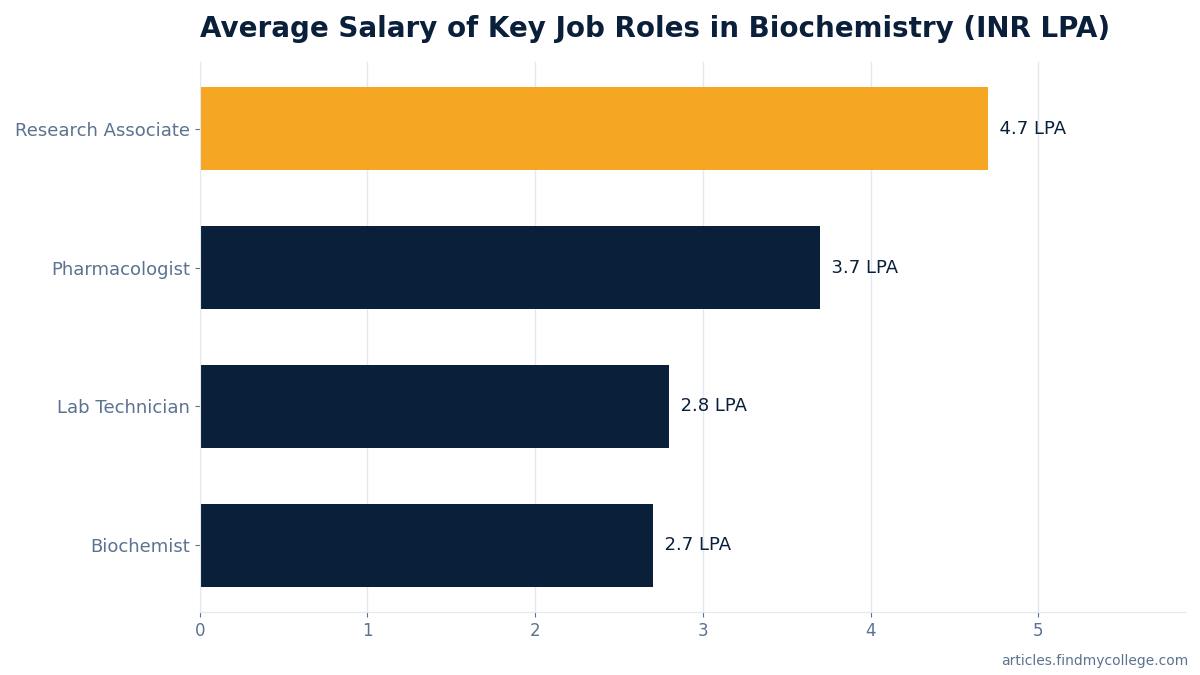
Top recruiters for M.Sc Biochemistry graduates include Cipla, Biocon, Ranbaxy, Dr. Reddy’s Laboratories, GlaxoSmithKline, and Wockhardt. Across 18 colleges, the median average placement package is 2.88 LPA.
How to Apply for M.Sc Biochemistry Admission in 2026: Step by Step
- Check Eligibility Criteria: Hold a bachelor’s degree in biochemistry, microbiology, chemistry, biology, or a related discipline with a minimum of 50% aggregate marks (5–10% relaxation for reserved categories).
- Register for Entrance Examination: Apply online for applicable entrance tests such as JET, NEET PG, or CUET PG based on university requirements.
- Submit Application Form: Fill out the application on the official university portal with personal details, contact information, educational qualifications, identity proofs, and signatures, and pay the application fee.
- Appear for Entrance Exam: Attempt the computer-based entrance test, such as the 90-minute CUET PG exam consisting of 75 compulsory subject-specific multiple-choice questions.
- Merit List & Seat Allotment: Await the publication of the merit list prepared by universities based on entrance exam scores to receive college allotments.
| What to do | Where | Link |
|---|---|---|
| Compare colleges, fees and cutoffs | M.Sc Biochemistry colleges in India | findmycollege.com |
Admissions across Indian universities are granted based on merit lists derived from entrance examination scores. Candidates must submit complete details on official portals and pay required fees to complete the process.
FAQs
How many years is a master’s in biochemistry?
Master of Science (M.Sc) in Biochemistry is a 2-year postgraduate program divided into 4 semesters. Candidates must hold a relevant bachelor’s degree with at least 50% aggregate marks to be eligible.
Is an MSc biochemistry a good career in India?
Yes, M.Sc Biochemistry offers strong career potential across pharmaceutical firms, research institutes, diagnostic labs, and biotech firms. Graduates secure roles like Research Associate, Biochemist, and Pharmacologist, with top recruiters including Cipla, Biocon, and Dr. Reddy’s Laboratories.
What subjects are taught in M.Sc Biochemistry 1st year?
First-year subjects include Cell Biology and Physiology, Biomolecules and Microbial Biochemistry, Bioanalytical Techniques, Bioenergetics and Intermediary Metabolism, Molecular Biology I, Nutritional & Clinical Biochemistry, and Plant Biochemistry.
What is the exam pattern for the CUET PG Biochemistry paper?
The CUET PG Biochemistry exam is a 90-minute computer-based test consisting of 75 compulsory subject-specific multiple-choice questions (MCQs). Each correct answer awards +4 marks, while incorrect answers deduct 1 mark.