Amity University Online Launches Second Edition of AONSAT 2026, Offers Scholarships up to 100% for Online Learners
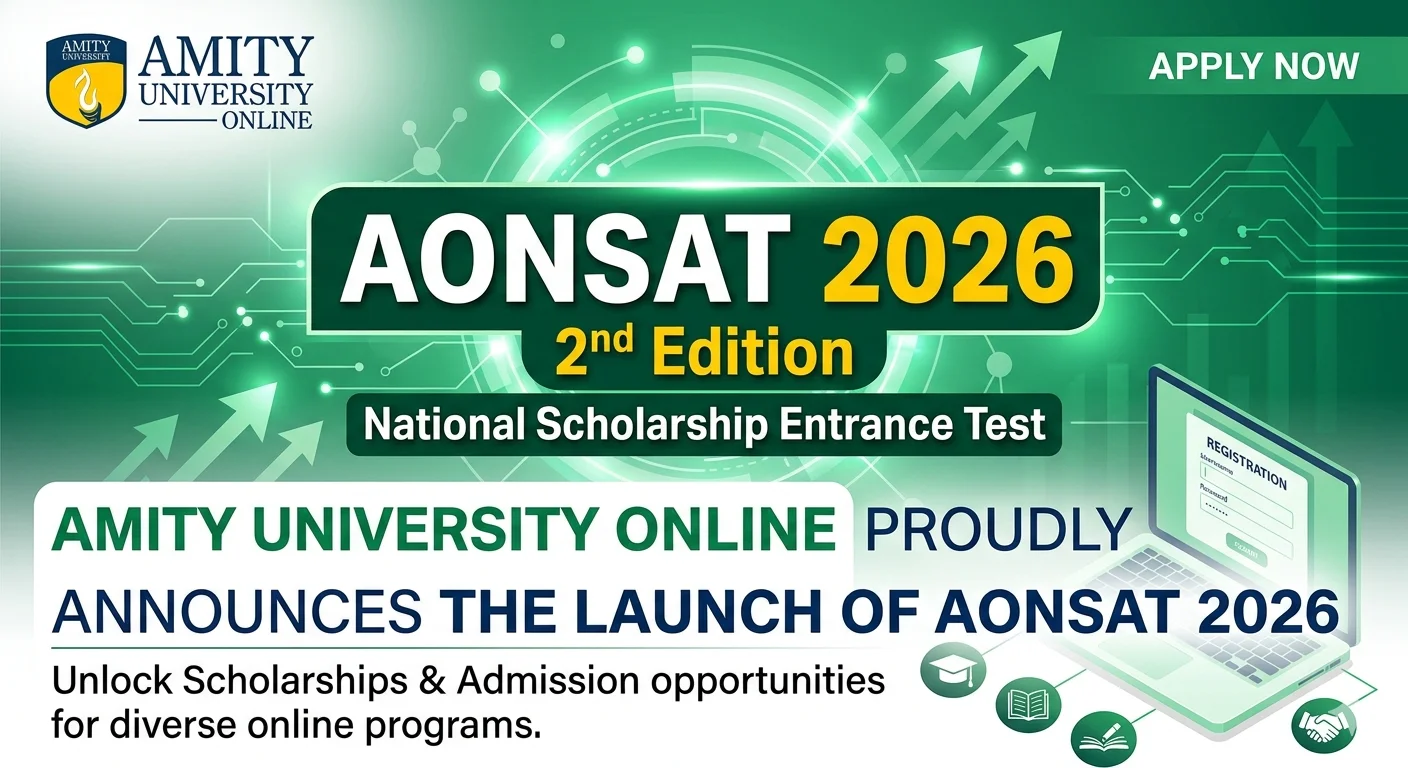
Amity University Online has announced the launch of the second edition of the Amity Online National Scholarship Aptitude Test (AONSAT) 2026, a scholarship-based entrance initiative aimed at supporting students seeking admission to online undergraduate and postgraduate programmes.
The initiative is designed to identify talented learners across the country and provide financial assistance through merit-based scholarships. The latest edition of AONSAT is expected to further strengthen access to quality online higher education by rewarding academic potential and aptitude.
The scholarship test has gained attention among students looking for flexible learning opportunities and affordable degree programmes. With the growing demand for online education, AONSAT has emerged as an important pathway for students who wish to pursue recognised online degrees while reducing their educational expenses through scholarships.
What is AONSAT 2026?
AONSAT stands for Amity Online National Scholarship Aptitude Test. It is a national-level aptitude examination conducted by Amity University Online to award scholarships to deserving students applying for various online degree programmes. The test is completely online and can be taken from home through a proctored examination system.
The university introduced the scholarship test to encourage students from different academic backgrounds to pursue higher education without worrying about financial barriers. Through this initiative, students can compete for substantial fee waivers based on their performance in the examination.
According to information released by the university, the examination follows a structured aptitude-based format that evaluates logical reasoning, quantitative aptitude, verbal ability, and analytical skills. The objective is to assess a candidate’s overall aptitude rather than subject-specific knowledge.
Scholarship Benefits Under AONSAT 2026
One of the major highlights of AONSAT 2026 is its scholarship structure. Students who perform exceptionally well in the examination can receive significant tuition fee benefits.
The scholarship scheme includes:
- Rank 1 holders in both undergraduate and postgraduate categories receive a 100% scholarship on programme fees.
- Rank 2 achievers receive a 50% scholarship.
- Rank 3 achievers receive a 20% scholarship.
- Candidates who qualify and score above the required benchmark can receive up to a 25% scholarship on first-semester fees.
This structure ensures that not only top rankers but also a larger pool of students can benefit from financial assistance. The university believes this approach will help make higher education more accessible and inclusive.
A Step Towards Affordable Online Education
The second edition of AONSAT comes at a time when online education continues to witness rapid growth across India. Students are increasingly choosing flexible learning options that allow them to study from anywhere while balancing personal and professional commitments.
Amity University Online has stated that the scholarship programme is aimed at reducing financial constraints and creating equal opportunities for learners from different regions of the country. The university hopes that more students will be encouraged to pursue recognised online degree programmes through this initiative.
The scholarship examination also supports the larger objective of expanding access to quality higher education through technology-enabled learning platforms.
Examination Mode and Pattern
The AONSAT 2026 examination is conducted entirely online. Students can appear for the test from their homes using a stable internet connection and a compatible device. The examination follows an online proctored format to ensure fairness and transparency.
Some key details of the examination include:
- Online proctored mode
- Duration of 45 minutes
- Around 30 aptitude-based questions
- Free registration process
- Multiple test slots available for candidates
The examination has been designed to be accessible and student-friendly while maintaining academic standards.
Eligibility Criteria for Students
The scholarship test is open to students applying for both undergraduate and postgraduate online programmes offered by Amity University Online.
For undergraduate courses, candidates should have completed or be appearing in Class 12 examinations from a recognised board. For postgraduate programmes, graduates from recognised institutions are eligible to participate in the scholarship test.
The university has kept the eligibility criteria broad so that a large number of learners can benefit from the scholarship opportunity.
Programmes Covered Under AONSAT
AONSAT scholarships are applicable across several online degree programmes offered by Amity University Online. Students from various academic streams can apply and compete for scholarship benefits.
Some of the programmes covered include:
Undergraduate Programmes
- Bachelor of Business Administration (BBA)
- Bachelor of Computer Applications (BCA)
- Bachelor of Commerce (BCom)
- Bachelor of Arts (BA)
Postgraduate Programmes
- Master of Business Administration (MBA)
- Master of Computer Applications (MCA)
- Master of Commerce (MCom)
- Master of Arts (MA)
Additional specialised online programmes offered by the university may also be included under the scholarship framework.
Registration Process
The registration process for AONSAT 2026 has been kept simple and fully online. Interested candidates need to visit the official AONSAT portal, select their preferred programme, fill out the application form, and book an examination slot.
The major steps include:
- Visit the official AONSAT registration portal.
- Select the desired UG or PG programme.
- Complete the online application form.
- Upload required details and documents.
- Choose a suitable test slot.
- Confirm registration and prepare for the examination.
The registration process is free of cost, allowing students to participate without any application fee burden.
Why Students Should Consider AONSAT
AONSAT offers several advantages to students planning to pursue online higher education. Beyond scholarship opportunities, the test provides learners with a chance to access recognised online degree programmes at reduced costs.
Key benefits include:
- Opportunity to earn up to 100% scholarship.
- Guaranteed fee benefits for eligible performers.
- Fully online and home-based examination.
- No registration fee.
- Transparent evaluation system.
- Access to recognised online degree programmes.
- Flexible learning opportunities after admission.
The university believes that such initiatives can play a crucial role in helping students achieve their academic goals while reducing financial challenges.
Growing Importance of Scholarship-Based Online Learning
The launch of the second edition of AONSAT reflects a broader trend in higher education where institutions are increasingly using scholarship-driven models to attract talented students. As online education becomes more mainstream, affordability remains a key concern for many learners.
By combining merit-based scholarships with flexible online learning, Amity University Online aims to create a more accessible education ecosystem. The university expects strong participation from students across India and abroad who are looking for quality online education at an affordable cost.
With scholarships, online accessibility, and a straightforward examination process, AONSAT 2026 is expected to become an important opportunity for students planning their higher education journey in the coming academic cycle.

📰 More Education News
- RSSB LDC result 2026 and cut off marks released for 10,644 postsSep 28, 2026 • Nishit Kumar
- TN NEET MDS 2026 round 2 allotment out: report by September 30Sep 28, 2026 • Nishit Kumar
- TS DOST special spot round counselling 2026 begins: apply by September 29Sep 28, 2026 • Nishit Kumar
- NEET UG 2026 mop-up round registration begins for MP MBBS, BDS seats; choice filling from October 4Sep 28, 2026 • Nishit Kumar