BBA vs BCA: Management or Tech, Which Pays Better in 2026?
Nishit Kumar is a senior EdTech industry leader with over a decade of experience in building and scaling education platforms, shaping their product, content, and growth strategy. At…
Admission alerts for this course will appear here as official notifications are published.
Deciding between a Bachelor of Business Administration (BBA) and a Bachelor of Computer Applications (BCA) is a pivotal choice for Indian students eyeing their career trajectory in 2026. While BBA is ideal for those aspiring to leadership roles in business and management, BCA is the clear path for individuals passionate about technology, software development, and IT. Both degrees offer distinct advantages, but their earning potential and career progression diverge significantly based on industry demand and individual skill development.
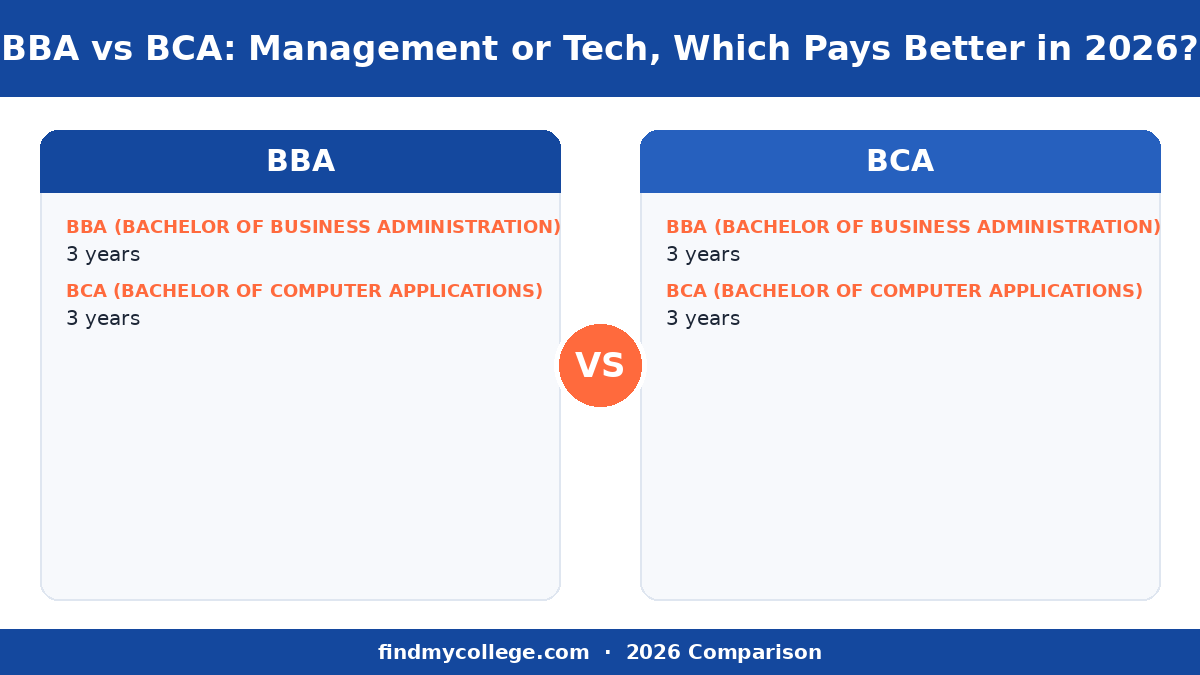
BBA vs BCA: Quick Comparison (2026)
| BBA (Bachelor of Business Administration) | BCA (Bachelor of Computer Applications) | |
|---|---|---|
| Duration | 3 years | 3 years |
| Eligibility | 10+2 from any stream (some colleges prefer Commerce/Maths) | 10+2 from any stream (some colleges require Maths/Computer Science) |
| Admission / Entrance | Merit-based or entrance exams like CUET, SET, IPMAT (for integrated BBA+MBA) | Merit-based or entrance exams like IPU CET, SET, NIMCET (for MCA) |
| Avg Fees (range) | ₹1,00,000 – ₹6,00,000 per annum | ₹80,000 – ₹4,00,000 per annum |
| Top Careers | Marketing Executive, HR Manager, Financial Analyst, Operations Manager, Business Development Executive | Software Developer, Web Developer, Database Administrator, System Analyst, Network Engineer, Data Analyst |
| Avg Starting Salary | ₹3,00,000 – ₹6,00,000 per annum | ₹3,50,000 – ₹7,00,000 per annum |
| Best For | Aspiring managers, entrepreneurs, those interested in business strategy and people management. | Tech enthusiasts, problem-solvers, those interested in coding, software, and IT infrastructure. |
Curriculum & Focus
BBA programs focus on developing a broad understanding of business functions, including marketing, finance, human resources, and operations. The curriculum emphasizes management principles, communication skills, and strategic thinking, preparing students for diverse roles across industries. In contrast, BCA is heavily geared towards technical skills, covering programming languages (Python, Java, C++), data structures, algorithms, database management, and web development. It’s a hands-on degree for those who enjoy building and troubleshooting. Verdict: BBA for business acumen, BCA for technical expertise.
Difficulty & Workload
The perceived difficulty of BBA often lies in its theoretical depth and case study analysis, requiring strong analytical and communication skills. While not as mathematically intensive as some engineering degrees, it demands consistent engagement with business concepts. BCA, on the other hand, is known for its practical, project-heavy nature, especially in coding and application development. Students without a strong aptitude for mathematics or logical problem-solving might find BCA challenging. Verdict: BBA for conceptual understanding, BCA for practical application and logical reasoning.
Fees & ROI
Generally, BBA programs, especially from top-tier private institutions, can have higher annual fees compared to BCA. However, the Return on Investment (ROI) for both degrees is heavily dependent on the college’s reputation, the student’s performance, and subsequent higher education. A BCA from a reputable institution followed by an MCA or specialized certifications often yields a higher starting salary and faster career growth in the booming tech sector. For BBA, an MBA is almost a prerequisite for significant career advancement and higher pay scales. Verdict: BCA often offers better direct ROI, but BBA’s ROI significantly improves with an MBA.
Placements & Salary
In 2026, the tech industry continues its robust growth, leading to strong demand for skilled BCA graduates. Entry-level roles in software development, data analysis, and cybersecurity often command competitive starting salaries, with rapid growth potential. BBA placements, while diverse, typically offer slightly lower starting packages unless from a top-tier college or specialized in high-demand areas like digital marketing or financial analysis. For both, internships and practical experience are crucial. Verdict: BCA generally offers higher starting salaries and better immediate placement prospects in the tech sector.
Higher Studies & Abroad Scope
Both degrees serve as excellent foundations for further education. A BBA naturally leads to an MBA (Master of Business Administration), which is often essential for climbing the corporate ladder and accessing senior management roles, both in India and abroad. BCA graduates typically pursue an MCA (Master of Computer Applications) or specialized Master’s degrees in fields like Data Science, Artificial Intelligence, or Cybersecurity. The global demand for IT professionals makes an MCA or a tech-focused Master’s a strong pathway for international career opportunities. Verdict: Both offer strong higher study options; BBA for MBA, BCA for MCA/tech Master’s.
Government-Job Scope
Both BBA and BCA graduates are eligible for various government jobs that require a bachelor’s degree, such as those offered by UPSC (Civil Services), SSC (Staff Selection Commission), and various state-level examinations. However, neither degree specifically targets government roles. BCA graduates might find specific opportunities in government IT departments or public sector banks’ tech divisions. BBA graduates can apply for administrative, banking, or management trainee positions. Success in government jobs primarily depends on competitive exam performance rather than the specific undergraduate degree. Verdict: Both are eligible, but neither provides a direct advantage; competitive exam performance is key.
What students actually say (community insights)
- Many students express significant confusion between BBA and BCA, often seeking guidance on which path offers better long-term prospects, especially concerning salary and career stability.
- A common sentiment suggests that BBA, particularly from a tier-3 college, might not be as valuable on its own, with many arguing that an MBA becomes almost mandatory to make the degree truly impactful. Some even perceive BBA as a less rigorous academic pursuit compared to other bachelor’s degrees.
- Conversely, BCA is often highlighted as a more practical and skill-oriented degree, especially for those who enjoy hands-on work like coding and app development. There’s a strong belief that a BCA from a decent college can lead to good entry-level tech jobs.
- Concerns are frequently raised about the general perception of both BBA and BCA graduates, with some feeling that these degrees are sometimes undervalued compared to traditional B.Tech or B.Com degrees, particularly regarding campus placements.
- Students with a strong aptitude for mathematics and logical reasoning are often advised towards BCA, while those with an interest in management, sales, or HR are steered towards BBA. However, a fear of mathematics can deter some from pursuing BCA.
- The discussion around pursuing an MBA after either BCA or BBA is prevalent, with many weighing the pros and cons of a BBA-MBA versus a BCA-MBA path, considering how each impacts their future career trajectory and specialization options.
Which one should you choose?
Your choice between BBA and BCA should align with your core interests, aptitudes, and long-term career aspirations.
- Choose BBA if: You are interested in understanding how businesses operate, aspire to leadership or managerial roles, enjoy working with people, have strong communication skills, and are open to pursuing an MBA for career advancement. It’s ideal for future entrepreneurs, marketing professionals, HR specialists, or financial analysts.
- Choose BCA if: You have a passion for technology, enjoy problem-solving, are comfortable with logical reasoning and mathematics, and are keen on a career in software development, IT infrastructure, data science, or cybersecurity. It’s perfect for aspiring coders, web developers, system analysts, or network engineers.
Ultimately, both degrees can lead to successful careers, but the path and required skill sets are distinct. Reflect on your strengths and passions to make an informed decision.
Frequently Asked Questions
Is BBA or BCA more difficult?
Difficulty is subjective. BBA demands strong analytical, communication, and conceptual understanding, while BCA requires logical reasoning, mathematical aptitude, and hands-on coding skills. Students who struggle with abstract concepts might find BBA challenging, while those who dislike coding or mathematics might find BCA difficult.
Can a BBA graduate get a job in the IT sector?
While a BBA doesn’t directly qualify you for technical IT roles, graduates can find positions in IT companies in non-technical capacities such as IT sales, digital marketing, HR, project management, or business analysis, especially if they gain relevant certifications or pursue an MBA with an IT specialization.
Can a BCA graduate pursue an MBA?
Yes, a BCA graduate can absolutely pursue an MBA. Many BCA graduates opt for an MBA to combine their technical knowledge with business acumen, opening doors to roles like IT project manager, product manager, or technology consultant. This combination is highly valued in the current market.
Which degree offers better scope for entrepreneurship?
Both degrees offer pathways to entrepreneurship. BBA provides a foundational understanding of business management, marketing, and finance, which is crucial for starting and running a venture. BCA equips you with the technical skills to build a product or service, especially in the tech startup ecosystem. The ‘better’ choice depends on whether your entrepreneurial idea is business-centric or tech-product-centric.
Are government jobs easier to get with a BBA or BCA?
Neither degree inherently makes government jobs easier to get. Eligibility for most government positions (like UPSC, SSC) requires any bachelor’s degree. Success depends on performance in competitive examinations. However, BCA graduates might find specific roles in government IT departments, while BBA graduates could target administrative or banking roles.
What if I’m not good at Maths but want to do BCA?
While BCA involves mathematics (discrete mathematics, statistics, algorithms), it’s more about logical problem-solving than advanced calculus. If your interest in coding and technology is strong, you can overcome mathematical challenges with dedicated effort. However, if you have a significant aversion to even basic logical math, BCA might be a struggle.
Is a BBA or BCA degree sufficient for a high-paying job without further studies?
While both can lead to decent entry-level jobs, achieving a ‘high-paying’ job often requires further specialization or higher education. For BBA, an MBA is almost essential for significant salary jumps. For BCA, an MCA, specialized certifications (e.g., in AI, Data Science), or continuous skill upgrades are crucial to stay competitive and command higher salaries in the rapidly evolving tech industry.
Which degree is better for studying abroad?
Both degrees offer good prospects for studying abroad. BBA graduates often pursue an MBA or Master’s in Management, Marketing, or Finance in countries like the USA, Canada, or UK. BCA graduates typically opt for Master’s in Computer Science, Data Science, AI, or Cybersecurity, which are in high demand globally. The ‘better’ option depends on your chosen field of advanced study and career goals.