
B.Sc in Cardiology (India 2026) – Course Overview
Nishit Kumar is a senior EdTech industry leader with over a decade of experience in building and scaling education platforms, shaping their product, content, and growth strategy. At…
Latest update: B.Sc in Cardiology 2026 admissions & dates updated. Read more ›
Welcome to the comprehensive overview of the B.Sc in Cardiology program in India for the academic year 2026. This page is designed to provide prospective students and their parents with a detailed understanding of this vital science stream, covering everything from eligibility criteria and admission processes to career opportunities and financial considerations. A B.Sc in Cardiology is a specialized undergraduate degree focused on the diagnosis, treatment, and prevention of cardiovascular diseases, preparing students for a rewarding career as a cardiac technologist or other allied healthcare professional.
What is B.Sc in Cardiology?
B.Sc in Cardiology is a three-year undergraduate program that trains students in the principles and practices of cardiovascular technology. Graduates learn to assist cardiologists in various diagnostic and interventional procedures, including ECG, echocardiography, stress tests, cardiac catheterization, and pacemaker implantation, playing a crucial role in patient care.
What is the eligibility for B.Sc in Cardiology in India (2026)?
To be eligible for B.Sc in Cardiology in India for the 2026 academic year, candidates must have successfully completed their 10+2 (or equivalent) examination with a science stream, typically including Physics, Chemistry, and Biology (PCB) or Physics, Chemistry, Mathematics (PCM) with Biology as an optional subject. A minimum aggregate score, usually ranging from 45% to 60%, is required, which varies by institution.
- Academic Qualification: 10+2 or equivalent from a recognized board.
- Subjects: Mandatory Physics, Chemistry, and Biology (PCB). Some institutions may consider PCMB.
- Minimum Marks: Generally 45-60% aggregate in the qualifying examination. Reserved categories may have relaxed criteria.
- Age Limit: Some colleges may have a minimum age requirement, typically 17 years as of December 31st of the admission year.
How do I get admission to B.Sc in Cardiology in 2026?
Admission to B.Sc in Cardiology programs in 2026 typically involves either merit-based selection based on 10+2 scores or through entrance examinations conducted by universities or state bodies. The process usually includes application submission, appearing for exams (if applicable), counselling, and document verification.
Admission Process Steps:
- Research & Shortlist: Identify colleges offering B.Sc in Cardiology and check their specific eligibility and admission criteria.
- Application Form: Fill out the online or offline application form, usually available from March to June 2026.
- Entrance Exam (if applicable): Prepare and appear for relevant entrance exams (e.g., NEET, AIIMS Paramedical, state-level exams).
- Merit List/Counselling: Based on 10+2 marks or entrance exam scores, a merit list is published, followed by counselling sessions.
- Document Verification & Fee Payment: Submit required documents and pay the admission fees to secure your seat.
What is the syllabus for B.Sc in Cardiology?
The B.Sc in Cardiology syllabus is designed to provide a strong foundation in human anatomy, physiology, and specialized cardiac procedures. It covers subjects ranging from basic medical sciences to advanced cardiovascular technology, clinical practices, and instrumentation.
Typical B.Sc in Cardiology Syllabus (Semester-wise Example):
| Semester | Key Subjects |
|---|---|
| Year 1 (Sem 1 & 2) | Human Anatomy & Physiology, Biochemistry, Pathology, Microbiology, Fundamentals of Cardiology, Medical Ethics & Patient Care |
| Year 2 (Sem 3 & 4) | Pharmacology, Electrocardiography (ECG), Echocardiography Principles, Cardiac Catheterization Techniques, Cardiac Imaging, Medical Instrumentation |
| Year 3 (Sem 5 & 6) | Advanced Echocardiography, Interventional Cardiology Procedures, Cardiac Electrophysiology, Cardiac Surgery Assistance, Clinical Training & Internship, Research Project |
How much does B.Sc in Cardiology cost in India (2026)?
The cost of pursuing B.Sc in Cardiology in India for 2026 varies significantly between government and private institutions. Government colleges generally have lower fees, ranging from INR 20,000 to INR 1,00,000 per annum, while private colleges can charge between INR 80,000 to INR 3,00,000 or more per annum, depending on their reputation, facilities, and location.
B.Sc in Cardiology Fee Ranges (Annual, 2026):
| Institution Type | Annual Fee Range (INR) | Additional Costs (Approx.) |
|---|---|---|
| Government Colleges | 20,000 – 1,00,000 | Hostel, Exam Fees, Books (10,000-30,000) |
| Private Colleges | 80,000 – 3,00,000+ | Hostel, Exam Fees, Books, Uniform (20,000-70,000) |
Is B.Sc in Cardiology worth it for jobs? What are the career prospects?
Yes, B.Sc in Cardiology is a highly valuable degree with excellent job prospects in India and abroad, driven by the increasing prevalence of cardiovascular diseases and advancements in cardiac care. Graduates can find roles as Cardiac Technologists, Cardiovascular Technicians, Cath Lab Technicians, and Echocardiography Technicians in hospitals, diagnostic centers, and research institutions.
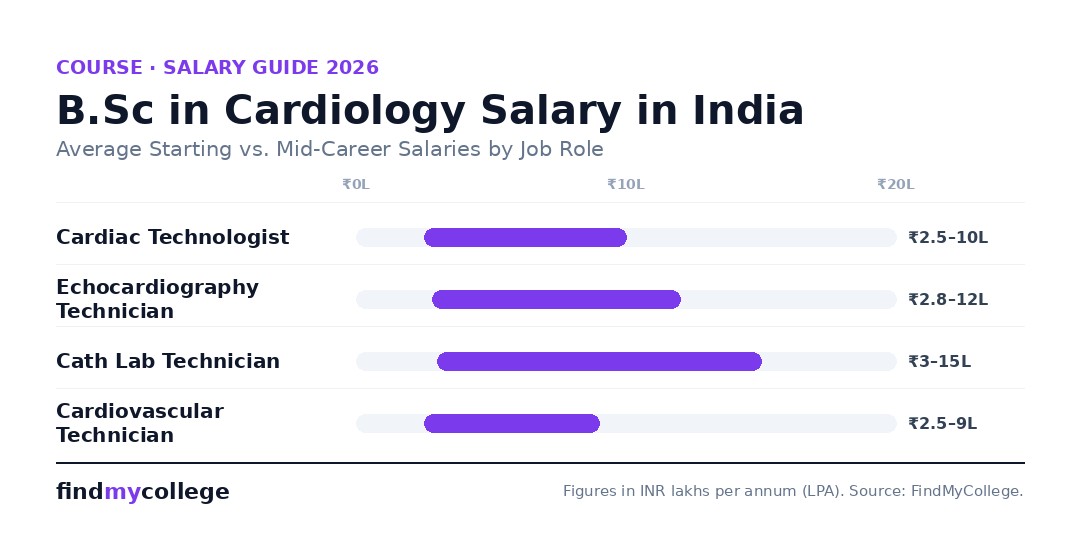
Career Roles & Average Salary Ranges (Annual, India):
| Job Role | Description | Average Starting Salary (INR) | Average Mid-Career Salary (INR) |
|---|---|---|---|
| Cardiac Technologist | Assists cardiologists in diagnostic tests and procedures. | 2.5 – 4.5 Lakhs | 5 – 10 Lakhs+ |
| Echocardiography Technician | Performs ultrasound imaging of the heart. | 2.8 – 5 Lakhs | 6 – 12 Lakhs+ |
| Cath Lab Technician | Assists in cardiac catheterization procedures. | 3 – 5.5 Lakhs | 7 – 15 Lakhs+ |
| Cardiovascular Technician | General role assisting with various cardiac tests. | 2.5 – 4 Lakhs | 4.5 – 9 Lakhs+ |
With experience and further specialization (e.g., M.Sc in Cardiovascular Technology), career growth can lead to supervisory roles, clinical specialists, or even academic positions.
Which are the top colleges for B.Sc in Cardiology in India?
Several reputable institutions across India offer excellent B.Sc in Cardiology programs, known for their strong faculty, clinical exposure, and infrastructure. Some of the top colleges include those affiliated with major medical universities and hospitals.
Some Top Institutions (Illustrative, not exhaustive):
- All India Institute of Medical Sciences (AIIMS), Delhi (offers similar paramedical courses)
- Post Graduate Institute of Medical Education and Research (PGIMER), Chandigarh
- Christian Medical College (CMC), Vellore
- Manipal Academy of Higher Education (MAHE), Manipal
- SRM Institute of Science and Technology, Chennai
- NIMS University, Jaipur
- Jawaharlal Institute of Postgraduate Medical Education and Research (JIPMER), Puducherry
It is recommended to check the specific program offerings and admission criteria for 2026 directly on the respective college websites.
B.Sc in Cardiology vs. other allied health courses: How do they compare?
B.Sc in Cardiology is a highly specialized allied health course, distinct from broader medical degrees or other paramedical programs. While all allied health courses aim to support medical professionals, Cardiology focuses specifically on the cardiovascular system.
Comparison with Related Allied Health Courses:
- B.Sc in Cardiology vs. B.Sc in Medical Lab Technology (MLT): MLT focuses on laboratory analysis of body fluids and tissues, while Cardiology focuses on direct patient care and diagnostic procedures related to the heart.
- B.Sc in Cardiology vs. B.Sc in Radiography: Radiography deals with imaging techniques (X-ray, CT, MRI) across all body parts, whereas Cardiology specializes in cardiac imaging (Echocardiography, Angiography).
- B.Sc in Cardiology vs. B.Sc in Perfusion Technology: Perfusion Technology is even more specialized, focusing on operating heart-lung machines during open-heart surgeries, often requiring a B.Sc in Cardiology or a related field as a prerequisite or a separate specialized degree.
Choosing B.Sc in Cardiology means committing to a specific and in-demand area of healthcare, offering deep expertise in cardiac care.
What are the pros and cons of pursuing B.Sc in Cardiology?
Pursuing a B.Sc in Cardiology offers a rewarding career path with significant advantages, though it also comes with certain challenges.
Pros:
- High Demand: Growing need for skilled cardiac technologists due to increasing heart disease prevalence.
- Specialized Knowledge: Deep expertise in a critical and complex area of medicine.
- Direct Patient Impact: Opportunity to directly contribute to patient diagnosis and treatment.
- Good Salary & Growth: Competitive salaries and clear career progression opportunities.
- Diverse Work Settings: Employment in hospitals, clinics, diagnostic centers, and research facilities.
Cons:
- Intense Curriculum: Requires strong understanding of complex medical concepts.
- High-Stress Environment: Working in critical care settings can be demanding.
- Long Working Hours: May involve irregular shifts and on-call duties.
- Continuous Learning: Need to stay updated with rapidly evolving medical technology and procedures.
- Limited Scope (Specialized): Career path is highly focused on cardiology, less broad than general medical degrees.
Frequently Asked Questions