
Bachelor of Visual Communication Salary in India 2026
Nishit Kumar is a senior EdTech industry leader with over a decade of experience in building and scaling education platforms, shaping their product, content, and growth strategy. At…
Latest update: Bachelor of Visual Communication 2026 admissions & dates updated. Read more ›
The Bachelor of Visual Communication (B.Voc) is an increasingly popular undergraduate degree in India, equipping students with practical skills in design, multimedia, and digital communication. For students and parents considering this path, understanding the potential salary and career prospects in 2026 is crucial. This comprehensive guide delves into the salary landscape, career opportunities, and factors influencing earnings for B.Voc graduates in India.
What is the average salary for a Bachelor of Visual Communication graduate in India?
The average starting salary for a Bachelor of Visual Communication graduate in India typically ranges from INR 2.5 Lakhs to INR 4.5 Lakhs per annum in 2026. This figure can vary significantly based on factors such as the specialization chosen, the skills acquired, the city of employment, the type of organization, and the individual’s portfolio and internship experience.
With 2-5 years of experience, a B.Voc graduate can expect their salary to increase to INR 4.0 Lakhs to INR 7.0 Lakhs per annum. Experienced professionals with a strong portfolio and leadership skills can command salaries upwards of INR 8.0 Lakhs to INR 15.0 Lakhs per annum, especially in senior design, creative director, or project management roles.
What are the top job roles and their salaries after a Bachelor of Visual Communication?
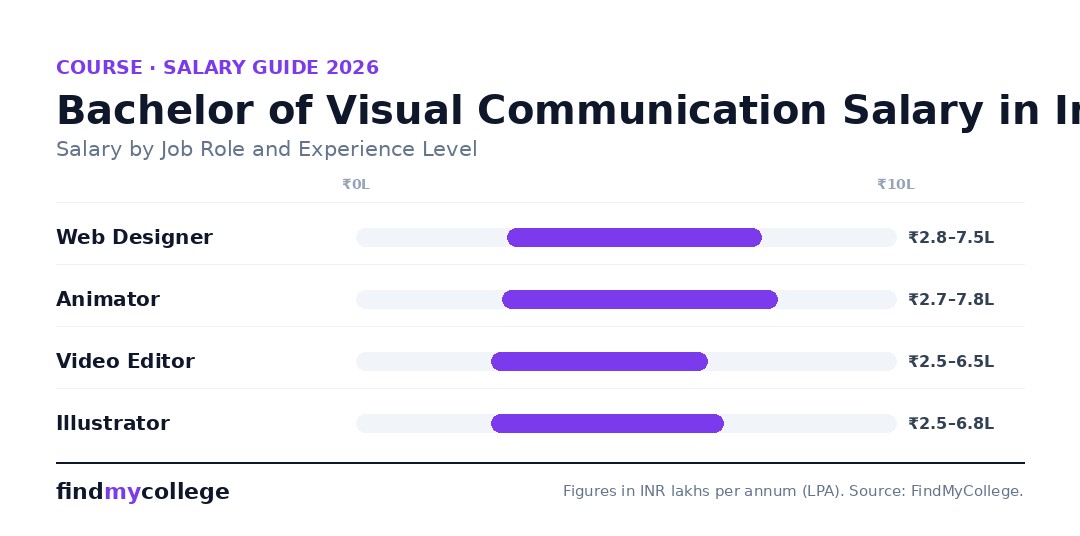
B.Voc in Visual Communication opens doors to a diverse range of creative and technical roles. The salary for each role varies based on industry demand, skill set, and experience. Below is a table outlining common job roles and their expected salary ranges in India for 2026:
| Job Role | Average Starting Salary (INR/annum) | Mid-Career Salary (2-5 years exp.) (INR/annum) |
|---|---|---|
| Graphic Designer | 2.5 – 4.0 Lakhs | 4.0 – 7.0 Lakhs |
| Web Designer | 2.8 – 4.2 Lakhs | 4.5 – 7.5 Lakhs |
| UI/UX Designer | 3.0 – 5.0 Lakhs | 5.0 – 9.0 Lakhs |
| Animator | 2.7 – 4.3 Lakhs | 4.2 – 7.8 Lakhs |
| Video Editor | 2.5 – 4.0 Lakhs | 4.0 – 6.5 Lakhs |
| Content Creator (Visual) | 2.8 – 4.5 Lakhs | 4.5 – 8.0 Lakhs |
| Illustrator | 2.5 – 4.0 Lakhs | 4.0 – 6.8 Lakhs |
| Photographer/Videographer | 2.0 – 3.5 Lakhs | 3.5 – 6.0 Lakhs |
| Digital Marketing Executive (Visual Focus) | 2.8 – 4.5 Lakhs | 4.5 – 7.5 Lakhs |
Which industries offer the best salaries for Visual Communication graduates?
Industries with a strong focus on digital presence, branding, and user experience tend to offer higher salaries for Visual Communication graduates. These include:
- IT & Software Development: Particularly for UI/UX design, front-end development, and product design roles.
- Advertising & Marketing Agencies: For graphic design, digital campaign design, and creative strategy.
- E-commerce & Retail: For website design, app UI, product photography, and digital content creation.
- Media & Entertainment: For animation, video editing, motion graphics, and visual effects.
- Gaming Industry: For character design, environment design, and UI design within games.
- Ed-Tech Companies: For creating engaging visual learning materials and platform interfaces.
How does location impact Bachelor of Visual Communication salaries in India?
Location plays a significant role in determining salary levels for B.Voc graduates. Major metropolitan cities and economic hubs generally offer higher salaries due to a greater concentration of companies, higher cost of living, and increased demand for skilled professionals.
- Tier-1 Cities (e.g., Bangalore, Mumbai, Delhi-NCR, Hyderabad, Pune): These cities typically offer 15-30% higher salaries compared to the national average, especially for roles in IT, advertising, and e-commerce.
- Tier-2 Cities (e.g., Chennai, Kolkata, Ahmedabad, Jaipur, Chandigarh): Salaries in these cities are usually closer to the national average, with good opportunities in local agencies and growing tech sectors.
- Tier-3 Cities & Rural Areas: Salaries tend to be lower, though opportunities might exist in local businesses, educational institutions, or for freelance work.
What factors influence salary growth for B.Voc graduates?
Several factors contribute to salary growth and career progression for Bachelor of Visual Communication graduates:
- Portfolio Quality: A strong, diverse, and professional portfolio showcasing practical skills and creativity is paramount.
- Specialized Skills: Proficiency in niche areas like UI/UX design, motion graphics, 3D animation, AR/VR design, or advanced video editing software (e.g., Adobe After Effects, Cinema 4D) can command higher pay.
- Software Proficiency: Mastery of industry-standard tools (e.g., Adobe Creative Suite – Photoshop, Illustrator, InDesign, XD; Figma, Sketch, Blender, DaVinci Resolve) is essential.
- Communication & Soft Skills: Ability to articulate design concepts, collaborate effectively, and manage client expectations.
- Internship Experience: Relevant internships during the course significantly boost employability and starting salary.
- Continuous Learning: Staying updated with new design trends, technologies, and software is crucial for long-term growth.
- Networking: Building connections within the industry can lead to better job opportunities and freelance projects.
- Higher Education: Pursuing a Master’s degree (e.g., M.Des, MBA in Design Management) can open doors to leadership and strategic roles with significantly higher compensation.
Is Bachelor of Visual Communication worth it for jobs and salary in 2026?
Yes, Bachelor of Visual Communication is increasingly worth it for jobs and salary in 2026, especially given the growing demand for visual content and digital experiences across all industries. The digital transformation has made visual communication an indispensable skill set for businesses of all sizes.
The program’s vocational nature ensures graduates are job-ready with practical skills. While starting salaries might be moderate, the potential for growth is high for those who continuously upskill, build a strong portfolio, and specialize in high-demand areas like UI/UX design or motion graphics. The ability to work across various media and industries also provides significant career flexibility and resilience.
How does a B.Voc in Visual Communication compare to a B.Des or BA in terms of salary?
While all three degrees relate to design and visual arts, their focus and, consequently, their salary potential can differ:
- Bachelor of Visual Communication (B.Voc): Focuses heavily on practical, industry-specific skills and vocational training. Graduates are often ready for immediate entry-level roles. Starting salaries are competitive, with strong growth potential based on skill specialization.
- Bachelor of Design (B.Des): A more comprehensive and theoretical design degree, often offered by premier design institutes (e.g., NID, NIFT). B.Des graduates often command higher starting salaries, especially from top institutions, and are groomed for more strategic or specialized design roles. However, admission is highly competitive.
- Bachelor of Arts (BA) in Visual Arts/Fine Arts: Typically more theoretical and academic, focusing on art history, theory, and traditional art forms. While it provides a strong foundation, BA graduates might need additional vocational training or a strong self-taught portfolio to compete for the same industry roles as B.Voc or B.Des graduates, potentially leading to lower initial salaries in commercial design fields.
In essence, B.Voc offers a practical, job-oriented pathway with good earning potential, while B.Des often provides a more premium entry point, and BA requires more self-directed skill development for commercial roles.
What are the career growth prospects after a Bachelor of Visual Communication?
The career growth prospects for B.Voc Visual Communication graduates are robust and diverse. With experience and continuous learning, individuals can transition into more senior and strategic roles:
- Junior Designer → Senior Designer → Lead Designer → Art Director/Creative Director: This is a common progression in design agencies and corporate creative teams.
- UI/UX Designer → Senior UI/UX Designer → Product Designer → Head of Design: A highly sought-after path in tech companies.
- Animator → Senior Animator → Animation Supervisor → Director of Animation: In animation studios.
- Freelancer → Studio Owner/Entrepreneur: Many B.Voc graduates leverage their skills to start their own design studios, agencies, or work as independent consultants, offering significant earning potential and flexibility.
- Educator: With sufficient industry experience and possibly a Master’s degree, graduates can also pursue teaching positions in design colleges.
Explore more on FindMyCollege
Related pages for Bachelor of Visual Communication aspirants on findmycollege.com:
Frequently Asked Questions
What is the eligibility for Bachelor of Visual Communication?
The basic eligibility for a Bachelor of Visual Communication (B.Voc) is typically passing 10+2 (or equivalent) from a recognized board, often with a minimum aggregate of 45-50%. Some colleges may require specific subjects like English or conduct an entrance exam and/or portfolio review.
How much does a Bachelor of Visual Communication course cost in India?
The course fee for a Bachelor of Visual Communication in India can range from INR 50,000 to INR 2.5 Lakhs per annum for government colleges and INR 1.5 Lakhs to INR 5.0 Lakhs per annum for private institutions. This variation depends on the college’s reputation, facilities, and location.
Are there any entrance exams for Bachelor of Visual Communication?
While many colleges offer direct admission based on 10+2 marks, some reputed institutions, particularly private ones, may conduct their own entrance exams. These exams often assess general aptitude, creative ability, and basic design knowledge. Some may also require a portfolio submission and an interview.
What are the common specializations within Bachelor of Visual Communication?
Common specializations include Graphic Design, Web Design, UI/UX Design, Animation, Multimedia, Photography & Videography, Advertising Design, and Digital Marketing (with a visual focus). Students often choose electives or projects to specialize in their area of interest.
Can I pursue a Master’s degree after Bachelor of Visual Communication?
Yes, after completing a B.Voc in Visual Communication, you can pursue various Master’s degrees such as M.Des (Master of Design), M.A. in Visual Arts, M.A. in Mass Communication, or even an MBA in Design Management, depending on your career aspirations and the specific university’s eligibility criteria.
What kind of companies hire B.Voc Visual Communication graduates?
B.Voc Visual Communication graduates are hired by a wide array of companies including advertising agencies (e.g., Ogilvy, Dentsu), digital marketing firms, IT companies (e.g., TCS, Infosys for UI/UX roles), e-commerce giants (e.g., Amazon, Flipkart), media houses, animation studios (e.g., Technicolor, Prime Focus), publishing houses, and even in-house creative teams of large corporations across various sectors.