B.V.Sc Full Form & Course Guide 2026: Eligibility, Fees, Jobs
Nishit Kumar is a senior EdTech industry leader with over a decade of experience in building and scaling education platforms, shaping their product, content, and growth strategy. At…
Latest update: B.V.Sc 2026 admissions & dates updated. Read more ›
Welcome to the comprehensive guide for students and parents interested in the B.V.Sc Full Form course in India for the 2026 academic year. This page provides an in-depth look at the Bachelor of Veterinary Science and Animal Husbandry program, covering everything from its core definition to career outcomes, helping you make an informed decision about this noble profession.
What is the B.V.Sc Full Form?
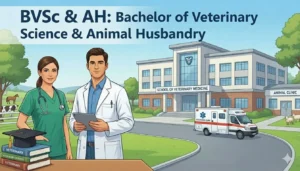
The B.V.Sc Full Form is Bachelor of Veterinary Science and Animal Husbandry. It is an undergraduate academic degree program awarded in the field of veterinary medicine, focusing on the health and welfare of animals, including livestock, poultry, and companion animals.
This professional degree equips students with the knowledge and skills required to diagnose, treat, and prevent diseases in animals, manage animal farms, conduct research, and contribute to public health by ensuring food safety and controlling zoonotic diseases. The curriculum is designed to provide a strong foundation in animal anatomy, physiology, pharmacology, pathology, surgery, medicine, and animal husbandry practices.
What is the eligibility for B.V.Sc in 2026?
To be eligible for B.V.Sc admission in 2026, candidates must have completed their 10+2 (or equivalent) examination with Physics, Chemistry, Biology (PCB) as compulsory subjects, along with English, from a recognized board. A minimum aggregate percentage, typically ranging from 50% to 60%, is required, with some relaxation for reserved categories.
Specific eligibility criteria may vary slightly between colleges and states, but the core requirement remains a strong science background. Age limits are also common, with candidates generally needing to be a minimum of 17 years old as of December 31st of the admission year and a maximum of 25 years (with some relaxation for SC/ST/OBC candidates).
What is the admission process for B.V.Sc in India for 2026?
The admission process for B.V.Sc in India for 2026 primarily involves appearing for a national-level entrance examination, most commonly NEET (National Eligibility cum Entrance Test) UG, followed by counselling conducted by the Veterinary Council of India (VCI) for 15% All India Quota (AIQ) seats and by respective state authorities for the remaining 85% state quota seats.
Key Steps in the B.V.Sc Admission Process:
- Appear for NEET UG: This is the primary entrance exam for B.V.Sc admissions. Candidates must qualify for NEET UG by securing the minimum cut-off percentile.
- VCI Counselling (15% AIQ): The Veterinary Council of India (VCI) conducts online counselling for 15% of the total seats in government veterinary colleges across India. Candidates register, fill choices, and participate in multiple rounds.
- State Quota Counselling (85%): Individual state admission authorities conduct counselling for the remaining 85% of seats in colleges within their respective states. This may involve separate application forms and counselling processes.
- Document Verification & Admission: Shortlisted candidates must report to the allotted college with all necessary documents for verification and complete the admission formalities.
Expected B.V.Sc Entrance Exam Dates (2026 Tentative)
While specific dates for 2026 are yet to be announced, based on previous years, here’s a tentative timeline:
| Event | Tentative Dates (2026) | Details |
|---|---|---|
| NEET UG Application Start | February – March 2026 | Online application submission |
| NEET UG Exam Date | First week of May 2026 | Pen-paper based exam |
| NEET UG Result Declaration | First week of June 2026 | Results published online |
| VCI AIQ Counselling Start | July 2026 | Online registration and choice filling |
| State Quota Counselling Start | July – August 2026 | Varies by state |
People Also Read
-
-
 Bvsc Course Duration — 2026 Course
 -

-
How much does B.V.Sc cost in India (2026 Fees)?
The cost of pursuing B.V.Sc in India varies significantly depending on whether the institution is government-funded or private. Government colleges typically have lower fees, ranging from INR 15,000 to INR 80,000 per annum, while private colleges can charge anywhere from INR 1,00,000 to INR 4,00,000 or more per annum.
These figures generally include tuition fees and basic charges. Additional expenses like hostel fees, mess charges, examination fees, and personal expenses are separate and should be factored into the overall budget. Scholarships are available based on merit and financial need, offered by government bodies and private organizations.
B.V.Sc Fee Structure (Annual Range 2026)
| Type of Institution | Annual Fee Range (INR) | Additional Costs (Approx. Annual) |
|---|---|---|
| Government Colleges | 15,000 – 80,000 | 30,000 – 80,000 (Hostel, Mess, Books, etc.) |
| Private Colleges | 1,00,000 – 4,00,000+ | 50,000 – 1,50,000 (Hostel, Mess, Books, etc.) |
What is the B.V.Sc course duration and syllabus?
The B.V.Sc course is a 5.5-year program, which includes 4.5 years of academic study and 1 year of compulsory rotating internship. The syllabus is comprehensive, covering a wide array of subjects related to animal health, production, and public health.
Key Subjects Covered in B.V.Sc:
- Veterinary Anatomy
- Veterinary Physiology
- Veterinary Biochemistry
- Veterinary Pharmacology and Toxicology
- Veterinary Pathology
- Veterinary Microbiology
- Veterinary Parasitology
- Veterinary Public Health and Epidemiology
- Animal Nutrition
- Livestock Production and Management
- Veterinary Gynaecology and Obstetrics
- Veterinary Surgery and Radiology
- Veterinary Medicine
- Livestock Products Technology
- Veterinary Extension Education
The internship year provides practical, hands-on experience in various clinical and non-clinical settings, preparing graduates for real-world challenges.
Is B.V.Sc worth it for jobs and salary in India?
Yes, B.V.Sc is a highly rewarding and stable career choice in India, offering diverse job opportunities and competitive salaries, especially with increasing awareness about animal welfare, pet ownership, and the demand for quality livestock products. Graduates can expect an initial salary ranging from INR 3 LPA to INR 6 LPA, which can significantly increase with experience and specialization.
Career Prospects after B.V.Sc:
- Veterinary Practitioner: Private practice, government veterinary hospitals, polyclinics.
- Animal Husbandry Officer: In state government departments, managing livestock development programs.
- Research Scientist: In veterinary research institutes, pharmaceutical companies, and universities.
- Poultry/Dairy Farm Manager: Overseeing health and production in large commercial farms.
- Wildlife Veterinarian: Working in zoos, wildlife sanctuaries, and conservation projects.
- Food Safety and Quality Control: Ensuring safety of meat, milk, and other animal products.
- Army Veterinary Corps: Serving in the Indian Army.
- Pharmaceutical Sales & Marketing: Specializing in animal health products.
- Academics: Teaching and research in veterinary colleges.
Average Salary Ranges for B.V.Sc Graduates (India, Annual)
| Job Role | Entry-Level Salary (INR) | Experienced Salary (INR) |
|---|---|---|
| Veterinary Doctor (Govt.) | 4,00,000 – 7,00,000 | 8,00,000 – 15,00,000+ |
| Private Practitioner | 3,00,000 – 6,00,000 | 7,00,000 – 12,00,000+ (can be higher with own clinic) |
| Animal Husbandry Officer | 4,50,000 – 7,50,000 | 9,00,000 – 16,00,000+ |
| Research Scientist | 4,00,000 – 8,00,000 | 10,00,000 – 20,00,000+ |
| Farm Manager (Poultry/Dairy) | 3,50,000 – 6,50,000 | 7,00,000 – 14,00,000+ |
B.V.Sc vs. MBBS: Which is better?
Choosing between B.V.Sc and MBBS depends entirely on your passion and career aspirations. MBBS (Bachelor of Medicine, Bachelor of Surgery) focuses on human health, while B.V.Sc (Bachelor of Veterinary Science and Animal Husbandry) focuses on animal health. Both are demanding, prestigious, and essential medical professions.
If you have a deep love for animals, are comfortable working with various species, and are interested in animal welfare, livestock production, and public health aspects related to animals, B.V.Sc is the better choice. If your calling is to treat human patients, MBBS is the appropriate path. Both require strong scientific aptitude, dedication, and a commitment to lifelong learning.
B.V.Sc vs. B.Sc Agriculture: What’s the difference?
B.V.Sc focuses specifically on animal health, disease, and production, training students to become veterinarians. In contrast, B.Sc Agriculture is a broader field that covers various aspects of crop production, soil science, horticulture, agricultural economics, and farm management, with a focus on plant and soil systems.
While both fields contribute to the agricultural sector, B.V.Sc is a professional medical degree for animals, whereas B.Sc Agriculture is a science degree focused on plant-based agriculture. A B.V.Sc graduate treats sick animals, while a B.Sc Agriculture graduate works to improve crop yields and agricultural practices.
Explore more on FindMyCollege
Related pages for B.V.Sc aspirants on findmycollege.com:
Frequently Asked Questions
What are the top colleges for B.V.Sc in India?
Some of the top colleges for B.V.Sc in India include Indian Veterinary Research Institute (IVRI) Bareilly, National Dairy Research Institute (NDRI) Karnal, Lala Lajpat Rai University of Veterinary and Animal Sciences (LUVAS) Hisar, Guru Angad Dev Veterinary and Animal Sciences University (GADVASU) Ludhiana, and various state agricultural universities with veterinary faculties.
Is NEET compulsory for B.V.Sc?
Yes, NEET UG is compulsory for B.V.Sc admissions in most government and many private veterinary colleges across India for the 15% All India Quota and often for state quota seats as well, as mandated by the Veterinary Council of India (VCI).
What is the scope of B.V.Sc abroad?
B.V.Sc graduates have excellent scope abroad, particularly in countries like the USA, Canada, UK, Australia, and New Zealand, which have high demand for veterinarians. However, graduates may need to clear licensing exams (e.g., NAVLE in North America, RCVS in UK) to practice in those countries.
Can I open my own clinic after B.V.Sc?
Yes, after completing your B.V.Sc degree and compulsory internship, you are eligible to register with the Veterinary Council of India (VCI) and obtain a license to practice veterinary medicine, which includes opening your own private clinic.
Are there any specializations after B.V.Sc?
Yes, after B.V.Sc, you can pursue postgraduate specializations (MV.Sc – Master of Veterinary Science) in various fields like Veterinary Surgery, Veterinary Medicine, Animal Nutrition, Veterinary Pathology, Public Health, Gynaecology, Poultry Science, etc., leading to more specialized roles and higher salaries.
What skills are essential for a B.V.Sc student?
Essential skills for a B.V.Sc student include a strong interest in animals, compassion, patience, good observation skills, problem-solving abilities, manual dexterity, communication skills (with pet owners and farmers), and the ability to work long hours and handle stressful situations.