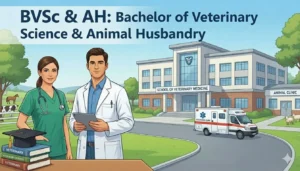
B.V.Sc Scope & Career in India 2026: Your Complete Guide
Nishit Kumar is a senior EdTech industry leader with over a decade of experience in building and scaling education platforms, shaping their product, content, and growth strategy. At…
Latest update: B.V.Sc 2026 admissions & dates updated. Read more ›
Embarking on a career in veterinary science in India offers a rewarding path for those passionate about animal health and welfare. The Bachelor of Veterinary Science (B.V.Sc) is a foundational undergraduate program designed to equip students with the knowledge and skills required to become competent veterinary professionals. This comprehensive guide delves into the B.V.Sc scope and career prospects in India for 2026, addressing common student and parent queries about eligibility, admissions, specializations, job opportunities, and earning potential.
What is B.V.Sc and Why Choose It?
B.V.Sc, or Bachelor of Veterinary Science, is a professional undergraduate degree focused on the medical diagnosis, treatment, and prevention of diseases in animals. It is a rigorous program that covers a wide array of subjects, from animal anatomy and physiology to surgery, medicine, public health, and livestock management. Choosing B.V.Sc offers a unique opportunity to contribute significantly to animal health, food safety, and even public health, given the strong link between animal and human well-being (One Health concept).
The program typically spans 5.5 years, including a compulsory 1-year rotating internship, which provides invaluable hands-on experience in various veterinary settings. Graduates are eligible to register with the Veterinary Council of India (VCI) and practice as licensed veterinarians.
What is the eligibility for B.V.Sc in India for 2026?
To be eligible for B.V.Sc in India for the 2026 academic year, candidates must have successfully completed their 10+2 (or equivalent) examination with Physics, Chemistry, Biology/Biotechnology, and English as core subjects. A minimum aggregate percentage, typically ranging from 50% to 60% for general category students and a relaxation for reserved categories, is usually required. Additionally, candidates must meet specific age criteria, generally being a minimum of 17 years old by December 31st of the admission year and a maximum of 25 years (with age relaxation for reserved categories).
Key Eligibility Criteria Summary:
- Educational Qualification: 10+2 or equivalent from a recognized board.
- Subjects: Compulsory Physics, Chemistry, Biology/Biotechnology, and English.
- Minimum Marks: 50-60% aggregate for General/OBC, 40-45% for SC/ST/PwD in PCB subjects.
- Age Limit: Minimum 17 years by December 31, 2026; Maximum 25 years (with 5-year relaxation for SC/ST/OBC/PwD).
- Entrance Exam: Qualification in NEET-UG is mandatory for most admissions.
People Also Read
-
-

-

-
 Bvsc Course Duration — 2026 Course
How do I get admission to B.V.Sc in 2026?
Admission to B.V.Sc programs in India for 2026 is primarily through the National Eligibility cum Entrance Test (NEET-UG). The Veterinary Council of India (VCI) conducts centralized counseling for 15% of the All India Quota (AIQ) seats in government veterinary colleges based on NEET-UG scores. State veterinary colleges fill the remaining 85% of seats through state-level counseling, also typically using NEET-UG scores, or sometimes through their own state-specific entrance exams.
B.V.Sc Admission Process 2026 (General Steps):
- Appear for NEET-UG 2026: This is the primary gateway for most B.V.Sc admissions.
- Check VCI & State Notifications: Post-NEET results, VCI and respective state authorities will release counseling schedules.
- Register for Counseling: Apply for VCI AIQ counseling or state quota counseling based on your domicile and preferences.
- Choice Filling & Locking: Select your preferred colleges and courses.
- Seat Allotment: Seats are allotted based on NEET rank, choices, and reservation policies.
- Document Verification & Admission: Report to the allotted college with required documents and complete admission formalities.
Important Dates (Tentative for 2026):
| Event | Tentative Dates (2026) |
|---|---|
| NEET-UG Application Start | February – March 2026 |
| NEET-UG Exam Date | May 2026 |
| NEET-UG Result Declaration | June 2026 |
| VCI AIQ Counseling Start | July – August 2026 |
| State Quota Counseling Start | July – September 2026 |
How much does B.V.Sc cost in India?
The cost of pursuing B.V.Sc in India varies significantly between government and private institutions. Government veterinary colleges typically have much lower fees, making them a more affordable option, while private colleges can be considerably more expensive. The fee structure also includes components like tuition fees, examination fees, hostel charges, and other miscellaneous expenses.
| Institution Type | Annual Fee Range (INR) | Total Course Fee (Approx. 5.5 years) |
|---|---|---|
| Government Colleges | ₹15,000 – ₹80,000 | ₹80,000 – ₹4,50,000 |
| Private Colleges | ₹1,00,000 – ₹3,50,000+ | ₹5,50,000 – ₹19,00,000+ |
Note: These are approximate ranges for 2026 and can vary based on specific college, state, and facilities. Hostel and mess charges are usually extra.
What are the specializations after B.V.Sc?
After completing B.V.Sc, graduates can pursue various postgraduate specializations (M.V.Sc and Ph.D.) to enhance their expertise and career prospects. These specializations allow veterinarians to focus on specific animal species, disease types, or areas of veterinary science.
Popular M.V.Sc Specializations:
- Veterinary Medicine: Focuses on diagnosis and treatment of internal diseases in animals.
- Veterinary Surgery and Radiology: Specializes in surgical procedures and diagnostic imaging.
- Veterinary Pathology: Deals with the study of animal diseases through examination of tissues and fluids.
- Veterinary Microbiology: Focuses on infectious diseases caused by bacteria, viruses, and fungi.
- Veterinary Public Health and Epidemiology: Concentrates on zoonotic diseases, food safety, and disease control at a population level.
- Animal Genetics and Breeding: Involves improving animal breeds and genetic traits.
- Animal Nutrition: Focuses on the dietary needs of various animal species.
- Livestock Production and Management: Deals with efficient management of farm animals.
- Veterinary Pharmacology and Toxicology: Studies the effects of drugs and toxins on animals.
Is B.V.Sc worth it for jobs in India? What is the career scope?
Yes, B.V.Sc is absolutely worth it for jobs in India, offering a diverse and stable career scope with increasing demand for skilled veterinary professionals. The career scope for B.V.Sc graduates is broad, encompassing government services, private practice, corporate sectors, research, academia, and even international opportunities. The growing awareness of animal welfare, the expanding livestock and poultry industries, and the rising trend of pet ownership all contribute to a robust job market for veterinarians.
Key Career Areas for B.V.Sc Graduates:
- Government Sector:
- Veterinary Officer/Assistant Surgeon: Working in state animal husbandry departments, treating livestock, implementing disease control programs, and providing extension services.
- Veterinary Public Health Specialist: Ensuring food safety (meat, milk, eggs), controlling zoonotic diseases in municipal corporations, and public health departments.
- Research Officer: In ICAR institutes, state agricultural universities, and other research organizations.
- Army Veterinary Corps (AVC): Serving in the Indian Army, caring for military animals.
- Wildlife Veterinarian: Working in national parks, zoos, and wildlife conservation projects.
- Private Practice:
- Companion Animal Practice: Opening private clinics for pets (dogs, cats, birds, exotic animals). This is a rapidly growing sector.
- Large Animal Practice: Providing veterinary services to livestock farmers (cattle, buffalo, sheep, goats).
- Mixed Practice: Catering to both companion and large animals.
- Corporate Sector:
- Pharmaceutical Companies: In R&D, sales, and marketing of veterinary medicines and vaccines.
- Feed Industry: Developing and marketing animal feed products.
- Poultry and Dairy Farms: Managing animal health, nutrition, and production.
- Pet Food Companies: Product development and quality control.
- Veterinary Diagnostic Labs: Performing lab tests for disease diagnosis.
- Academia and Research:
- Professor/Lecturer: Teaching in veterinary colleges after M.V.Sc/Ph.D.
- Research Scientist: Conducting research on animal diseases, genetics, nutrition, etc.
- International Organizations: Opportunities with organizations like FAO, WHO, OIE, and various NGOs working in animal welfare and public health globally.
What is the average salary after B.V.Sc in India?
The average salary after B.V.Sc in India varies significantly based on the sector (government vs. private), experience level, specialization, and location. Entry-level salaries can range from ₹3.5 LPA to ₹6 LPA, while experienced professionals, especially those in specialized private practice or senior government roles, can earn upwards of ₹8 LPA to ₹15 LPA or more. Private practice, particularly in urban areas with a focus on companion animals, often offers higher earning potential for established veterinarians.
| Job Role | Entry-Level Salary (INR/Year) | Mid-Career Salary (INR/Year) | Senior-Level Salary (INR/Year) |
|---|---|---|---|
| Veterinary Officer (Govt.) | ₹4,50,000 – ₹6,50,000 | ₹7,00,000 – ₹10,00,000 | ₹10,00,000 – ₹15,00,000+ |
| Private Practitioner (Pet Clinic) | ₹3,50,000 – ₹5,50,000 | ₹6,00,000 – ₹12,00,000 | ₹12,00,000 – ₹25,00,000+ (Clinic Owners) |
| Veterinary Consultant (Corporate) | ₹4,00,000 – ₹7,00,000 | ₹8,00,000 – ₹15,00,000 | ₹15,00,000 – ₹30,00,000+ |
| Research Scientist | ₹5,00,000 – ₹8,00,000 | ₹9,00,000 – ₹16,00,000 | ₹16,00,000 – ₹25,00,000+ |
Note: These are approximate salary ranges for 2026 and can vary significantly based on location, employer, and individual skills.
B.V.Sc vs. MBBS: Which is better?
Comparing B.V.Sc and MBBS depends entirely on an individual’s passion and career aspirations, as both are highly respected medical fields. MBBS (Bachelor of Medicine, Bachelor of Surgery) focuses on human medicine, while B.V.Sc is dedicated to animal medicine. If your primary interest lies in human health, MBBS is the clear choice. However, if you have a deep love for animals, are fascinated by their biology, and wish to contribute to animal welfare, livestock production, and public health through the ‘One Health’ approach, B.V.Sc is undoubtedly the better fit. Both fields offer stable careers, opportunities for specialization, and significant societal impact.
B.V.Sc vs. B.Sc Agriculture: What’s the difference?
B.V.Sc and B.Sc Agriculture are distinct fields, though both relate to the agricultural sector. B.V.Sc (Bachelor of Veterinary Science) is a professional medical degree focused specifically on the health, diagnosis, treatment, and prevention of diseases in animals. It leads to a career as a licensed veterinarian. In contrast, B.Sc Agriculture is an undergraduate science degree that covers a broader spectrum of agricultural sciences, including crop production, soil science, horticulture, agricultural economics, and extension. While B.Sc Agriculture graduates work to improve crop yields and agricultural practices, B.V.Sc graduates are directly involved in animal health and livestock management from a medical perspective.
Explore more on FindMyCollege
Related pages for B.V.Sc aspirants on findmycollege.com:
Frequently Asked Questions
Is NEET compulsory for B.V.Sc admission in 2026?
Yes, for the majority of B.V.Sc seats in India, including the 15% All India Quota and most state quota seats, qualifying NEET-UG is compulsory for admissions in 2026.
What subjects are taught in B.V.Sc?
B.V.Sc covers a wide range of subjects including Veterinary Anatomy, Physiology, Biochemistry, Pharmacology, Pathology, Microbiology, Parasitology, Public Health, Animal Nutrition, Genetics & Breeding, Livestock Production & Management, Veterinary Medicine, Surgery & Radiology, Gynaecology & Obstetrics, and Extension Education.
Can B.V.Sc graduates work abroad?
Yes, B.V.Sc graduates can work abroad, but they typically need to clear specific licensing exams or fulfill registration requirements of the respective country (e.g., NAVLE in North America, RCVS in the UK, or equivalent exams in Australia/New Zealand).
What is the future scope of veterinary science in India?
The future scope of veterinary science in India is very promising due to increasing pet ownership, growth in the livestock and poultry industries, rising demand for safe animal products, and the critical role of veterinarians in public health and wildlife conservation. New avenues in specialized pet care, animal forensics, and biotechnology are also emerging.
Are there government jobs after B.V.Sc?
Yes, there are numerous government job opportunities for B.V.Sc graduates, primarily as Veterinary Officers/Assistant Surgeons in state animal husbandry departments, in the Army Veterinary Corps, in municipal corporations for public health, and in research institutions.
What skills are essential for a successful B.V.Sc career?
Essential skills include a strong passion for animals, excellent observational skills, problem-solving abilities, manual dexterity, communication skills (with animal owners), empathy, resilience, and a commitment to lifelong learning.
Is B.V.Sc a difficult course?
B.V.Sc is a demanding and rigorous course that requires significant dedication, strong academic performance in science subjects, and a genuine interest in animal health. The extensive curriculum and long duration make it challenging, but highly rewarding for those committed.