CBSE Class 12 Hindi Elective sample paper 2026-27 released: what changes for board aspirants
In short
- CBSE has released the Class 12 Hindi Elective Sample Question Paper and Marking Scheme for the 2026-27 board examinations.
- The sample paper is designed to help students understand question formats, section-wise weightage, and difficulty levels for the upcoming exams.
- The updated paper pattern includes 20% MCQs, 30% competency-based questions, and 50% short and long answer questions.
- For Humanities and Languages, the total marks are 100, comprising 80 for theory and 20 for internal assessment.
- Students are advised to solve at least 5 to 7 full-length sample papers per subject for effective revision and exam confidence.
The Central Board of Secondary Education (CBSE) has released the Sample Question Paper and Marking Scheme for Class 12 Hindi Elective for the upcoming 2026-27 board examinations. This release aims to assist students in preparing for the board examinations by providing insight into the expected question formats, section-wise weightage, and overall difficulty level.
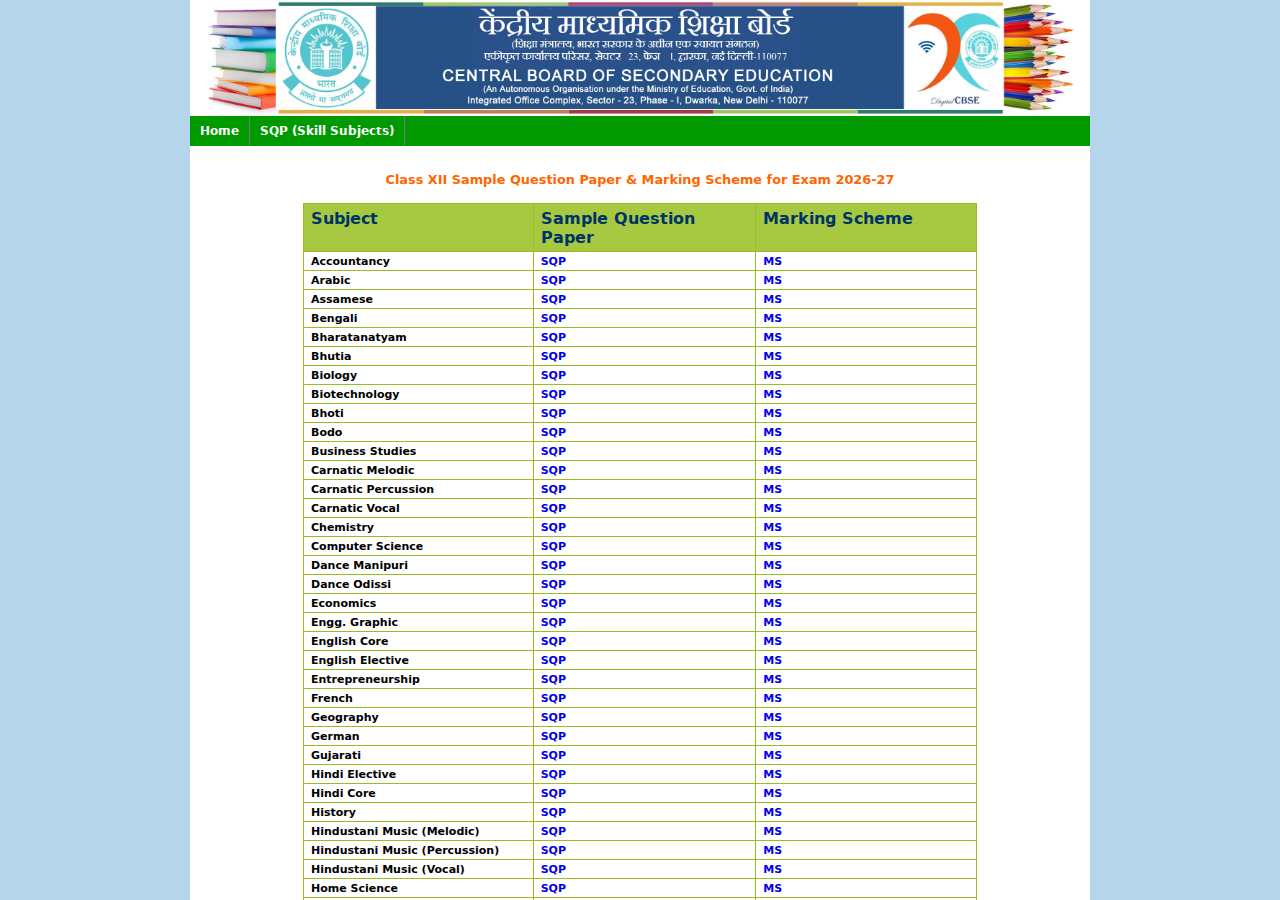
The newly released sample paper for Hindi Elective is structured according to the latest syllabus, updated exam pattern, and revised marking scheme as announced by CBSE. This initiative is part of CBSE’s regular practice of issuing model papers for board classes, including Class 10 and Class 12, on its official website, cbseacademic.nic.in.
Revised Examination Pattern for 2026-27
The CBSE Class 12 Sample Paper 2026-27 for Hindi Elective, along with other subjects, reflects notable changes in the examination pattern. According to myCBSEguide, these changes include an increased emphasis on competency-based questions and a greater focus on objectivity through more Multiple Choice Questions (MCQs), true/false, fill-ups, Assertion-Reasoning (ARQ), and Statement type questions.
The updated question paper pattern for Class 12 incorporates a significant proportion of different question types. Most case studies in the new pattern are now based on real-life situations, and analytical and evaluating-type questions have been added across almost all subjects. The distribution of question types is detailed below:
| Component | Weightage | Description |
|---|---|---|
| MCQs | 20% | Objective-type questions including single correct answers |
| Competency-Based Questions | 30% | Case-based, source-based, assertion-reason, and application-based questions |
| Short & Long Answer Questions | 50% | Descriptive type questions testing conceptual clarity and explanation |
Subject-Wise Marking Scheme and Preparation Guidance
For Humanities and Languages, including Hindi Elective, the total marks for the Class 12 board examination are 100. This is divided into 80 marks for the theory paper and 20 marks for internal assessment. This structure is consistent with the broader distribution of marks across different streams, as outlined by CBSE.
To ensure effective revision and build exam confidence, students are advised to solve at least 5 to 7 full-length sample papers per subject. Most CBSE Class 12 sample paper PDFs include detailed solutions and official marking schemes, which can be crucial for self-assessment. The detailed nature of these sample papers, providing a complete exam-like experience, is designed to help students thoroughly prepare for the final board examination.
| Stream / Subject Type | Theory Marks | Practical / Internal | Total Marks |
|---|---|---|---|
| Science (Physics, Chemistry, Biology) | 70 | 30 Practical | 100 |
| Commerce (Accountancy, Business Studies, Economics) | 80 | 20 Project | 100 |
| Humanities & Languages | 80 | 20 Internal Assessment | 100 |

Further reading
📰 More Education News
- CBSE Class 12 Physics sample paper 2026-27 released: download to understand new exam patternSep 24, 2026 • Nishit Kumar
- Apply for Palakkad Pharmacy College Admissions for 2026-27 cycle nowSep 24, 2026 • Nishit Kumar
- CBSE Class 12 English Core sample paper 2026-27 released: 13 compulsory questions, 80 marksSep 24, 2026 • Nishit Kumar
- NEST 2027: Apply in January; exam in JuneSep 24, 2026 • Nishit Kumar