IIT Bombay Highlights Common CEED 2026 Preparation Mistakes on September 15, 2026
The Indian Institute of Technology, Bombay (IIT Bombay) today, September 15, 2026, issued crucial advice for prospective students preparing for the Common Entrance Examination for Design (CEED) exam, highlighting common mistakes to avoid to ensure an appropriate study plan. This guidance aims to assist candidates in navigating the challenging and significant design entrance test effectively.
The CEED exam, administered annually by IIT Bombay, is a pivotal assessment for admission to postgraduate design programs, evaluating students’ analytical, logical, and creative thinking abilities. Understanding and circumventing these identified pitfalls are essential for candidates aiming to secure a place in competitive design courses.
CEED 2026 Preparation: Key Mistakes to Avoid
IIT Bombay emphasized that a primary mistake in CEED preparation is starting without thoroughly reading the latest syllabus and official notification. Candidates often collect an excessive number of books and courses, which can lead to confusion and dilute focus. Ignoring Previous Year Question Papers (PYQs) is another significant error, as these provide invaluable insight into the exam pattern and question types. In addition, taking mock tests without proper analysis of performance and chasing multiple attempts while accuracy declines are counterproductive strategies that candidates must avoid.
Neglecting time management is a critical oversight that can severely impact preparation. Many students also leave important documents or later stages of the selection process until the last minute, creating unnecessary stress. A top mistake highlighted for CEED 2025 and CEED 2026 preparation is not fully understanding the CEED Syllabus, which is foundational to effective study. Similarly, ignoring the syllabus and exam pattern is a common pitfall observed in UCEED 2027 preparation as well.
Understanding the CEED Exam Structure and Syllabus
The CEED exam is structured into two distinct parts: PART A and PART B, each designed to assess different aspects of a candidate’s aptitude for design. Part A tests logical reasoning, visual ability, environmental and social awareness, and language skills, forming the analytical foundation.
Part B, that said, focuses on practical design abilities, assessing drawing skills, creativity, and problem-solving through various design tasks. IIT Bombay clarified that CEED rewards a broad spectrum of skills, including observation, creativity, problem-solving, visual communication, and design thinking, as much as it does traditional drawing skills.
Comprehensive CEED Syllabus Overview
The complete CEED syllabus covers many topics essential for aspiring design postgraduates. Key areas include Visualization and spatial ability, Design thinking and headache solving, Drawing skills, Creativity, Communication skills, Analytical and logical reasoning, Environmental and social awareness, and Observation and design sensitivity. Also, the syllabus incorporates topics related to form, function, aesthetics, and technical drawing, ensuring a big-picture evaluation of design aptitude.
CEED and Other Design Entrance Exams
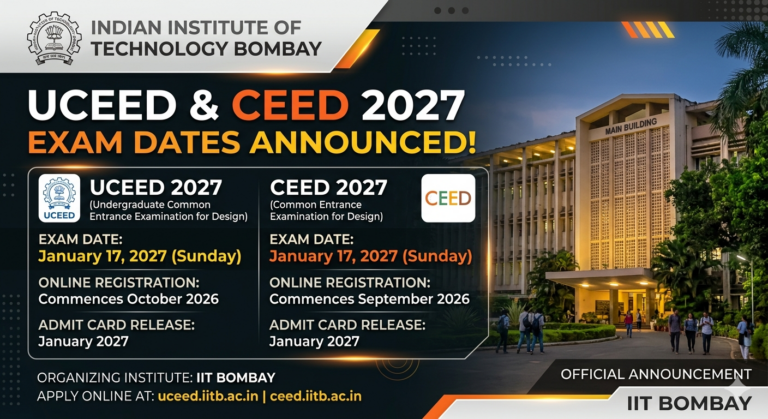
While CEED is specifically for postgraduate design programs, IIT Bombay also conducts the Undergraduate Common Entrance Examination for Design (UCEED) annually. UCEED assesses aptitude and skills for admission to undergraduate design programs (B.Des). Another significant national-level design entrance examination is the NIFT (National Institute of Fashion Technology) Entrance Exam, which consists of two primary components: the General Ability Test (GAT) and the Creative Ability Test (CAT). These exams collectively cater to various levels of design education across India.
Official Notifications and Preparation Strategy
IIT Bombay regularly issues fresh notifications or corrigendum for the CEED exam, and candidates are strongly advised to refer to these official updates. Adhering to the latest information is crucial for accurate preparation. The National Testing Agency (NTA) is also a key authority in the broader Indian education landscape, often involved in conducting national-level examinations.

📰 More Education News
- ABVP Submits NEET UG 2027 Reform Plan to Nilekani Panel, Proposes Two-Stage Exam, Twice a YearSep 15, 2026 • Simran
- Gujarat NEET UG Counselling 2026 Round 2 Merit List Released at medadmgujarat.orgSep 15, 2026 • Simran
- Gujarat NEET UG Round 2 Merit List 2026 Out: Check Provisional List at medadmgujarat.orgSep 15, 2026 • Simran
- WBJEE Decentralised Counselling 2026 Phase 1 Round 2 Seat Allocation (Out) at wbjeeb.co.inSep 15, 2026 • Simran