NEET UG 2026: Nilekani backs AI-generated tests, computer-based exams to end leaks
In short
- Nandan Nilekani proposed AI-generated questions and computer-based testing at the Bloomberg New Economy Forum 2026 to eliminate exam leaks.
- The suggestion follows the cancellation of NEET-UG 2026 on May 12, 2026, due to a widespread paper leak affecting over 2.27 million candidates.
- Nilekani leads a task force, constituted in July 2026, to recommend measures for a leak-proof and technology-driven public examination system.
- The Supreme Court indicated on July 27, 2026, it would seek suggestions from Nilekani's task force on transitioning NEET-UG to a computer-based test.
- The Public Examinations (Prevention of Unfair Means) Amendment Bill, 2026, proposes increased penalties for paper leaks, including imprisonment up to 10 years.
Nandan Nilekani, co-founder of Infosys and head of a high-powered task force on exam reforms, has called for a fundamental shift in India’s examination system by replacing traditional question papers with AI-generated questions and implementing nationwide computer-based testing. His proposals, made at the Bloomberg New Economy Forum 2026 on Tuesday before July 27, 2026, aim to address the persistent issue of question paper leaks in high-stakes examinations.
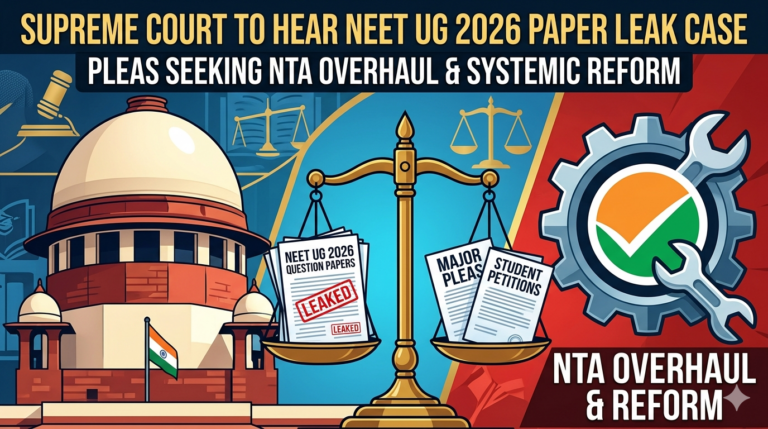
The recommendations come in the wake of the NEET-UG 2026 examination scandal, which saw the test for over 2.27 million candidates cancelled on May 12, 2026, due to a widespread paper leak. This incident triggered nationwide student protests and led to the resignation of then Union Education Minister Dharmendra Pradhan on July 25, 2026, with Pralhad Joshi assuming charge the following day.
Nilekani’s Vision for Leak-Proof Exams
Nilekani, who also founded the Unique Identification Authority of India (UIDAI) and led the Aadhaar project, suggested that generating question papers from a large question bank at the last minute could remove the economic incentive for leaks. He elaborated that AI could be used to generate exam papers on the day of the test itself, effectively eliminating the physical question paper and its associated vulnerabilities. “The question then becomes, why do we need to have something called a question paper? Because the moment you have a question paper, then that creates an economic incentive for that to be sold,” Nilekani stated.
He further added, “The way to do that is to really have a massive bank of questions. And only at the last minute generate the question paper for that day. And therefore, then the question of a question paper goes away, and there is no economic incentive for that.” The task force, which Nilekani heads, is exploring the transition of all public examinations to a computer-based testing (CBT) model. Expanding the necessary infrastructure for such a move would require more than 1.5 lakh locations across the country.
Government and Judicial Response to Exam Reforms
The Union government constituted the high-powered task force in July 2026, taking a “very serious view” of the NEET-UG 2026 paper leak. The task force is mandated to recommend measures to make India’s public examination system leak-proof and technology-driven. Prime Minister Narendra Modi has expressed keen interest in implementing the task force’s suggestions, stating, “Nothing is more important than the welfare and future of our youth! We have decided to set up fast-track courts to ensure swift and stringent punishment for those involved in paper leaks.”
The Supreme Court, on July 27, 2026, indicated its intention to seek suggestions from Nilekani’s task force on transitioning NEET-UG to a computer-based test. A Bench comprising Justices P.S. Narasimha and Alok Aradhe, hearing a petition for NEET-UG reforms filed by RJD MP Sudhakar Singh, emphasized the need for institutionalisation and a permanent mechanism for exam security. Justice Narasimha questioned, “When the transition occurs from physical conduct to online, what additional safeguards need to be taken, how the database is secured etc… Data storage is also an issue.” The Supreme Court will hear the matter again on August 3, 2026, alongside other pending NEET reform petitions.
The NEET-UG 2026 Scandal and Previous Recommendations
The NEET-UG 2026 examination, held on May 3, 2026, was cancelled on May 12, 2026, after investigators found a substantial overlap between a ‘guess paper’ circulated before the exam and the actual question paper. The scandal led to a replacement examination (‘re-NEET’) being announced for June 2026, and tragically, at least 12 students scheduled to retake the exam took their own lives. The Central Bureau of Investigation (CBI) took over the investigation on May 12, 2026, and uncovered a paper leak network spanning Rajasthan, Maharashtra, and other states. Arrests included Pune-based chemistry professor P. V. Kulkarni and biology professor Manisha Gurunath Mandhare, who allegedly had access to question papers through their work as translators for the National Testing Agency (NTA).
The 2026 incident was not isolated. Following the NEET-UG 2024 paper leak controversy, the K. Radhakrishnan Committee, chaired by former ISRO chairman Dr K. Radhakrishnan, was constituted. This committee submitted its report to the Ministry of Education in October 2024, making 101 recommendations for overhauling the NTA and strengthening exam security. The Supreme Court had previously questioned the Centre about rolling out these recommendations, stressing the need for a permanent mechanism for sealing question papers and appointing senior officers. Solicitor General of India Tushar Mehta had detailed existing safeguards, including multiple layers of moderation, CCTV/CISF surveillance at printing presses, and secure transportation and storage of question papers in bank strong rooms.
Transition to Computer-Based Testing and Global Context
India’s transition to computer-based testing has been ongoing for over a decade, with exams like CAT moving online in 2009 and JEE Main in 2013. However, NEET-UG remained a paper-based examination due to its complexity and the sheer volume of candidates. The 2026 paper leak has fundamentally altered this approach. While computer-based tests offer enhanced security, they are not without their own challenges. CUET-UG has experienced disruptions due to technical and server issues. Globally, instances like the March 2025 SAT experiencing premature test submissions due to a security setting error, alleged hacking of LSAT questions in China in 2025, and the theft of national exam papers from UK boards in 2023 highlight the evolving nature of exam security threats in the digital realm.
The Public Examinations (Prevention of Unfair Means) Amendment Bill, 2026, proposes increasing imprisonment for paper leaks from 3-5 years to 5-10 years and enhancing the maximum fine from ₹10 lakh to ₹50 lakh. Prime Minister Modi also announced the setting up of fast-track courts for speedy trials of NEET paper leak cases, underscoring the government’s commitment to addressing the issue comprehensively.
Further reading

📰 More Education News
- Rajasthan High Court stenographer admit card out: skill test from October 28Oct 13, 2026 • Nishit Kumar
- NEET paper leaks: Nilekani suggests last-minute question papers, expanded computer testsOct 13, 2026 • Nishit Kumar
- UKSSSC Livestock Extension Officer admit card released: download before 18 October examOct 13, 2026 • Nishit Kumar
- TN TET 2026: Download your result nowOct 13, 2026 • Nishit Kumar