OCI card: eligibility, benefits, and restrictions explained for foreign nationals of Indian origin
In short
- The OCI Scheme was introduced in August 2005 and officially launched on 9 January 2006 in Hyderabad.
- As of 31 January 2022, 40.68 lakh OCI registration cards have been issued to eligible foreign nationals.
- OCI cardholders receive a lifelong, multiple-entry visa for India and are exempt from FRRO/FRO registration for stays of any duration.
- Eligible applicants include those who were Indian citizens on or after 26 January 1950, or their descendants, and foreign spouses after two years of marriage.
- OCI status does not grant all rights of Indian citizens, such as voting or holding public office, and can be cancelled under specific conditions.
The Overseas Citizenship of India (OCI) Scheme, designed for foreign nationals of Indian origin, provides a range of benefits akin to permanent residency in India. Introduced in August 2005 through an amendment to the Citizenship Act, 1955, the scheme was officially launched on 9 January 2006 at the Pravasi Bharatiya Divas convention in Hyderabad.
The OCI scheme emerged in response to persistent demands for dual citizenship from the Indian diaspora, particularly in North America and other developed countries. While the Constitution of India does not permit dual citizenship, OCI status serves as the closest alternative, allowing overseas citizens to maintain formal ties with India. As of 31 January 2022, 40.68 lakh OCI registration cards have been issued.
Eligibility for OCI Registration
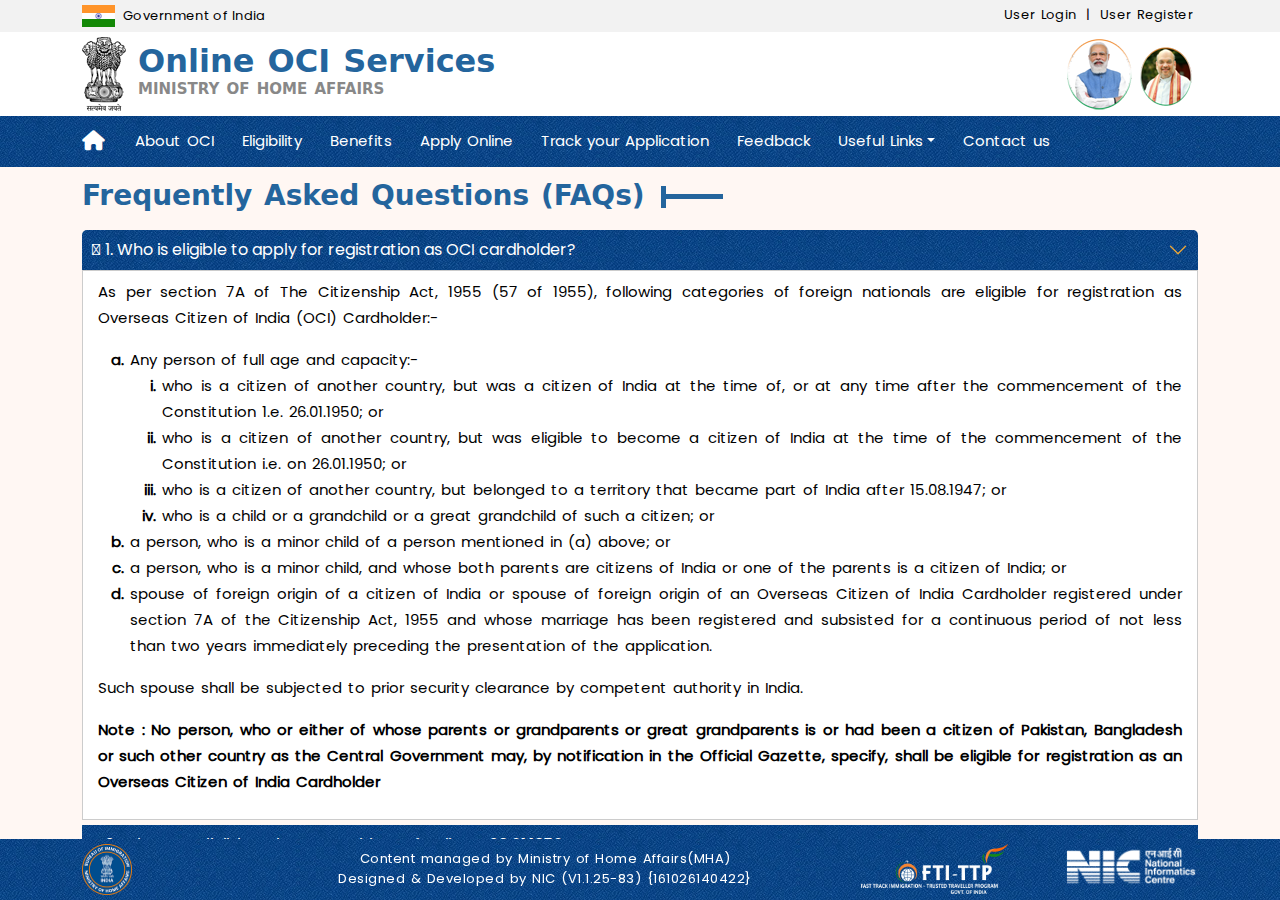
Eligibility for OCI registration extends to several categories of foreign nationals. This includes individuals who were citizens of India on or after 26 January 1950, or those who were eligible to become citizens on that date. Persons who belonged to a territory that became part of India after 15 August 1947 are also eligible. This encompasses territories such as Sikkim (26 April 1975), Puducherry (16 August 1962), Dadra & Nagar Haveli (11 August 1961), and Goa, Daman and Diu (20 December 1961).
Children, grandchildren, or great-grandchildren of eligible persons can also apply. Minor children whose parents are both Indian citizens or one parent is an Indian citizen are eligible. Foreign-origin spouses of Indian citizens or OCI cardholders can apply if their marriage has been registered and subsisted for at least two years immediately before the application, subject to security clearance. Dutch nationals of Surinamese origin up to the sixth generation whose forefathers came from India in the 19th century are also eligible. However, a person is not eligible if they, or their parents, grandparents, or great-grandparents, are or were citizens of Pakistan, Bangladesh, or any other country specified by the Central Government.
Application Process and Fees
Applications for OCI registration must be submitted online through the official OCI Services portal: https://ociservices.gov.in. Required documents include proof of current citizenship, evidence of address, and documents to establish eligibility. Foreign nationals applying from within India must meet applicable visa and residence-document requirements; tourist, missionary, and mountaineering visa holders cannot apply from within India.
The application fee for an OCI card varies based on the location of application. For applications submitted at an Indian Mission/Post abroad, the fee is US $275 or its equivalent in local currency. For applications made within India, the fee is ₹15,000. If an OCI registration is refused, a portion of the fee is refundable: US $250 abroad (with a non-refundable processing fee of US $25) and ₹13,600 in India (with a non-refundable processing fee of ₹1,400).
| Location | Cost |
|---|---|
| In India | ₹ 15000 |
| Abroad | US $275 |
| Location | Refundable Amount | Non-refundable Processing Fee |
|---|---|---|
| Indian Mission/Post abroad | US $ 250 or equivalent in local currency | US $ 25 |
| India | Rs.13,600/- (implied from 15000-1400) | Rs.1400/- |
Benefits and Restrictions of OCI Status
OCI cardholders are granted a lifelong, multiple-entry visa to visit India for any purpose and are exempt from registration with the Foreigners Regional Registration Officer (FRRO) or Foreigners Registration Officer (FRO), regardless of the length of their stay. The OCI card is a smart card and is valid with a valid foreign passport. OCI cardholders have parity with resident Indian nationals in domestic airfares and entry fees for national parks, wildlife sanctuaries, monuments, historical sites, and museums. They are treated like Non-Resident Indians for inter-country adoption of Indian children and can practice professions such as doctors, dentists, nurses, pharmacists, advocates, architects, and chartered accountants in India. They are also entitled to appear for the All India Pre-Medical Test or similar tests for admission and are eligible for appointment as teaching faculty.
However, OCI status is not equivalent to dual citizenship, and cardholders remain foreign nationals. They do not enjoy all rights available to Indian citizens, such as voting in Indian elections or claiming constitutional rights reserved for Indian citizens. OCI cardholders cannot be elected as President (Article 58) or Vice-President (Article 66), nor can they be appointed as a Judge of the Supreme Court (Article 124) or High Court (Article 217). They cannot register as a voter (Section 16 of Representation of the People Act, 1950) and are not eligible to be members of the House of the People, Council of States, Legislative Assembly, or Legislative Council. They cannot purchase agricultural land, farmhouses, or plantation properties in India, though they can inherit them. Special permission is required for certain activities like research, missionary or Tabligh activities, mountaineering, journalism, and internships with foreign diplomatic missions. OCI holders must also obtain Protected Area Permits (PAP) or Restricted Area Permits (RAP) to visit restricted zones.
Maintenance and Cancellation of OCI Status
The OCI card needs to be renewed whenever a new passport is issued for holders under the age of 20. For holders above the age of 50, renewal is required only once after the issuance of a new passport. OCI cardholders living in India must report address or occupation changes to the FRRO via email. When renewing a foreign passport, OCI cardholders must update their OCI record online within three months; a late penalty of US $25 applies after this period. The cost for a duplicate OCI card is US $100.
The government can cancel OCI status under specific circumstances, including fraud, disrespect to the Constitution, working with enemy nations, or serving jail time for two years or more within five years of getting the card. OCI status can also be cancelled even before conviction if someone faces charges that could lead to seven or more years in prison. When OCI status is cancelled, the entire family loses their OCI status at once. OCI holders eligible through marriage lose their OCI status upon divorce. OCI cardholders cannot access government subsidies or repatriation help from the Indian Government.
Evolution of the OCI Scheme
The OCI program has undergone several changes since its inception. Before 9 January 2015, OCI cardholders needed to carry a passport with a lifelong ‘U’ visa stamp; this requirement was removed on that date. The Person of Indian Origin (PIO) card scheme, launched in 2002, was merged with the OCI scheme on 9 January 2015, a move announced by Prime Minister Narendra Modi during his 2014 US visit. This merger automatically upgraded all PIO cardholders to OCI status, simplifying processes and reducing confusion. PIO cards lasted 15 years and required registration for stays over 180 days, while OCI cards never expired and did not require registration.
On 4 March 2021, OCI holders became subject to Protected Area Permit requirements for certain activities/areas and needed to register with FRRO upon change of address or occupation. On 15 April 2021, OCI renewal guidelines were relaxed, requiring renewal only once after age 20, but mandating uploading new passport and photo for renewals before age 20 and once after age 50. The timeline for re-issuance of OCI cards was temporarily extended until 31 December 2022 due to the COVID-19 pandemic.
| Version | First Issued |
|---|---|
| First version | 9 January 2006 |
| Second version | 9 January 2015 |
| Current version | 15 April 2021 |

📰 More Education News
- WB HS Semester 3 exam 2027 concluded: results expected by November second weekOct 16, 2026 • Nishit Kumar
- RRB Technician answer key 2026 out for grade 1, 3; raise objections by 22 OctoberOct 16, 2026 • Nishit Kumar
- NEET MDS 2026 counselling: CEE Kerala reopens applications, 49 seats vacant; apply by October 16Oct 16, 2026 • Nishit Kumar
- Rajasthan NEET UG 2026 stray vacancy round registration starts: apply by October 17Oct 16, 2026 • Nishit Kumar