Skill Development in Higher Education: Ministry of Education Highlights New Initiatives Under NEP 2020 to Boost Employability
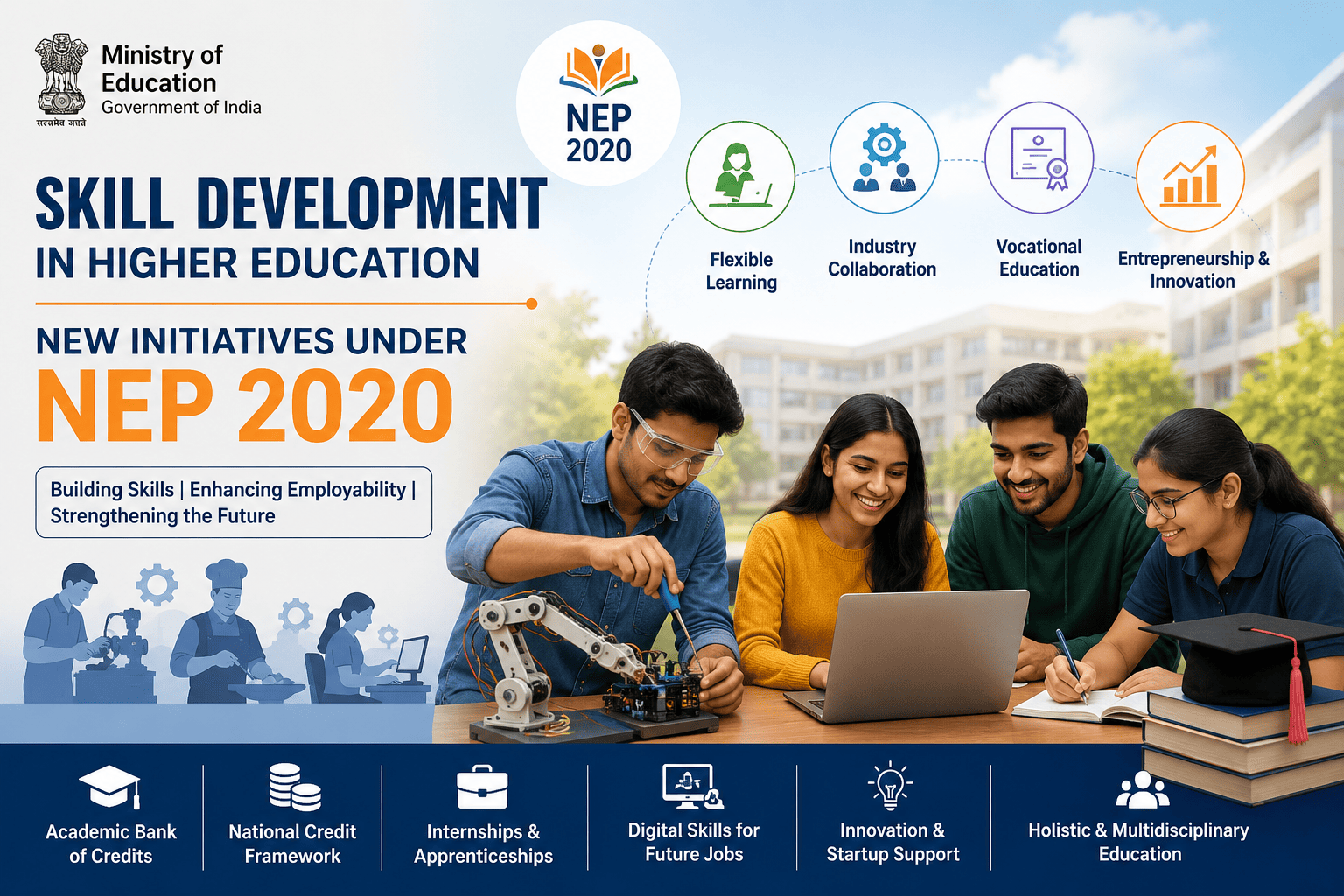
The Ministry of Education (MoE) has highlighted several major initiatives being implemented under the National Education Policy (NEP) 2020 to strengthen skill development in higher education. The government aims to transform India’s education system by making students more employable through industry-oriented learning, vocational education, internships, apprenticeships, and flexible academic pathways.
The latest update comes as the Centre continues to focus on creating a future-ready workforce that can meet the demands of emerging industries. Through NEP 2020, universities and colleges across the country are gradually shifting from traditional, theory-based education to a more practical and skill-focused learning model.
NEP 2020 Puts Skill Development at the Centre of Higher Education
One of the biggest reforms introduced under the National Education Policy 2020 is the integration of skill development into mainstream higher education. The Ministry of Education believes that degrees alone are no longer sufficient in today’s rapidly evolving job market. Students also need practical knowledge, technical expertise, and workplace experience to secure quality employment.
To address this gap, higher education institutions are being encouraged to redesign their curriculum by including vocational courses, internships, project-based learning, and industry collaborations. This approach enables students to gain real-world exposure while completing their academic programmes.
The policy also promotes multidisciplinary education, allowing students to choose courses across different disciplines and develop a broader range of competencies.
Greater Focus on Vocational Education
The Ministry has reiterated its commitment to increasing vocational education in colleges and universities. Under NEP 2020, the government has set a target of ensuring that 50% of learners receive exposure to vocational education by 2025.
Higher education institutions are working with industries, Sector Skill Councils, training partners, and professional organisations to provide students with hands-on learning opportunities. These collaborations are expected to improve employability while reducing the gap between classroom education and industry requirements.
Vocational education is no longer being treated as a separate stream but as an integral part of higher education.
National Credit Framework Offers Flexible Learning
One of the key reforms highlighted by the Ministry is the implementation of the National Credit Framework (NCrF).
The framework integrates academic learning, vocational education, and experiential learning into a unified credit system. Students can now earn credits through:
- Internships
- Apprenticeships
- Skill development programmes
- Online certification courses
- Research projects
- Community service activities
These credits can be accumulated throughout a student’s academic journey, making higher education more flexible and learner-centric.
Academic Bank of Credits Supports Multiple Entry and Exit
The Academic Bank of Credits (ABC) is another major initiative supporting NEP 2020 reforms.
ABC enables students to digitally store their academic credits earned from recognised institutions. If a student temporarily discontinues studies, the accumulated credits remain secure and can be used when rejoining a programme.
The system supports the Multiple Entry and Multiple Exit option introduced under NEP 2020, giving learners greater flexibility to complete their education according to their personal and professional needs.
Industry Partnerships to Improve Employability
The Ministry has also emphasized stronger collaboration between higher education institutions and industries.
Universities are increasingly partnering with companies to provide:
- Industry internships
- Live projects
- Apprenticeship programmes
- Skill certification courses
- Industrial training
- Expert lectures from professionals
Such collaborations help students understand workplace expectations before graduation while improving their job readiness.
Digital Skills and Emerging Technologies Receive Special Attention
With technology transforming every industry, the Ministry is encouraging institutions to offer courses in emerging fields such as:
- Artificial Intelligence (AI)
- Data Science
- Cybersecurity
- Cloud Computing
- Robotics
- Internet of Things (IoT)
- Digital Marketing
- Semiconductor Technology
Students are also being encouraged to complete online certification programmes through various digital learning platforms to complement their regular degree courses.
Entrepreneurship and Innovation Become Key Focus Areas
Apart from employment, NEP 2020 also promotes entrepreneurship.
Universities are setting up innovation centres, startup incubation hubs, and entrepreneurship development cells where students receive mentoring, funding support, and business guidance.
The government aims to nurture job creators alongside job seekers by encouraging students to transform innovative ideas into successful startups.
Experiential Learning Gains Importance
The Ministry stated that practical learning is becoming an essential part of higher education.
Many universities are now incorporating:
- Laboratory-based learning
- Community engagement
- Field visits
- Case studies
- Research projects
- Internships
These activities help students develop critical thinking, communication, teamwork, and problem-solving skills that employers increasingly value.
Faculty Training to Support NEP 2020 Implementation
Successful implementation of skill-based education also depends on trained educators.
The Ministry has introduced faculty development programmes that help teachers adopt outcome-based education, digital teaching methods, and experiential learning practices.
Continuous teacher training is expected to improve classroom delivery and ensure effective implementation of NEP reforms across institutions.
Government Aims to Build a Future-Ready Workforce
The Ministry of Education said these initiatives are aligned with the vision of Viksit Bharat 2047, which seeks to build a globally competitive and innovation-driven workforce.
By integrating vocational education, flexible learning pathways, industry partnerships, and digital skills into higher education, the government hopes to improve graduate employability while preparing students for future jobs across multiple sectors.
As universities continue implementing NEP 2020 reforms, India’s higher education ecosystem is gradually shifting from a degree-centric approach to a competency-based education system. The Ministry believes that this transformation will play a crucial role in creating a skilled workforce capable of supporting the country’s long-term economic growth and global competitiveness.




Further reading
📰 More Education News
- IIM Bodh Gaya MBA admission criteria 2027-29 announced todaySep 20, 2026 • Nishit Kumar
- JEE Advanced 2026 minimum marks for SC, ST categories: 46 aggregate, 4 per subjectSep 20, 2026 • Nishit Kumar
- JEE Advanced 2027 eligibility: two attempts, age limit set at October 1Sep 20, 2026 • Nishit Kumar
- CPRI recruitment 2026 registration begins for 110 posts; apply by October 12Sep 20, 2026 • Nishit Kumar