Semi Government Medical Colleges in West Bengal 2026: WBMCC Fees
Nishit Kumar is a senior EdTech industry leader with over a decade of experience in building and scaling education platforms, shaping their product, content, and growth strategy. At…
West Bengal established 5 medical colleges across Rampurhat (Birbhum), Cooch Behar, Diamond Harbour (South 24-Parganas), Purulia, and Raiganj (North Dinajpur), adding 500 MBBS seats with an intake capacity of 100 seats per college.
| Parameter | Details |
|---|---|
| Approved New Medical Colleges in WB | 5 colleges |
| Intake Per New College | 100 MBBS seats |
| Total Additional MBBS Seats | 500 MBBS seats |
| Centre-State Funding Sharing Ratio | 60:40 |
| Hospital Attachment Distance Limit | Within 10 km |
| College | City | Ownership | Total course fee | NIRF rank |
|---|---|---|---|---|
| All India Institute of Medical Sciences New Delhi | Delhi | Government | — | 1 (Medical, 2025) |
| Christian Medical College Vellore | Vellore | Private | ₹2.90 lakh | 3 (Medical, 2025) |
| Manipal University Manipal | Manipal | — | ₹4.79 lakh | 3 (Overall, 2025) |
| Jawaharlal Institute of Post Graduate Medical Education and Research | Pondicherry | Government | ₹1.29 lakh | 4 (Medical, 2025) |
| Banaras Hindu University | Varanasi | Government | ₹48,690 | 6 (Medical, 2025) |
| Kasturba Medical College Manipal | Manipal | Private | ₹94.97 lakh | 10 (Medical, 2025) |
| Saveetha Institute of Medical and Technical Sciences | Chennai | — | ₹1.13 crore | 11 (Medical, 2025) |
| Dr. DY Patil Vidyapeeth | Pune | — | ₹1.53 crore | 12 (Medical, 2025) |
| All India Institute of Medical Sciences Rishikesh | Rishikesh | Government | ₹12,150 | 13 (Medical, 2025) |
Government MBBS Colleges
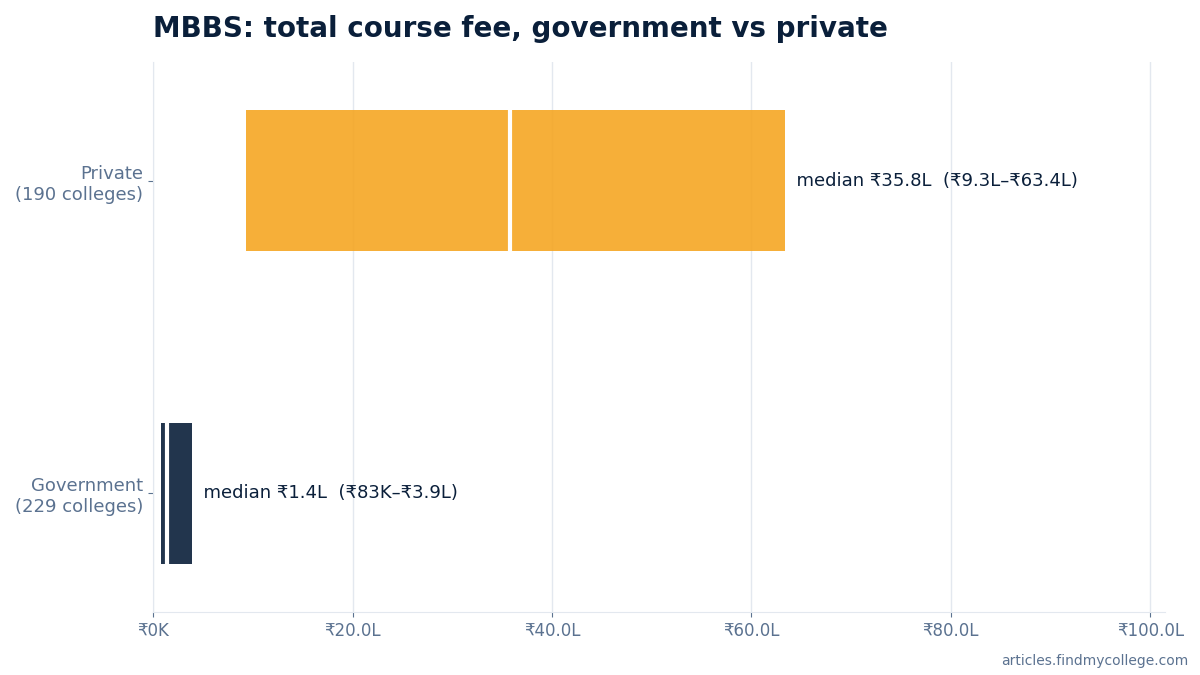
Government medical colleges provide accessible medical education with subsidized fee structures. At least 233 government colleges offer MBBS programs nationwide. For government medical colleges with fee data across 229 institutions, the median total course fee is ₹1.37 lakh, with the middle half ranging between ₹83,000 and ₹3.87 lakh.
West Bengal expanded its public healthcare education network by establishing 5 new government medical colleges in districts that previously had no medical colleges. Prior to this expansion, West Bengal had 9 medical colleges with a combined intake capacity of 1,900 students.
| College | City | Ownership | Total course fee |
|---|---|---|---|
| Lady Hardinge Medical College | Delhi | Government | ₹8,275 |
| All India Institute of Medical Sciences Rishikesh | Rishikesh | Government | ₹12,150 |
| Maulana Azad Medical College | Delhi | Government | ₹14,005 |
| Regional Institute of Medical Sciences | Imphal | Government | ₹15,000 |
| Anugrah Narayan Magadh Medical College and Hospital | Gaya | Government | ₹24,000 |
| Murshidabad Medical College & Hospital | Murshidabad | Government | ₹24,520 |
| Rajendra Institute of Medical Sciences | Ranchi | Government | ₹27,000 |
| Jhargram Government Medical College | Jhargram | Government | ₹32,000 |
| Government Kilpauk Medical College | Chennai | Government | ₹33,000 |
| Institute of Post Graduate Medical Education and Research | Kolkata | Government | ₹33,500 |
List of New District Medical Colleges in West Bengal
The 5 new medical colleges established in West Bengal are distributed across key districts to increase regional healthcare access and medical training seats. Each college has been set up with an intake capacity of 100 MBBS seats and is attached to a district or referral hospital.
| District | Location | MBBS Seat Intake Capacity | Hospital Attachment Limit |
|---|---|---|---|
| Birbhum | Rampurhat | 100 | Within 10 km |
| Cooch Behar | Cooch Behar | 100 | Within 10 km |
| South 24-Parganas | Diamond Harbour | 100 | Within 10 km |
| Purulia | Purulia | 100 | Within 10 km |
| North Dinajpur | Raiganj | 100 | Within 10 km |
Private MBBS Colleges
Private medical colleges account for a significant portion of MBBS seats across India, with at least 196 private colleges offering MBBS programs. Fee structures in private institutions vary widely. Across 190 private colleges with fee data, the median total course fee is ₹35.82 lakh, with the middle half spanning between ₹9.32 lakh and ₹63.42 lakh. The median average placement package across 54 evaluated medical colleges stands at 7.9 LPA.
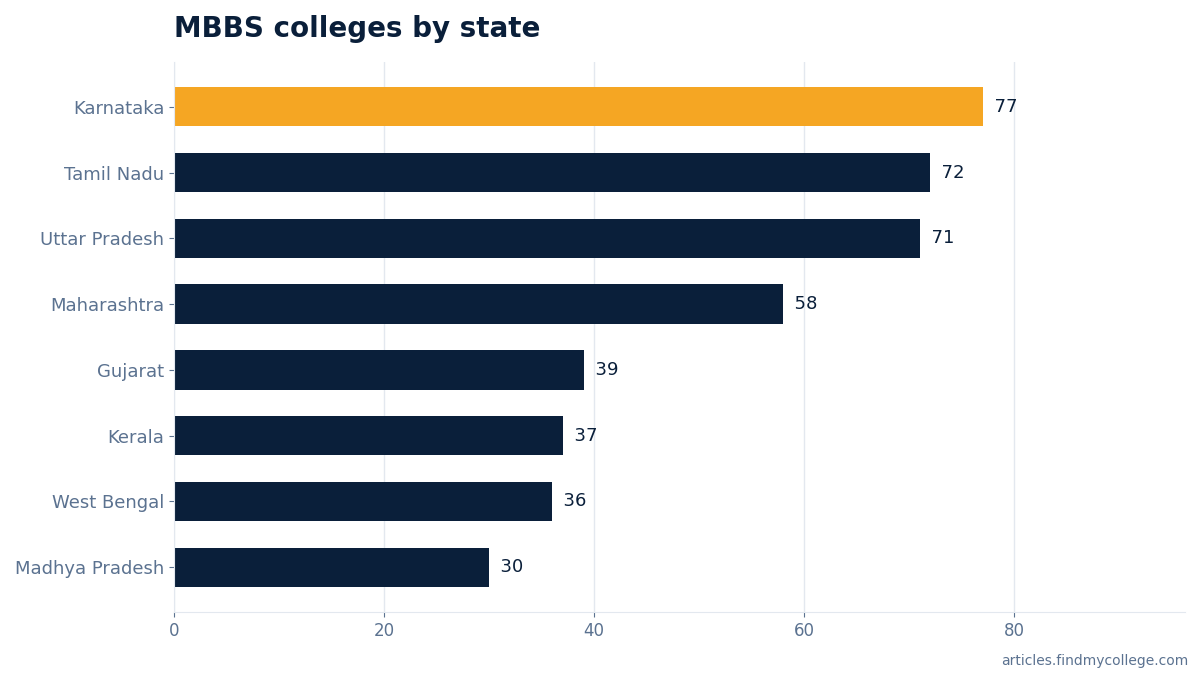
State-wise distribution of medical colleges shows Karnataka leading with 77 colleges, followed by Tamil Nadu with 72, Uttar Pradesh with 71, Maharashtra with 58, Gujarat with 39, and Kerala with 37 institutions.
| College | City | Ownership | Total course fee | Average package |
|---|---|---|---|---|
| Father Muller Medical College | Mangalore | Private | ₹10.25 lakh | 12.95 LPA |
| Jawaharlal Nehru Medical College | Belagavi | Private | ₹45.75 lakh | 11.76 LPA |
| Vydehi Institute of Medical Sciences and Research Centre | Bangalore | Private | ₹1.81 crore | 10.56 LPA |
| Terna Medical College | Navi Mumbai | Private | ₹38.28 lakh | 9.75 LPA |
| Kanachur Institute of Medical Sciences | Mangalore | Private | ₹7.72 lakh | 9.72 LPA |
| Kasturba Medical College Mangalore | Mangalore | Private | ₹70.89 lakh | 9.4 LPA |
| Sri Devaraj Urs Medical College | Kolar | Private | ₹87.30 lakh | 8.47 LPA |
| Mahatma Gandhi Medical College and Hospital | Jaipur | Private | ₹1.15 crore | 8 LPA |
| Dayanand Medical College and Hospital | Ludhiana | Private | ₹20.30 lakh | 7 LPA |
| JJM Medical College | Davanagere | Private | ₹7.68 lakh | 5.71 LPA |
| City | Colleges | Fee range | Well-known options |
|---|---|---|---|
| Chennai | 24 | ₹33,000 – ₹1.52 crore | Madras Medical College, Saveetha Institute of Medical and Technical Sciences |
| Bangalore | 19 | ₹44,750 – ₹1.81 crore | Rajiv Gandhi University of Health Sciences, Ramaiah Medical College |
| Delhi | 13 | ₹8,275 – ₹77.67 lakh | All India Institute of Medical Sciences New Delhi, Maulana Azad Medical College |
| Kolkata | 11 | ₹33,500 – ₹37.45 lakh | West Bengal University of Health Sciences, Calcutta National Medical College |
| Bhopal | 11 | ₹5.81 lakh – ₹95.00 lakh | All India Institute of Medical Sciences Bhopal, LNCT University |
| Hyderabad | 11 | ₹52,250 – ₹75.00 lakh | Bhaskar Medical College, Apollo Institute of Medical Science & Research |
| Mangalore | 10 | ₹7.68 lakh – ₹1.05 crore | Nitte University, Yenepoya University Mangalore |
| Pune | 10 | ₹64,950 – ₹1.53 crore | Armed Forces Medical College, Dr. DY Patil Vidyapeeth |
MBBS Seat Matrix Across West Bengal Medical Colleges
The addition of 5 new district medical colleges added 500 MBBS seats to the state medical education pool, bringing 100 seats to each of the selected locations. This expansion adds to the existing base of 9 medical colleges in West Bengal that previously offered 1,900 total MBBS seats.
| Parameter | Details |
|---|---|
| Total New Medical Colleges Approved | 5 |
| Intake per College | 100 MBBS seats |
| Total New MBBS Seats | 500 MBBS seats |
| Centre:State Fund Sharing Ratio | 60:40 |
| Total Approved Colleges Across India | 58 |
| Prior Total Medical Colleges in WB | 9 colleges (1,900 total intake) |
Government Fund Sharing and Development Model for West Bengal Medical Colleges
- College Allocation: The Central government approved 58 new medical colleges across India, allocating 5 to West Bengal.
- Fund Sharing Ratio: Funding for setting up the medical colleges is shared between the Centre and the state government in a 60:40 ratio.
- Execution Responsibility: The responsibility of setting up the colleges lies with the state government.
- Hospital Attachment: Medical colleges are attached to existing district or referral hospitals within a distance of 10 km.
The Central government approved 58 new medical colleges across India, allocating 5 to West Bengal. Funding is shared between the Centre and state in a 60:40 ratio, with colleges attached to existing district or referral hospitals within 10 km.
Hospital Attachment Rules for New West Bengal Medical Colleges
| District | Location | MBBS Seat Intake Capacity | Hospital Attachment Limit |
|---|---|---|---|
| Birbhum | Rampurhat | 100 | Within 10 km |
| Cooch Behar | Cooch Behar | 100 | Within 10 km |
| South 24-Parganas | Diamond Harbour | 100 | Within 10 km |
| Purulia | Purulia | 100 | Within 10 km |
| North Dinajpur | Raiganj | 100 | Within 10 km |
The selected districts in West Bengal previously had no medical colleges. Each new medical college is attached to an existing district or referral hospital located within a distance of 10 km.
How to Choose a MBBS College
- Hospital Attachment Distance: Check whether the college is attached to an existing district or referral hospital within a distance of 10 km.
- Seat Intake Capacity: Verify institution capacity details, such as the 100 MBBS seats per college established in new district institutions.
- Fee Structure: Compare course costs by ownership, with government colleges having a median fee of ₹1.37 lakh and private colleges having a median fee of ₹35.82 lakh.
- Regional Availability: Consider location options in districts like Rampurhat (Birbhum), Cooch Behar, Diamond Harbour (South 24-Parganas), Purulia, and Raiganj (North Dinajpur).
Evaluating hospital distance, seat capacity, and fee structure helps candidates select suitable medical institutions. Applicants should compare government and private fee metrics alongside geographic location during seat selection.
How to Apply for MBBS Admission in 2026: Step by Step
- Identify new district medical college locations: Select from 5 colleges established in districts that previously had no medical colleges: Rampurhat (Birbhum), Cooch Behar, Diamond Harbour (South 24-Parganas), Purulia, and Raiganj (North Dinajpur).
- Review MBBS seat capacity: Note that each of the 5 new medical colleges has an intake capacity of 100 MBBS seats, adding a total of 500 seats to the state.
- Check referral hospital proximity: Confirm that the college is attached to an existing district or referral hospital situated within a distance of 10 km.
- Examine funding and institutional expansion: Consider that these institutions were created under a 60:40 Centre-State fund sharing model, expanding on West Bengal’s prior setup of 9 medical colleges with 1,900 seats.
| What to do | Where | Link |
|---|---|---|
| Compare colleges, fees and cutoffs | MBBS colleges in India | findmycollege.com |
West Bengal added 500 new MBBS seats across 5 district medical colleges, expanding from its previous baseline of 9 medical colleges with 1,900 seats. These institutions operate with 60:40 Centre-State funding and attach to referral hospitals within 10 km.
FAQs
How many new medical colleges were set up in West Bengal under the central initiative?
Five new medical colleges were established in West Bengal in Rampurhat (Birbhum), Cooch Behar, Diamond Harbour (South 24-Parganas), Purulia, and Raiganj (North Dinajpur).
What is the MBBS seat intake capacity per new medical college in West Bengal?
Each of the 5 medical colleges has an intake capacity of 100 MBBS seats, creating a total of 500 additional MBBS seats in West Bengal.
What is the fund sharing ratio between the Centre and West Bengal for these medical colleges?
The funds for setting up these medical colleges are shared between the Central Government and the West Bengal State Government in a 60:40 ratio.
What is the maximum allowed distance between a new medical college and its referral hospital?
The new medical colleges are attached to existing district or referral hospitals located within a distance of 10 km.