

MBBS vs BAMS: Is an AYUSH Degree Worth It After NEET 2026?
Nishit Kumar is a senior EdTech industry leader with over a decade of experience in building and scaling education platforms, shaping their product, content, and growth strategy. At…
Admission alerts for this course will appear here as official notifications are published.
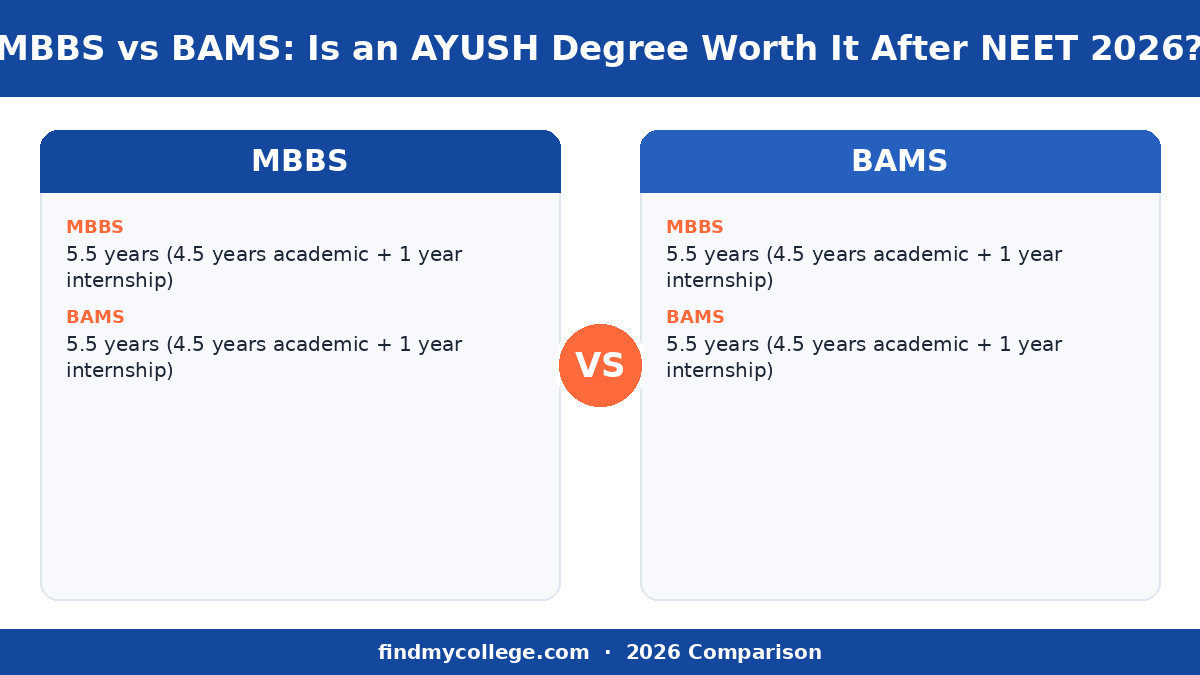
Deciding between MBBS (Bachelor of Medicine, Bachelor of Surgery) and BAMS (Bachelor of Ayurvedic Medicine and Surgery) after NEET 2026 is a pivotal choice for aspiring medical professionals in India. While MBBS is the established path to modern allopathic medicine, BAMS offers a distinct career in traditional Ayurvedic healthcare. MBBS is ideal for those committed to a rigorous, evidence-based, and globally recognized medical career, often involving extensive specialization. BAMS, conversely, suits individuals passionate about holistic healing, traditional Indian medicine, and a practice that integrates ancient wisdom with contemporary understanding.
MBBS vs BAMS: Quick Comparison (2026)
| MBBS | BAMS | |
|---|---|---|
| Duration | 5.5 years (4.5 years academic + 1 year internship) | 5.5 years (4.5 years academic + 1 year internship) |
| Eligibility | 10+2 with Physics, Chemistry, Biology/Biotechnology & English; Min. 50% aggregate (Gen) | 10+2 with Physics, Chemistry, Biology/Biotechnology & English; Min. 50% aggregate (Gen) |
| Admission / Entrance | NEET UG (Mandatory) | NEET UG (Mandatory) |
| Avg Fees (range) | Govt: ₹10,000 – ₹1.5 Lakhs/year; Private: ₹5 Lakhs – ₹25 Lakhs/year | Govt: ₹20,000 – ₹1 Lakh/year; Private: ₹1.5 Lakhs – ₹5 Lakhs/year |
| Top Careers | General Physician, Specialist (after PG), Surgeon, Medical Researcher, Hospital Administrator | Ayurvedic Practitioner, Ayurvedic Consultant, Panchakarma Specialist, Ayurvedic Researcher, Medical Officer (AYUSH) |
| Avg Starting Salary | ₹30,000 – ₹70,000/month (Intern/Junior Doctor); ₹60,000 – ₹1.5 Lakhs/month (after residency) | ₹20,000 – ₹45,000/month (Junior Practitioner); ₹40,000 – ₹80,000/month (experienced) |
| Best For | Allopathic medicine, specialization, global practice, high earning potential, research-driven healthcare | Holistic healing, traditional medicine, patient-centric care, lower fees, direct practice |
Curriculum & focus
The MBBS curriculum is rigorously structured around modern allopathic medicine, covering subjects like Anatomy, Physiology, Biochemistry, Pharmacology, Pathology, Microbiology, Forensic Medicine, Community Medicine, and clinical rotations in various specialties. Its focus is on evidence-based diagnosis, treatment, and prevention of diseases using contemporary medical science. The BAMS curriculum, while incorporating some modern medical sciences (e.g., Anatomy, Physiology), primarily centers on ancient Ayurvedic texts, principles, and practices. It delves into subjects like Ayurveda Samhita, Dravyaguna (Ayurvedic pharmacology), Rachana Sharir (Ayurvedic anatomy), Rog Nidan (Ayurvedic pathology), and Panchakarma therapy. The focus is on holistic well-being, personalized treatment, and natural remedies. Verdict: MBBS for modern scientific medicine; BAMS for traditional holistic healthcare.
Difficulty & workload
Both MBBS and BAMS are demanding degrees requiring significant dedication. However, MBBS is generally perceived as more academically rigorous due to the sheer volume of complex scientific information, extensive practical training, and the high-stakes nature of patient care in allopathy. The competitive environment, especially for NEET PG, adds immense pressure. BAMS also requires deep memorization of ancient texts and understanding of complex philosophical concepts, but the academic pressure, while substantial, is often considered slightly less intense than MBBS. Verdict: MBBS has a higher perceived difficulty and workload, especially post-graduation.
Fees & ROI
MBBS is significantly more expensive than BAMS, particularly in private colleges. Government MBBS colleges offer highly subsidized fees, but admission is extremely competitive. Private MBBS colleges can cost upwards of ₹1 crore for the entire course. The Return on Investment (ROI) for MBBS can be very high, especially after specialization, but it’s a long-term game requiring further investment in NEET PG coaching and residency. BAMS fees are considerably lower across both government and private institutions, making it a more accessible option financially. While the starting salaries are lower, the quicker path to independent practice and lower educational debt can offer a decent ROI for those seeking a more immediate return. Verdict: BAMS offers a more affordable education with quicker ROI; MBBS demands higher investment for potentially higher long-term returns.
Placements & salary
MBBS graduates generally command higher starting salaries and have broader placement opportunities in government hospitals, private hospitals, corporate chains, and clinics. The scope for specialization after NEET PG further boosts earning potential significantly. However, competition for government jobs and PG seats is intense. BAMS graduates typically start with lower salaries and have primary placement opportunities in AYUSH hospitals, government AYUSH dispensaries, private Ayurvedic clinics, and wellness centers. There’s a growing demand for Ayurvedic practitioners, especially in wellness tourism and integrated healthcare, but the salary ceiling is generally lower than for specialized MBBS doctors. Verdict: MBBS offers higher earning potential and wider placement options, especially with specialization; BAMS provides stable but generally lower-paying opportunities.
Higher studies & abroad scope
For MBBS graduates, higher studies are almost a necessity for career progression, primarily through NEET PG for MD/MS specializations in India. The degree is globally recognized, opening doors for postgraduate studies and practice abroad (though often requiring licensing exams like USMLE, PLAB, etc.). The path for MBBS abroad can be complex and expensive, but the recognition is strong. For BAMS graduates, higher studies include MD (Ayurveda) or MS (Ayurveda) in various Ayurvedic specialties. The scope for practicing BAMS abroad is limited compared to MBBS, primarily restricted to countries with a significant Indian diaspora or those open to alternative medicine. Recognition and licensing vary widely by country, making it a less straightforward path for international practice. Verdict: MBBS offers robust and globally recognized higher study and abroad opportunities; BAMS has limited international scope.
Government-job scope
Both MBBS and BAMS graduates have access to government jobs, but the nature and volume differ. MBBS graduates are eligible for positions as Medical Officers in state and central government hospitals, PHCs (Primary Health Centers), and various health departments. Competition is high, but the number of available posts is substantial. For BAMS graduates, government opportunities exist as AYUSH Medical Officers in state AYUSH departments, government Ayurvedic hospitals, and PHCs where AYUSH services are integrated. While the number of AYUSH posts is increasing, it is generally lower than for allopathic doctors. Verdict: Both have government job scope, but MBBS offers more numerous and diverse opportunities.
What students actually say (community insights)
- Many students highlight the brutal competition for MBBS, especially for NEET PG, and the significant financial burden of private MBBS colleges, often leading to a long period before substantial earnings.
- A common sentiment suggests that while MBBS offers higher prestige and earning potential, it’s a demanding and often stressful path that doesn’t end with the undergraduate degree.
- There’s a recurring debate about the professional identity of BAMS graduates, with some MBBS students questioning their right to be called ‘doctors’ in the same vein as allopathic practitioners.
- Some insights suggest that BAMS graduates can establish successful private practices relatively quickly and with lower overheads, sometimes even out-earning ‘just’ MBBS doctors who haven’t specialized.
- Concerns are raised about the oversaturation in certain medical fields, with some arguing that hospitals might hire multiple BAMS graduates for the salary of one MBBS doctor, impacting job availability and pay scales.
- A segment of students points out that while MBBS abroad can be a viable option, it’s often a ‘shady path’ fraught with uncertainty and only advisable if one can afford reputable institutions in specific countries.
Which one should you choose?
Your choice between MBBS and BAMS should align with your career aspirations, financial capacity, and philosophical approach to medicine.
- Choose MBBS if: You are passionate about modern scientific medicine, aspire to specialize in a specific medical field (e.g., cardiology, surgery), seek global recognition for your degree, are prepared for a highly competitive and academically rigorous journey, and have the financial resources (or can secure a government seat) for a potentially long and expensive education.
- Choose BAMS if: You have a strong interest in traditional Indian medicine, holistic healing, and natural remedies, prefer a patient-centric approach that integrates ancient wisdom, are looking for a more affordable medical education, and are content with practicing primarily within India or in specific international niches. It’s also a good option if you prioritize establishing an independent practice sooner with lower initial investment.
Frequently Asked Questions
Is BAMS a recognized medical degree?
Yes, BAMS is a fully recognized medical degree in India, regulated by the National Commission for Indian System of Medicine (NCISM). BAMS graduates are licensed to practice Ayurvedic medicine and surgery.
Can BAMS doctors perform surgery?
BAMS doctors are trained in certain surgical procedures (Shalya Tantra) as per the Ayurvedic curriculum. Recent amendments by the CCIM (now NCISM) have allowed BAMS postgraduates in specific surgical specialties to perform a defined set of general surgical procedures, which has been a subject of ongoing debate with allopathic medical associations.
Can BAMS doctors prescribe allopathic medicines?
In some states, BAMS doctors are permitted to prescribe certain allopathic medicines for emergency or primary care, often after completing a bridge course or based on specific state government notifications. However, this varies significantly by state and is a contentious issue within the medical community.
Is NEET PG required after BAMS?
Yes, if BAMS graduates wish to pursue postgraduate studies (MD/MS in Ayurveda), they need to appear for the AIAPGET (All India Ayush Post Graduate Entrance Test), which is the equivalent of NEET PG for AYUSH courses.
Which degree has better job security, MBBS or BAMS?
Both degrees offer job security, but in different sectors. MBBS offers broader security in the vast allopathic healthcare system. BAMS offers security within the growing AYUSH sector, which is increasingly supported by government initiatives and public interest in traditional medicine.
Can I switch from BAMS to MBBS or vice-versa?
No, there is no direct lateral entry or bridge course to switch from BAMS to MBBS or vice-versa. To pursue the other degree, you would need to clear NEET UG again and start the entire course from the beginning.
What is the future scope of BAMS in India?
The future scope of BAMS in India is promising, driven by government promotion of AYUSH, increasing public interest in holistic health, and the integration of traditional medicine into mainstream healthcare. Opportunities are growing in wellness tourism, research, and public health programs.
Are BAMS doctors called ‘doctors’?
Yes, BAMS graduates are legally entitled to use the prefix ‘Dr.’ as they hold a recognized medical degree. However, there is an ongoing debate and some contention from allopathic medical associations regarding the use of the term ‘doctor’ in a general sense, often advocating for clear distinction based on the system of medicine practiced.