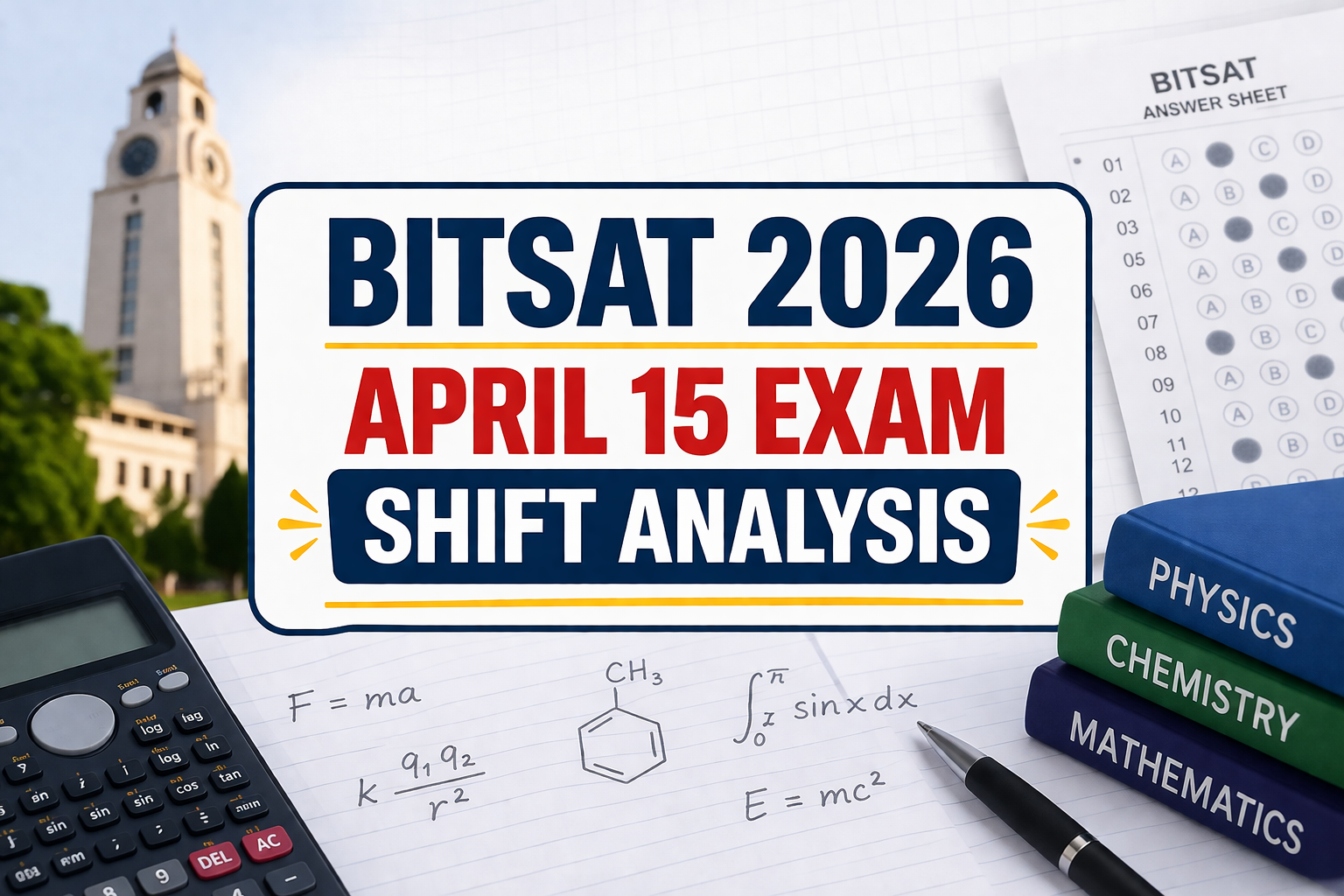
BITSAT 2026 Session 1 Kicks Off: Detailed Shift 1 Analysis, Shift 2 Reporting, and Exam Day Protocols
The Birla Institute of Technology and Science (BITS), Pilani, has officially commenced the BITSAT 2026 Session 1 today. As Shift 1 concludes and Shift 2 begins, the atmosphere at exam centers is a mix of high-stakes focus and meticulous security.
With BITS Pilani introducing new incentives this year—including a 100% tuition-blind scholarship for the top 500 rank holders—the competition is more intense than ever.
For those heading into their slots later today or tomorrow, here is a deep dive into the latest updates, subject trends, and strict compliance rules.
BITSAT 2026 Shift 1 Analysis: Subject-Wise Difficulty
The first shift, which ran from 9:00 AM to 12:00 PM, saw a “Moderate to Tough” overall difficulty level. Candidates were able to view their scores instantly on their computer screens after submitting the test, a hallmark of the BITSAT process that provides immediate clarity.
-
Mathematics: Students reported this as the most challenging and time-consuming section. While most questions were from the standard syllabus (Calculus, Vectors, and 3D Geometry), there were reports of a few tricky questions from Coordinate Geometry and Probability.
-
Physics & Chemistry: These sections were largely formula-based and aligned with NCERT. Physics focused heavily on Current Electricity, Electrostatics, and Kinematics, while Chemistry was dominated by Organic reactions and Electrochemistry.
-
English & Logical Reasoning: The Logical Reasoning section was described as “Easy” and a major score-booster. However, the English Proficiency section was cited as “Difficult,” with complex vocabulary and reading comprehension passages.
Shift 2 Reporting Time and Schedule
Timing is the most frequent cause of disqualification. BITSAT centers follow a zero-tolerance policy for latecomers. If you are scheduled for the afternoon slot, follow this timeline strictly:
-
Exam Window: 2:00 PM to 5:00 PM.
-
Reporting Starts: 12:30 PM.
-
Gate Closing: 1:30 PM sharp.
Once the gate closes, the biometric system locks, and no manual entry is permitted. Use the 60 minutes between reporting and the exam start for mandatory fingerprint scanning and photograph capture.
People Also Read

Elaborate Dress Code Guidelines
To ensure a smooth frisking process and prevent the use of micro-technology, candidates should adhere to the following:
-
Recommended Clothing: Wear light-colored, half-sleeve T-shirts or shirts. Plain trousers or leggings are ideal. Choose clothes with minimal pockets—cargo pants are strongly discouraged.
-
Footwear: Wear open sandals or slippers. Closed shoes, boots, or sneakers with thick soles will undergo extra scrutiny (including removal) at the security desk as they can be used to hide gadgets.
-
Avoid Metallic Items: This includes belts with large buckles, clothing with metal buttons, and any form of jewelry (rings, earrings, nose pins, or bracelets).
-
Headgear: Caps, mufflers, and hats are prohibited. If you wear religious headgear (like a turban), you must report at least 30 minutes earlier for a manual check.
Mandatory Documents and Stationery
Do not arrive at the center without these three essentials:
-
BITSAT 2026 Admit Card: A physical printout is mandatory. Ensure your photo and signature are clearly visible. Digital copies on phones are not valid.
-
Valid Photo ID: Original Aadhaar Card, PAN Card, Passport, or Driving License.
-
Self-Declaration Form: This is part of the hall ticket and must be filled out before reaching the gate.
Note on Stationery: You do not need to bring rough paper. A Scribble Pad will be provided at your terminal. You must return this pad before leaving the hall. Bring only a simple, transparent blue or black ballpoint pen.
Prohibited Items and Malpractice Policy
The 2026 security protocols are specifically targeting “hidden tech.” The following are strictly banned:
-
All Watches: Digital, smart, and even analog watches are banned. An on-screen timer will be available on your computer.
-
Electronics: Mobile phones, Bluetooth earpieces, health bands, and calculators.
-
Personal Belongings: Bags and wallets. Most centers do not have a locker facility, so it is best to leave these with a parent or in a vehicle.
-
Opaque Bottles: Only transparent, unlabelled water bottles are allowed.


📰 More Education News
- SNUSAT Result 2026 Phase 1 to Be Declared Today at ugapplications.snu.edu.in; Know How to Download ResultMay 29, 2026 • Simran
- NEET UG, PG Counselling 2026-27: MCC Issues Guidelines for Nationality Conversion to NRIMay 29, 2026 • Simran
- IIT Madras SWAYAM Plus Launches 3 New AI Courses Under AI for All InitiativeMay 29, 2026 • Simran
- Mumbai University 2026 Second Merit List Out Tomorrow! Get Live Updates for College-Wise AdmissionsMay 29, 2026 • Simran