Bachelor of Siddha Medicine & Surgery (BSMS) Overview 2026
Nishit Kumar is a senior EdTech industry leader with over a decade of experience in building and scaling education platforms, shaping their product, content, and growth strategy. At…
Latest update: Bachelor of Siddha Medicine & Surgery 2026 admissions & dates updated. Read more ›
Welcome to the comprehensive overview of the Bachelor of Siddha Medicine & Surgery (BSMS) course in India for the academic year 2026. This page is designed to provide prospective students and their parents with a deep understanding of this unique medical stream, covering everything from its core principles to career outcomes.
What is Bachelor of Siddha Medicine & Surgery (BSMS)?
The Bachelor of Siddha Medicine & Surgery (BSMS) is an undergraduate degree program focused on the ancient Siddha system of medicine, one of the oldest traditional medical systems in the world, originating from South India. It is a holistic healthcare system that emphasizes the balance of three humors (Vatham, Pitham, Kapham) and the five elements (earth, water, fire, air, space) within the body, offering both preventive and curative treatments.
The BSMS curriculum integrates traditional Siddha principles with modern medical sciences, providing students with a strong foundation in anatomy, physiology, pathology, pharmacology, toxicology, and surgery, alongside Siddha diagnostics, therapeutics, and formulations. Graduates are qualified to practice as Siddha physicians.
What is the eligibility for Bachelor of Siddha Medicine & Surgery (BSMS) in 2026?
To be eligible for the BSMS course in 2026, candidates must have successfully completed their 10+2 (or equivalent) examination with Physics, Chemistry, and Biology as core subjects, and must also qualify in the National Eligibility cum Entrance Test (NEET-UG).
The primary eligibility criteria are:
- Educational Qualification: Completion of 10+2 or equivalent examination from a recognized board with Physics, Chemistry, and Biology (PCB) as compulsory subjects.
- Minimum Marks: Generally, a minimum aggregate of 50% marks in PCB for General category candidates, 45% for PwD candidates, and 40% for SC/ST/OBC candidates.
- Age Limit: The candidate must be at least 17 years old as of December 31st of the admission year (i.e., December 31, 2026). There is no upper age limit as per recent Supreme Court rulings, though some state quotas might have specific guidelines.
- NEET-UG Qualification: Mandatory qualification in NEET-UG with a minimum percentile score (typically 50th percentile for General, 40th for SC/ST/OBC, and 45th for PwD).
- Domicile: While NEET is national, specific state quotas and government colleges may have domicile requirements.
How long is the BSMS course duration?
The Bachelor of Siddha Medicine & Surgery (BSMS) program has a total duration of 5 years and 6 months. This includes 4 years and 6 months of academic study followed by a compulsory one-year rotating internship.
The internship is crucial for practical exposure, allowing students to apply their theoretical knowledge in clinical settings under supervision, covering various departments like Maruthuvam (General Medicine), Sool Maruthuvam (Obstetrics & Gynaecology), Sirappu Maruthuvam (Special Medicine), and Emergency Medicine.
What is the admission process for BSMS in 2026?
The admission process for BSMS in 2026 primarily involves qualifying the NEET-UG examination, followed by state-level or All India Ayush Admissions Central Counseling Committee (AACCC) counseling.
- NEET-UG Application & Exam: Candidates must apply for and appear in the NEET-UG examination, typically held in May.
- NEET-UG Results: Results are usually declared in June, providing candidates with their scores and percentile.
- Counseling Registration: Eligible candidates (those who meet the NEET cut-off) must register for counseling. This can be through the AACCC portal for All India Quota (AIQ) seats (15% of government seats) or respective state counseling authorities for state quota seats (85% of government seats and private college seats).
- Choice Filling & Locking: During counseling, candidates select their preferred colleges and courses based on their NEET rank.
- Seat Allotment: Seats are allotted based on NEET rank, choices filled, and availability.
- Document Verification & Admission: Allotted candidates must report to the respective college with original documents for verification and complete the admission formalities and fee payment.
Key Dates for BSMS Admission 2026 (Tentative)
| Event | Tentative Dates 2026 |
|---|---|
| NEET-UG Application Start | February – March 2026 |
| NEET-UG Application End | March – April 2026 |
| NEET-UG Exam Date | First week of May 2026 |
| NEET-UG Result Declaration | First week of June 2026 |
| AACCC/State Counseling Registration | July – August 2026 |
| Admission Process Completion | September – October 2026 |
How much does Bachelor of Siddha Medicine & Surgery (BSMS) cost? (Fees)
The cost of pursuing a BSMS degree varies significantly between government and private institutions, with government colleges being substantially more affordable due to subsidies.
- Government Colleges: Annual fees can range from INR 10,000 to INR 50,000. This typically includes tuition, library, and laboratory fees. Hostel and mess charges are extra.
- Private Colleges: Annual fees are considerably higher, ranging from INR 1,00,000 to INR 3,00,000 or more, depending on the college’s reputation, facilities, and location. This range usually covers tuition and basic amenities, with additional costs for hostel, mess, and other facilities.
It’s important for students to factor in additional expenses such as study materials, examination fees, accommodation, food, and personal expenses, which can add another INR 50,000 to INR 1,50,000 annually.
What subjects are covered in the BSMS syllabus?
The BSMS syllabus is a comprehensive blend of traditional Siddha medical knowledge and modern scientific principles, structured across 4.5 years of academic study.
Key subjects include:
- Siddha Fundamentals: Siddha Maruthuva Adippadai Thathuvangal (Fundamentals of Siddha Medicine), Uyir Vedhiyal (Biochemistry), Udal Koorugal (Anatomy), Udal Thathuvam (Physiology).
- Siddha Pathology & Diagnostics: Noi Naadal (Pathology & Diagnostics), Noi Anugavidhi (Principles of Disease Diagnosis).
- Siddha Pharmacology & Formulations: Gunapadam (Pharmacology – Mooligai, Thathu, Jeeva Vaguppu), Siddha Maruthuva Noolgal (Siddha Medical Texts).
- Modern Medical Sciences: Modern Anatomy, Physiology, Pathology, Microbiology, Forensic Medicine & Toxicology.
- Clinical Subjects: Maruthuvam (General Medicine), Sool Maruthuvam (Obstetrics & Gynaecology), Sirappu Maruthuvam (Special Medicine), Kuzhandai Maruthuvam (Paediatrics), Aruvai Maruthuvam (Surgery), Thol Maruthuvam (Dermatology), Eye & ENT.
- Preventive & Social Medicine: Sugathara Thathuvam (Hygiene & Community Medicine).
Sample BSMS Subject List (Year-wise)
| Year | Key Subjects |
|---|---|
| 1st Year | Siddha Maruthuva Adippadai Thathuvangal, Udal Koorugal (Anatomy), Udal Thathuvam (Physiology), Uyir Vedhiyal (Biochemistry), Tamil Language. |
| 2nd Year | Noi Naadal (Pathology & Diagnostics), Gunapadam (Mooligai), Sattam Saarntha Maruthuvamum Nanju Maruthuvamum (Forensic Medicine & Toxicology). |
| 3rd Year | Gunapadam (Thathu & Jeeva Vaguppu), Maruthuvam (General Medicine), Aruvai Maruthuvam (Surgery), Sugathara Thathuvam (Hygiene & Community Medicine). |
| 4th Year | Sool Maruthuvam (Obstetrics & Gynaecology), Kuzhandai Maruthuvam (Paediatrics), Sirappu Maruthuvam (Special Medicine), Research Methodology & Biostatistics. |
Is Bachelor of Siddha Medicine & Surgery (BSMS) worth it for jobs? (Career Prospects & Salary)
Yes, BSMS is a worthwhile career path, especially for those passionate about traditional medicine and holistic healthcare, offering diverse job opportunities in both government and private sectors with competitive salaries that grow with experience.
Graduates can pursue various roles:
- Siddha Physician/Consultant: Working in government Siddha hospitals, private clinics, or establishing their own practice.
- Medical Officer: In government AYUSH departments, primary health centers, or public health initiatives.
- Researcher: In institutions focused on Siddha drug development, clinical trials, and traditional medicine research.
- Academician: Teaching in Siddha medical colleges.
- Drug Manufacturer/Formulator: In pharmaceutical companies specializing in Siddha medicines.
- Wellness & Spa Consultant: In holistic wellness centers and medical tourism.
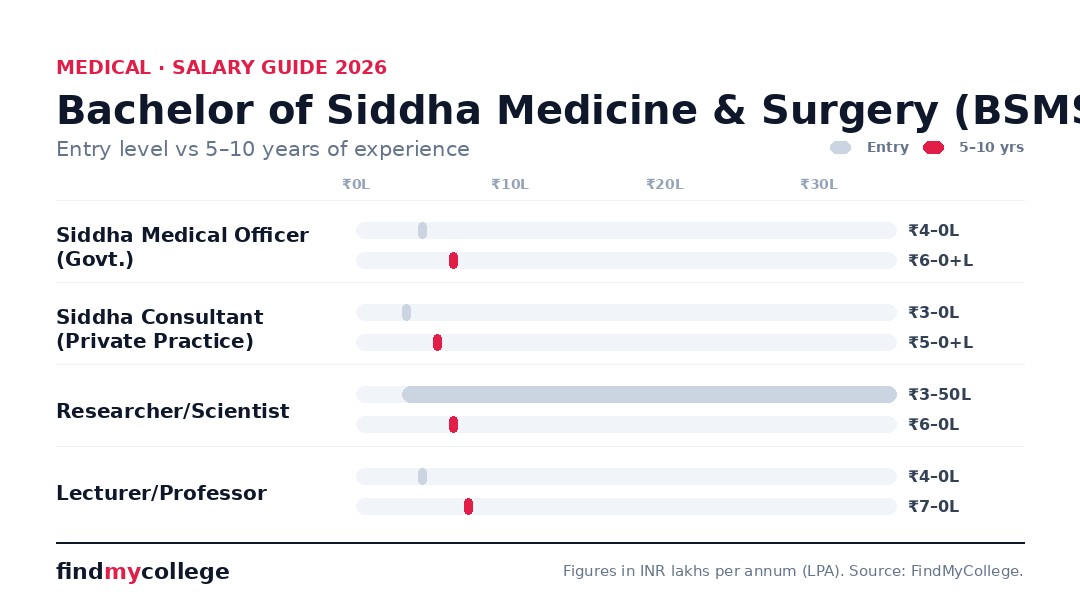
Average Salary for BSMS Graduates in India (Entry-Level to Experienced)
| Role | Entry-Level Salary (INR/Year) | Mid-Level Salary (INR/Year) | Experienced Salary (INR/Year) |
|---|---|---|---|
| Siddha Medical Officer (Govt.) | 4,00,000 – 6,00,000 | 6,00,000 – 10,00,000+ | 10,00,000 – 15,00,000+ |
| Siddha Consultant (Private Practice) | 3,00,000 – 5,00,000 | 5,00,000 – 12,00,000+ | 12,00,000 – 20,00,000+ |
| Researcher/Scientist | 3,50,000 – 6,00,000 | 6,00,000 – 10,00,000 | 10,00,000 – 18,00,000+ |
| Lecturer/Professor | 4,00,000 – 7,00,000 | 7,00,000 – 12,00,000 | 12,00,000 – 20,00,000+ |
Salaries are highly dependent on location, experience, type of employer, and individual skill set. Post-graduation (MD/MS in Siddha) can significantly boost career prospects and earning potential.
What are the higher study options after BSMS?
After completing BSMS, graduates have several options for higher education to specialize and enhance their career prospects, primarily through postgraduate degrees in Siddha medicine.
- MD (Siddha): Master of Doctor in Siddha, specializing in various branches like Noi Naadal (Pathology), Gunapadam (Pharmacology), Sirappu Maruthuvam (Special Medicine), Pothu Maruthuvam (General Medicine), Sool Maruthuvam (Obstetrics & Gynaecology), Kuzhandai Maruthuvam (Paediatrics), etc.
- MS (Siddha): Master of Surgery in Siddha, though less common, some institutions may offer surgical specializations.
- PhD (Siddha): For those interested in research and academia, a doctoral degree allows for in-depth study and contribution to the field.
- MBA in Hospital Management: For those interested in the administrative and management aspects of healthcare.
- Public Health Programs: Masters in Public Health (MPH) can open doors to roles in public health policy and community health.
BSMS vs. BAMS vs. BHMS: Which is better?
The choice between BSMS, BAMS (Bachelor of Ayurvedic Medicine & Surgery), and BHMS (Bachelor of Homeopathic Medicine & Surgery) depends entirely on a student’s interest in a specific traditional medical system, as each has its unique philosophy, diagnostic methods, and treatment modalities.
Comparison Table: BSMS vs. BAMS vs. BHMS
| Feature | BSMS (Siddha) | BAMS (Ayurveda) | BHMS (Homoeopathy) |
|---|---|---|---|
| Origin | Ancient Tamil civilization (South India) | Ancient India (Vedic period) | Germany (18th Century) |
| Core Philosophy | 3 Humors (Vatham, Pitham, Kapham), 5 Elements, 96 Thathuvams | 3 Doshas (Vata, Pitta, Kapha), 5 Elements | “Like cures like” (Law of Similars), infinitesimal doses |
| Diagnosis | Pulse diagnosis (Nadi Pariksha), urine, eye, tongue, voice, body touch, stool | Pulse diagnosis (Nadi Pariksha), tongue, urine, stool, general examination | Detailed case-taking, symptom totality, individualization |
| Treatment | Herbal, mineral, animal-based medicines, Varmam, Thokkanam (massage) | Herbal, mineral, animal-based medicines, Panchakarma (detoxification) | Highly diluted remedies (potencies) |
| Focus | Holistic healing, rejuvenation, specific chronic conditions | Preventive, curative, lifestyle management, rejuvenation | Stimulating body’s self-healing mechanism |
| Duration | 5.5 years (incl. 1-year internship) | 5.5 years (incl. 1-year internship) | 5.5 years (incl. 1-year internship) |
| Eligibility | 10+2 PCB + NEET-UG | 10+2 PCB + NEET-UG | 10+2 PCB + NEET-UG |
All three are recognized medical systems in India under the AYUSH ministry. The choice should align with a student’s personal interest in the philosophy and practice of each system.
Frequently Asked Questions
Is BSMS recognized by the Medical Council of India (MCI)?
No, the Medical Council of India (MCI), now the National Medical Commission (NMC), regulates modern (Allopathic) medicine. BSMS is regulated by the Central Council of Indian Medicine (CCIM) under the Ministry of AYUSH, Government of India, ensuring its recognition and validity as a medical degree.
Can BSMS doctors perform surgery?
BSMS graduates receive training in basic surgical procedures (Aruvai Maruthuvam) as part of their curriculum. However, the scope of surgical practice for Siddha doctors is generally limited to minor procedures and specific traditional surgical techniques, and is governed by regulations set by the CCIM and state authorities, distinct from the extensive surgical scope of MBBS doctors.
Are there government colleges for BSMS?
Yes, there are several government Siddha medical colleges in India, primarily located in Tamil Nadu, which is the cradle of Siddha medicine. These colleges offer subsidized education and are highly sought after due to their quality of education and lower fees. Examples include Government Siddha Medical College, Chennai, and Government Siddha Medical College, Palayamkottai.
What is the scope of BSMS abroad?
The scope of BSMS abroad is limited compared to conventional medicine (MBBS). While some countries, particularly those with a significant Indian diaspora or interest in alternative medicine, may recognize Siddha practitioners, direct practice as a registered physician might require additional certifications, licensing exams, or specific country-wise approvals. Opportunities are more likely in wellness, research, or academic roles.
What is the difference between Siddha and Ayurveda?
While both Siddha and Ayurveda are ancient Indian medical systems, they differ in their origin, philosophical underpinnings, diagnostic methods, and therapeutic approaches. Siddha originated in South India (Tamil Nadu) and emphasizes the 96 Thathuvams and the use of minerals and metals, alongside herbs. Ayurveda originated in North India and focuses on the Tridoshas (Vata, Pitta, Kapha) and primarily uses herbal preparations and Panchakarma therapies. Both aim for holistic well-being.
Can I open my own clinic after BSMS?
Yes, after completing your BSMS degree and compulsory internship, you are eligible to register with the respective state Siddha Medical Council and open your own private Siddha clinic. Many BSMS graduates choose this path, offering consultations, traditional therapies, and Siddha medicines.