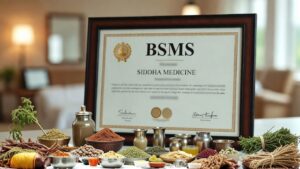
Bachelor of Siddha Medicine & Surgery (BSMS) Scope & Career 2026
Nishit Kumar is a senior EdTech industry leader with over a decade of experience in building and scaling education platforms, shaping their product, content, and growth strategy. At…
Latest update: Bachelor of Siddha Medicine & Surgery 2026 admissions & dates updated. Read more ›
The Bachelor of Siddha Medicine & Surgery (BSMS) is a comprehensive undergraduate degree program focused on the ancient Siddha system of medicine. This page provides a deep dive into the Bachelor of Siddha Medicine & Surgery Scope & Career prospects in India for 2026, covering everything from eligibility and course structure to career paths, salaries, and future growth.
What is Bachelor of Siddha Medicine & Surgery (BSMS)?
The Bachelor of Siddha Medicine & Surgery (BSMS) is a 5.5-year undergraduate program, including a one-year compulsory internship, that trains students in the principles and practices of the Siddha system of medicine. Siddha is one of the oldest traditional medical systems, originating in South India, focusing on holistic health, natural remedies, and lifestyle modifications.
What is the core curriculum of BSMS?
The BSMS curriculum integrates ancient Siddha texts and practices with modern medical sciences, providing a well-rounded education. Students learn about Siddha philosophy, anatomy, physiology, pathology, pharmacology, toxicology, preventive medicine, and various therapeutic procedures.
What is the eligibility for Bachelor of Siddha Medicine & Surgery in 2026?
To be eligible for the Bachelor of Siddha Medicine & Surgery (BSMS) program in 2026, candidates must have successfully completed their 10+2 (or equivalent) examination with Physics, Chemistry, and Biology as core subjects, and must also qualify in a national-level entrance examination, primarily NEET UG.
What are the specific academic requirements for BSMS admission?
- Educational Qualification: Candidates must have passed 10+2 or its equivalent examination from a recognized board.
- Mandatory Subjects: Physics, Chemistry, and Biology (or Biotechnology) are compulsory subjects. English is also required.
- Minimum Marks: Generally, a minimum aggregate of 50% marks in PCB for General category candidates, 45% for PwD, and 40% for SC/ST/OBC candidates is required.
- Age Limit: The candidate must be at least 17 years old as of December 31st of the admission year. There is usually no upper age limit for NEET UG, but some state quotas or institutions might have specific restrictions.
Which entrance exams are required for BSMS admission in 2026?
Admission to BSMS courses in India is primarily through the National Eligibility cum Entrance Test (NEET-UG). Candidates must appear for NEET-UG and secure the minimum qualifying percentile to be eligible for counseling.
NEET UG 2026 Tentative Schedule & Pattern
| Aspect | Details |
|---|---|
| Application Start | February – March 2026 |
| Application End | March – April 2026 |
| Exam Date | First Sunday of May 2026 |
| Result Declaration | June 2026 |
| Exam Mode | Offline (Pen & Paper) |
| Total Questions | 200 (180 to be attempted) |
| Total Marks | 720 |
| Subjects | Physics, Chemistry, Biology (Botany & Zoology) |
People Also Read

How much does Bachelor of Siddha Medicine & Surgery (BSMS) cost in India?
The cost of pursuing a Bachelor of Siddha Medicine & Surgery (BSMS) in India varies significantly based on the type of institution (government vs. private) and its location. Government colleges generally have much lower fees compared to private institutions.
BSMS Fee Structure 2026 (Annual Ranges)
| Institution Type | Annual Tuition Fee (INR) | Additional Costs (Hostel, Exam, etc.) |
|---|---|---|
| Government Colleges | ₹10,000 – ₹50,000 | ₹5,000 – ₹20,000 |
| Private Colleges | ₹1,00,000 – ₹3,50,000+ | ₹30,000 – ₹1,00,000+ |
These figures are indicative ranges for 2026 and can vary. It’s crucial to check the specific fee structure of the colleges you are interested in.
What is the career scope after Bachelor of Siddha Medicine & Surgery (BSMS)?
The career scope after completing a Bachelor of Siddha Medicine & Surgery (BSMS) is diverse, offering opportunities in clinical practice, research, education, public health, and the pharmaceutical industry. Graduates can work as Siddha physicians, researchers, lecturers, or even pursue higher education.
What are the primary job roles for BSMS graduates?
BSMS graduates can find employment in various sectors. The primary roles include:
- Siddha Physician/Consultant: Practicing in government or private Siddha hospitals, clinics, or establishing their own private practice.
- Medical Officer: Working in AYUSH (Ayurveda, Yoga & Naturopathy, Unani, Siddha, and Homoeopathy) departments of government hospitals and dispensaries.
- Researcher: Engaging in research and development of Siddha medicines, formulations, and therapies in government or private research institutions.
- Lecturer/Professor: Teaching in Siddha medical colleges after pursuing postgraduate studies.
- Drug Manufacturer/Formulator: Working with pharmaceutical companies specializing in Siddha medicines for product development, quality control, and manufacturing.
- Public Health Specialist: Contributing to public health initiatives, particularly in rural and tribal areas, promoting traditional healthcare.
- Wellness Consultant: Advising on lifestyle, diet, and preventive health based on Siddha principles in wellness centers and resorts.
What is the salary range for BSMS graduates in India?
The salary for BSMS graduates in India depends on the job role, experience, employer (government vs. private), and location. Entry-level salaries are generally moderate but can significantly increase with experience and specialization.
BSMS Salary Ranges by Role (Annual, Entry-Level to Mid-Career)
| Job Role | Annual Salary (INR) |
|---|---|
| Siddha Physician (Private Clinic) | ₹3,00,000 – ₹8,00,000+ |
| Medical Officer (Government) | ₹4,50,000 – ₹9,00,000+ |
| Research Associate | ₹3,50,000 – ₹7,00,000 |
| Lecturer (Entry-Level) | ₹4,00,000 – ₹7,50,000 |
| Drug Formulator | ₹3,00,000 – ₹6,00,000 |
Experienced Siddha practitioners with a strong patient base or those in senior government positions can earn significantly more, often exceeding ₹10-15 lakhs per annum.
Is Bachelor of Siddha Medicine & Surgery (BSMS) worth it for jobs and career growth?
Yes, Bachelor of Siddha Medicine & Surgery (BSMS) is increasingly worth it for jobs and career growth, especially with the growing global interest in traditional and holistic healthcare. The government’s push for AYUSH systems and the rising demand for alternative therapies contribute to a positive outlook for BSMS graduates.
What are the advantages of pursuing BSMS?
- Growing Demand: Increased awareness and acceptance of traditional medicine systems, both nationally and internationally.
- Government Support: Strong governmental initiatives and funding for AYUSH systems, creating more job opportunities in public health.
- Holistic Approach: Focus on preventive care and natural remedies, appealing to a segment of the population seeking alternatives to allopathic medicine.
- Diverse Career Paths: Opportunities in clinical practice, research, academia, pharmaceutical industry, and wellness.
- Unique Specialization: Siddha medicine offers a distinct knowledge base and therapeutic approach, setting graduates apart.
What are the challenges or considerations for BSMS graduates?
- Recognition & Integration: While growing, full integration and recognition alongside allopathic medicine can still be a challenge in some areas.
- Initial Earnings: Entry-level salaries might be lower compared to some allopathic medical fields, though they grow with experience.
- Awareness: Siddha system is less known globally compared to Ayurveda, though it has a strong base in South India.
- Competition: Growing number of AYUSH graduates can lead to competition for government posts.
What are the higher education options after BSMS?
After completing BSMS, graduates have several higher education options to specialize further, enhance their clinical skills, or enter research and academia. The primary postgraduate degree is MD (Siddha).
What are the postgraduate specializations available?
The main postgraduate degree is MD (Siddha), which typically lasts for 3 years. Specializations include:
- Pothu Maruthuvam (General Medicine): Focus on general diagnosis and treatment.
- Gunapadam (Pharmacology): Study of Siddha drug properties, formulations, and toxicology.
- Noi Naadal (Pathology & Diagnosis): Advanced diagnostics and understanding of disease processes.
- Siddha Maruthuvam (Specialized Branches): Further specialization in specific areas like Varmam (vital points therapy), Sirappu Maruthuvam (special medicine), etc.
- Kuzhandai Maruthuvam (Pediatrics): Siddha approach to child health.
- Thol Maruthuvam (Dermatology): Siddha remedies for skin conditions.
Graduates can also pursue PhD programs after MD (Siddha) for a career in advanced research or higher academic positions.
How does BSMS compare to other medical streams like MBBS or BAMS?
BSMS, MBBS, and BAMS are distinct medical streams, each with its unique philosophy, diagnostic methods, and treatment modalities. While MBBS is allopathic, BSMS and BAMS are traditional Indian systems.
Comparison of BSMS, BAMS, and MBBS
| Feature | BSMS (Siddha) | BAMS (Ayurveda) | MBBS (Allopathy) |
|---|---|---|---|
| System Origin | Ancient Tamil/South Indian | Ancient Indian | Modern Western |
| Core Philosophy | Five elements (earth, water, fire, air, ether) & three humors (Vatham, Pitham, Kapham) | Five elements & three doshas (Vata, Pitta, Kapha) | Evidence-based, scientific principles |
| Duration | 5.5 years (incl. internship) | 5.5 years (incl. internship) | 5.5 years (incl. internship) |
| Treatment Focus | Herbal, mineral, animal products, Varmam, Yoga | Herbal, mineral, diet, Yoga, Panchakarma | Pharmaceuticals, surgery, advanced diagnostics |
| Recognition | Recognized by Central Council of Indian Medicine (CCIM) | Recognized by Central Council of Indian Medicine (CCIM) | Recognized by National Medical Commission (NMC) |
| Job Market | Growing, niche in South India, government AYUSH posts | Well-established, pan-India, government AYUSH posts | Broadest, highest demand, global opportunities |
Choosing between these streams depends on a student’s interest in traditional vs. modern medicine, philosophical alignment, and career aspirations.
Explore more on FindMyCollege
Related pages for Bachelor of Siddha Medicine & Surgery aspirants on findmycollege.com:
Frequently Asked Questions
Is BSMS recognized by the government?
Yes, BSMS is a fully recognized medical degree by the Government of India, regulated by the Central Council of Indian Medicine (CCIM), now under the National Commission for Indian System of Medicine (NCISM).
Can BSMS doctors perform surgery?
BSMS graduates are trained in certain minor surgical procedures and emergency care as part of their curriculum. However, their scope of surgical practice is defined by regulations and is generally limited compared to MBBS doctors.
What are the top colleges for BSMS in India?
Some of the top government and private colleges for BSMS in India include Government Siddha Medical College (Chennai, Palayamkottai), Sri Sairam Siddha Medical College & Research Centre (Chennai), and Velumailu Siddha Medical College (Sriperumbudur).
Is NEET compulsory for BSMS admission?
Yes, NEET-UG is compulsory for admission to all undergraduate AYUSH courses, including BSMS, across India from 2017 onwards.
Can BSMS graduates practice abroad?
Practicing abroad as a BSMS graduate depends on the recognition of the Siddha system in specific countries. Some countries with a significant Indian diaspora or interest in traditional medicine might offer opportunities, but it often requires additional certifications or licensing.
What is the future of Siddha medicine in India?
The future of Siddha medicine in India is promising, with increasing government support, dedicated ministries (AYUSH), and a growing public interest in holistic and traditional healthcare. Research and integration with modern medicine are also expanding.
Are there any scholarships available for BSMS students?
Yes, various scholarships are available for BSMS students, including central and state government scholarships for AYUSH courses, scholarships for minority communities, and merit-based scholarships offered by private institutions or trusts. Students should check the National Scholarship Portal and state government portals.