GATE 2027 Physics Syllabus Out: Subject-Wise Weightage, Important Topics, Books
The Graduate Aptitude Test in Engineering (GATE) 2027 Physics syllabus has been officially released today, 10 September 2026, providing crucial information for candidates preparing for the examination. This release outlines the subject-wise weightage, important topics, and recommended books, enabling aspirants to strategize their preparation effectively.
This early release of the GATE 2027 Physics syllabus is a significant development for thousands of engineering and science graduates aiming for postgraduate admissions and public sector employment. It allows candidates ample time to thoroughly understand the examination structure and focus on key areas, thereby enhancing their chances of success in this highly competitive national-level examination.
GATE 2027 Physics Syllabus: Key Details
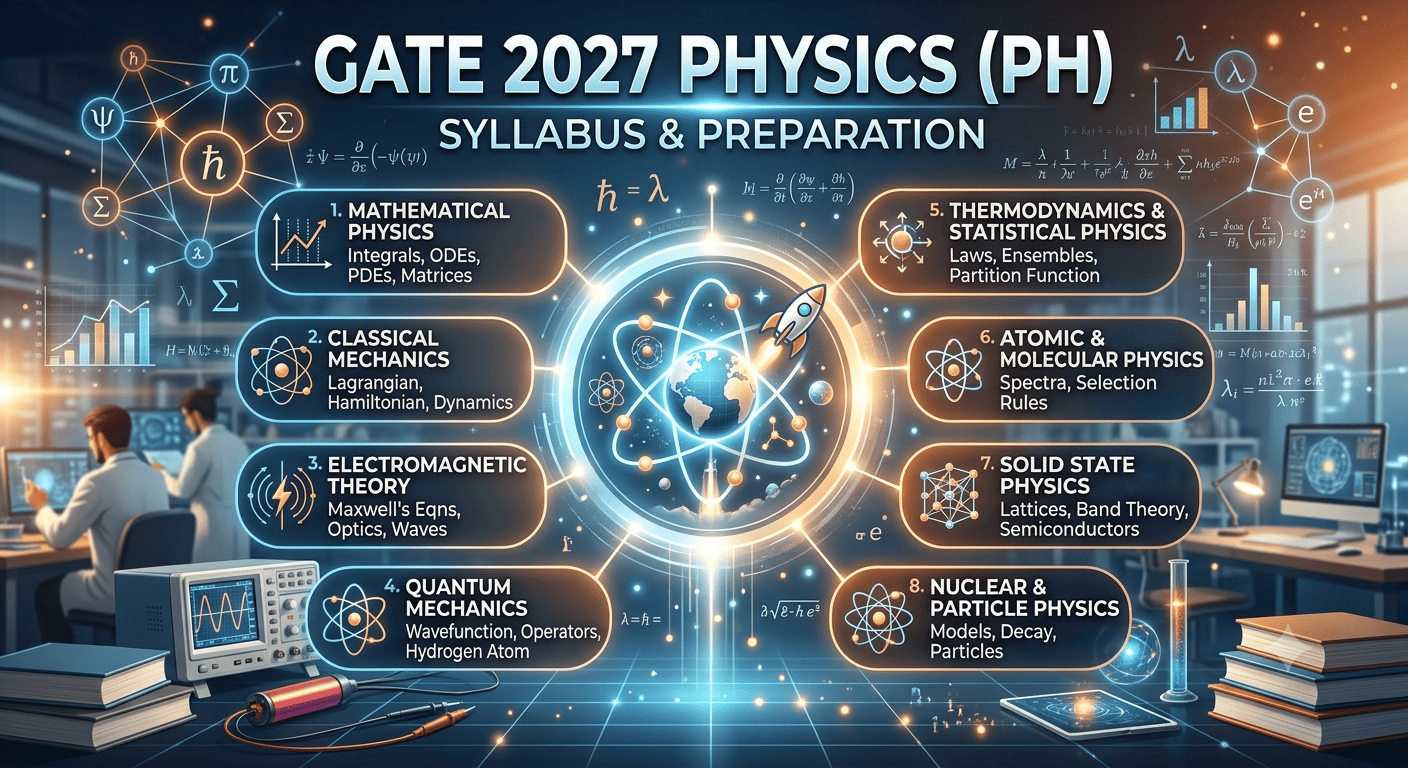
The newly released GATE 2027 Physics syllabus provides a detailed breakdown of the topics that will be covered in the examination. This includes detailed sections on Classical Mechanics, Electromagnetism, Quantum Mechanics, Thermodynamics and Statistical Physics, Electronics, and Atomic & Molecular Physics. Candidates are advised to meticulously review each section to ensure complete coverage of the curriculum.
Understanding the subject-wise weightage is critical for candidates to allocate their study time efficiently. While specific percentages for each section will be detailed within the official syllabus document, historical trends suggest a balanced distribution across core physics disciplines. Aspirants should prioritize topics that carry higher weightage while ensuring a foundational understanding of all areas.
GATE 2027 Physics: Important Topics
The official GATE 2027 Physics syllabus highlights several important topics within each major section. For instance, in Classical Mechanics, key areas often include Lagrangian and Hamiltonian formulations, central force problems, and rigid body dynamics. Electromagnetism typically emphasizes Maxwell’s equations, electromagnetic waves, and boundary value problems.
Similarly, Quantum Mechanics focuses on wave-particle duality, Schrödinger equation, perturbation theory, and angular momentum. Thermodynamics and Statistical Physics cover concepts like laws of thermodynamics, ensembles, and phase transitions. Electronics includes semiconductor devices and operational amplifiers, while Atomic & Molecular Physics explores atomic spectra, molecular bonding, and laser physics. Candidates should pay special attention to these identified crucial topics for their preparation.
People Also Read




GATE 2027 Physics: Recommended Books
The official release of the GATE 2027 Physics syllabus also includes recommendations for study materials and books. While the specific list of recommended books will be available in the detailed syllabus document, candidates typically refer to standard textbooks for a thorough understanding of concepts. For Classical Mechanics, books by H. Goldstein or J.C. Upadhyaya are often suggested. For Electromagnetism, D.J. Griffiths or J.D. Jackson are popular choices.
In Quantum Mechanics, books by D.J. Griffiths or R. Shankar are widely used. Thermodynamics and Statistical Physics can be studied from texts by F. Reif or R.K. Pathria. For Electronics, books by B.L. Theraja or J. Millman are commonly recommended. Atomic & Molecular Physics can be covered using books by B.H. Bransden and C.J. Joachain or H.E. White. Aspirants are encouraged to consult these authoritative texts to build a strong conceptual foundation.
How to Access the GATE 2027 Physics Syllabus
Candidates can access the complete GATE 2027 Physics syllabus directly from the official GATE examination portal. The syllabus document is typically available in PDF format for easy download and reference. This matters a lot for all aspiring candidates to download the official syllabus to avoid relying on outdated or unofficial information.
- Go to the official GATE website.
- Navigate to the ‘Syllabus’ section.
- Select ‘GATE 2027’ from the options.
- Click on ‘Physics (PH)’ to view and download the detailed syllabus.
- Save the PDF document for future reference and study planning.
GATE 2027: What Next for Aspirants?
With the release of the GATE 2027 Physics syllabus, candidates should immediately begin structuring their study plans. This involves analyzing the weightage of each topic, identifying their strengths and weaknesses, and allocating sufficient time for each section. Regular revision and solving previous year’s question papers will be instrumental in mastering the syllabus and understanding the examination pattern.
The GATE examination is a gateway to M.Tech and Ph.D. admissions in premier institutions like IITs, NITs, and IIITs, as well as recruitment into various Public Sector Undertakings (PSUs). Therefore, a strategic and well-planned approach based on the official syllabus is paramount for candidates aiming for a high score and securing their desired career opportunities.






Further reading
📰 More Education News
- HP NEET PG 2026 round 1 counselling registration deadline extendedOct 27, 2026 • Nishit Kumar
- AEC Asansol BTech direct admissions 2026-27 open: apply by 31 OctoberOct 27, 2026 • Nishit Kumar
- UP NEET MDS 2026 Round 3 registration closes today, October 27Oct 27, 2026 • Nishit Kumar
- CUET PG 2027 exam schedule revised: NTA shifts dates to March 2-31Oct 27, 2026 • Nishit Kumar