GATE 2027 biomedical engineering syllabus released: download PDF, understand exam pattern
In short
- IIT Madras released the GATE 2027 Biomedical Engineering (BM) syllabus on gate2027.iitm.ac.in.
- The syllabus comprises 10 sections, with Engineering Mathematics as a compulsory component.
- The GATE 2027 exam will be conducted in the first week of February 2027.
- The online application window for GATE 2027 is expected to open in the first week of September 2027.
- IIT Kanpur is the organizing institute for GATE 2027.
IIT Madras has released the Graduate Aptitude Test in Engineering (GATE) 2027 Biomedical Engineering (BM) syllabus on its official website, gate2027.iitm.ac.in. This release aims to assist candidates in planning their study schedules and understanding subject-wise priorities for the upcoming examination.
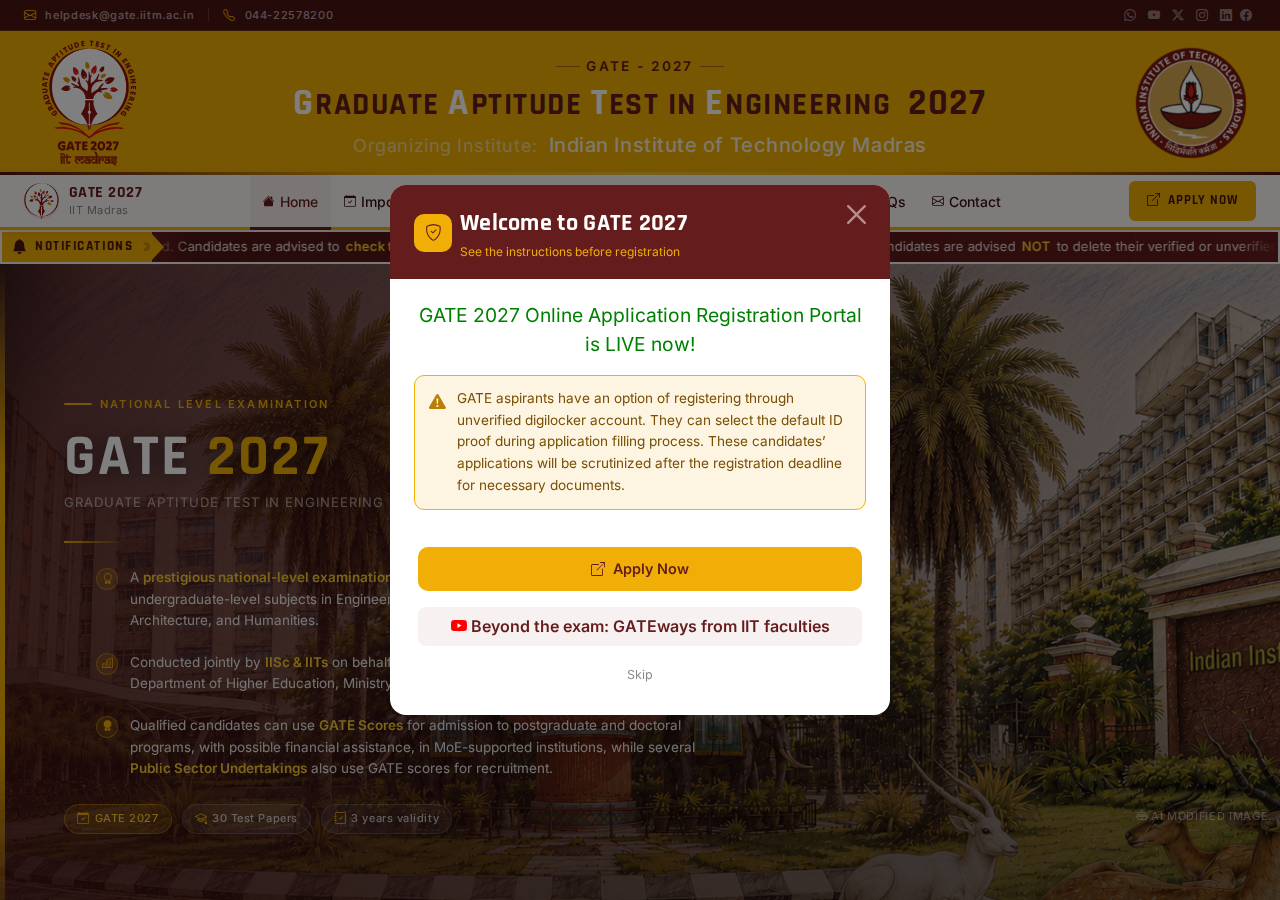
The GATE 2027 exam, organized by IIT Kanpur, is scheduled to be conducted in the first week of February 2027. The online application process for GATE 2027 is anticipated to commence in the first week of September 2027.
GATE 2027 Biomedical Engineering Syllabus Overview
The GATE 2027 Biomedical Engineering (BM) syllabus consists of a total of 10 sections. Engineering Mathematics is a compulsory section, carrying 13 marks in the BM paper. Core topics covered include Electrical Circuits, Signals and Systems, Analog and Digital Electronics, and Bioinstrumentation.
The examination evaluates candidates on their understanding of engineering fundamentals and core biomedical engineering subjects. The General Aptitude (GA) syllabus is common for all subjects and includes English language skills, numerical ability, analytical reasoning, and data interpretation. Subject-specific questions in the BM paper account for 85 marks, while general aptitude questions are worth 15 marks.
| Particular | Details |
|---|---|
| Exam | Graduate Aptitude Test in Engineering (GATE) |
| Organising Institute | IIT Madras |
| GATE Biomedical Engineering Paper Code | BM |
| Total sections | 10 |
Detailed Syllabus Sections
The Engineering Mathematics syllabus encompasses Linear Algebra, Calculus, Differential Equations, Analysis of Complex Variables, Probability and Statistics, and Numerical Methods. The Electrical Circuits section covers network analysis, AC/DC circuits, circuit theorems, and filter fundamentals. Signals and Systems focuses on signal analysis and system response in both continuous and discrete domains.
Analog and Digital Electronics includes the basic characteristics and applications of diodes, BJTs, MOSFETs, and operational amplifiers. Other key sections are Measurements and Control Systems, Sensors and Bioinstrumentation, Mammalian Cell Biology, Human Anatomy and Physiology, Medical Imaging Systems, Biomechanics, and Biomaterials and Tissue Engineering. The General Aptitude section’s English syllabus covers grammar, vocabulary, sentence completion, verbal analogies, word groups, instructions, critical reasoning, and verbal deduction. Quantitative aptitude topics include numerical computation, estimation, ratios, percentages, powers, exponents, logarithms, permutations and combinations, probability, statistics, mensuration, geometry, and data interpretation using tables, charts, and graphs. Analytical and spatial aptitude covers logical and analytical reasoning, pattern recognition, spatial visualisation, transformation, paper folding, and assembling of shapes.
GATE 2027 Exam Pattern and Marking Scheme
The GATE 2027 examination will be a Computer Based Test (CBT) with a duration of 3 hours. It will comprise 65 questions in total, including 10 General Aptitude questions and 55 subject-specific questions. The question types will include Multiple Choice Questions (MCQs), Multiple Select Questions (MSQs), and Numerical Answer Type (NAT) questions.
There will be negative marking for MCQs, but no negative marking for NAT questions. Questions will be of 1 mark and 2 marks each. The distribution of marks for the Biomedical Engineering paper includes 15 marks for General Aptitude, 13 marks for Engineering Mathematics, and 72 marks for subject-specific questions, totaling 100 marks.
| Particulars | Details |
|---|---|
| Examination Mode | Computer Based Test (CBT) |
| Exam Duration | 3 Hrs |
| Number of Subjects | 27 |
| Sections | General Aptitude (GA) + Candidate’s Selected Subjects |
| Type of Questions | i) Multiple Choice Questions (MCQs) ii) Multiple Select Questions (MSQs) iii) Numerical Answer Type (NAT) |
| Number of Questions | 10 (GA) + 55 (subject) = 65 Questions |
| Section | Marks |
|---|---|
| General Aptitude | 15 Marks |
| Engineering Mathematics | 13 Marks |
| Subject Questions | 72 Marks |
| Total | 100 Marks |
Further reading

📰 More Education News
- ITM Business School admission guide released: know programs, financial aid, GATE cutoffsSep 22, 2026 • Nishit Kumar
- AILET 2027 GK preparation tips released by NLU Delhi for December 13 examSep 22, 2026 • Nishit Kumar
- AILET 2027 registration closes November 10 for NLU Delhi BA LLB HonoursSep 22, 2026 • Nishit Kumar
- Indore International College: Apply for B.Pharm 2026 admissions nowSep 22, 2026 • Nishit Kumar