GATE 2027 biotechnology syllabus revised after five years by IIT Madras
In short
- IIT Madras has released the GATE 2027 Biotechnology (BT) syllabus, which includes six sections.
- The GATE 2027 Biotechnology syllabus has been revised after five years and is available in PDF format.
- The GATE 2027 exam will be a Computer-Based Test (CBT) with a duration of 3 hours (180 minutes).
- The exam will consist of 65 questions for a total of 100 marks, with 15 marks for General Aptitude and 85 for the subject.
- IIT Kanpur is the organizing institute for GATE 2027, which will be conducted for 30 test papers.
IIT Madras has released the Graduate Aptitude Test in Engineering (GATE) 2027 Biotechnology (BT) syllabus. This revision marks the first update to the Biotechnology syllabus in five years.
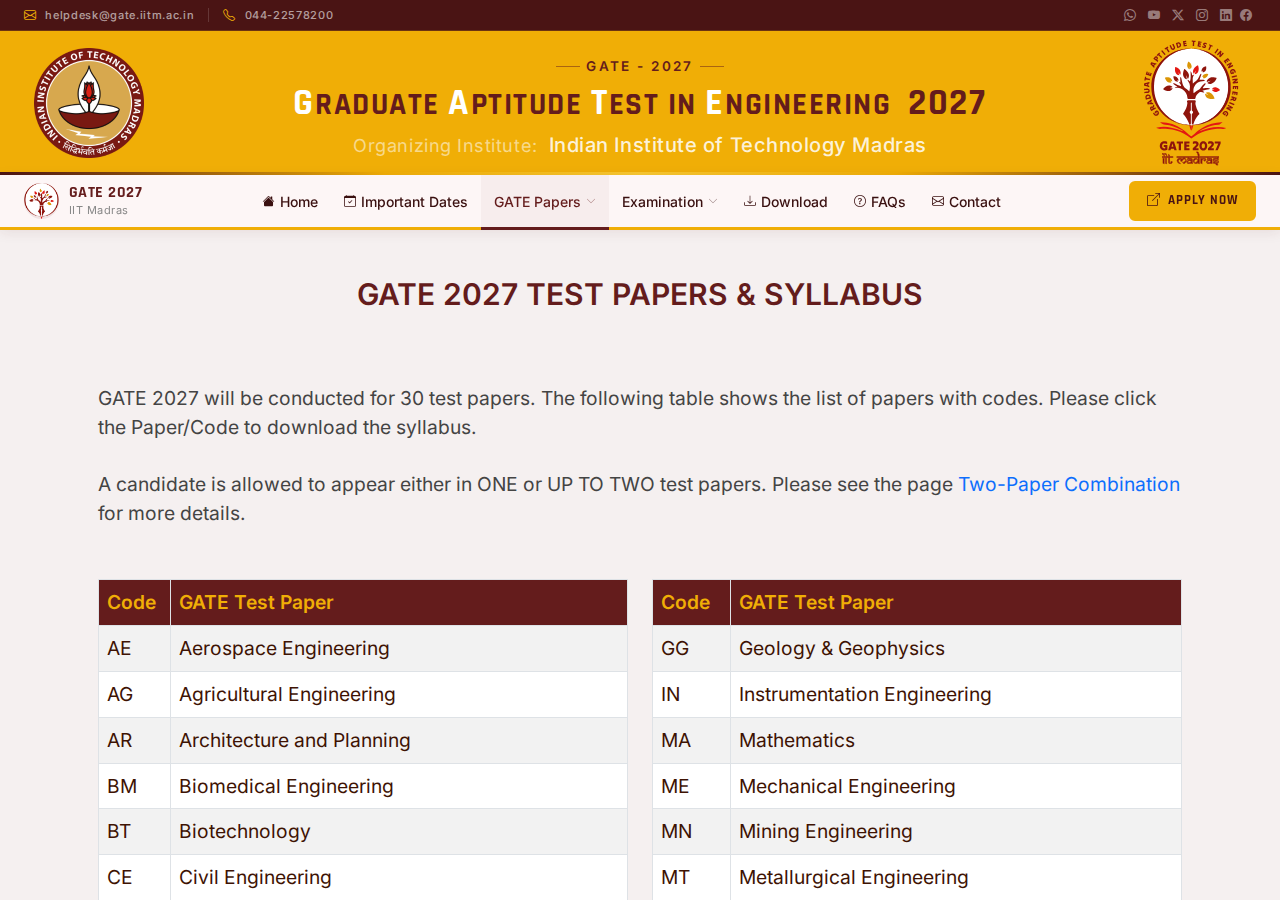
The GATE 2027 examination will be conducted for 30 test papers, with IIT Kanpur serving as the organizing institute. The Biotechnology paper, identified by the code BT, will be a Computer-Based Test (CBT) lasting 3 hours.
Revised GATE 2027 Biotechnology Syllabus Structure
The GATE 2027 Biotechnology (BT) syllabus is structured into six main sections, differing from the eight major areas covered in GATE 2026. The overall exam syllabus is divided into three parts: General Aptitude, Engineering Mathematics, and the Core syllabus. General Aptitude is common across all subjects, while Engineering Mathematics and the core Biotechnology syllabus are specific to the BT paper.
The core syllabus for GATE 2027 Biotechnology now includes General Biology; Genetics, Cellular, and Molecular Biology; Fundamentals of Biological Engineering; Plant, Animal, and Microbial Biotechnology; and Recombinant DNA Technology and Other Tools in Biotechnology. The General Biology section specifically covers biochemistry, microbiology, and immunology chapters. The complete syllabus has been released in PDF format.
| Particulars | Details |
|---|---|
| Exam Name | Graduate Aptitude Test in Engineering (GATE) |
| GATE Paper Code of Biotechnology | BT |
| Organising IIT of GATE 2027 | IIT Kanpur |
| Subject | Biotechnology |
| Number of sections | 6 |
| Exam Mode | Computer-Based Test |
Examination Pattern and Marking Scheme
The GATE 2027 examination will be a Computer-Based Test (CBT) with a duration of 3 hours (180 minutes). Each paper will be for a total of 100 marks, comprising 65 questions. General Aptitude (GA) is common for all papers, accounting for 15 marks with 10 questions, while the subject-specific questions will cover the remaining 85 marks with 55 questions.
The question types will include Multiple Choice Questions (MCQs), Multiple Select Questions (MSQs), and Numerical Answer Type (NAT) questions. There will be no negative marking for MSQ and NAT questions. However, for incorrect answers in MCQs, 1/3 mark will be deducted for a 1-mark question, and 2/3 mark will be deducted for a 2-mark question. Candidates are permitted to appear in either one or up to two test papers, and all test papers will be in English.
| Particulars | Details |
|---|---|
| Examination Mode | Computer Based Test (CBT) |
| Exam Duration | 3 Hrs |
| Number of Subjects | 27 |
| Sections | General Aptitude (GA) + Candidate’s Selected Subjects |
| Type of Questions | i) Multiple Choice Questions (MCQs) ii) Multiple Select Questions (MSQs) iii) Numerical Answer Type (NAT) |
| Number of Questions | 10 (GA) + 55 (subject) = 65 Questions |
| Section | Marks |
|---|---|
| General Aptitude | 15 Marks |
| Engineering Mathematics | 13 Marks |
| Subject Questions | 72 Marks |
| Total | 100 Marks |
Detailed Syllabus for General Aptitude and Engineering Mathematics
The General Aptitude (GA) syllabus, common for all subjects, has been released on the official website. It encompasses English, Reading Comprehension, Quantitative Aptitude, and Analytical and Spatial Aptitude. The English section includes grammar, vocabulary, and critical reasoning, while Reading Comprehension focuses on passage interpretation. Quantitative Aptitude covers numerical computation, ratios, percentages, and data interpretation. Analytical and Spatial Aptitude involves logical reasoning and pattern recognition.
Engineering Mathematics, a component of the Biotechnology paper, includes Linear Algebra, Calculus, Differential Equations, Probability and Statistics, and Numerical Methods. Specific topics range from matrices and determinants in Linear Algebra to multivariable calculus and sequences in Calculus. Differential Equations cover linear and nonlinear ODEs, and Probability and Statistics include various distributions and regression analysis. Numerical Methods focus on solving algebraic equations and integration techniques.
| Topics | Syllabus |
|---|---|
| English | English Grammar, Vocabulary, Sentence completion, Verbal analogies, word groups, instructions, critical reasoning, and verbal deduction |
| Reading comprehension | Reading comprehension and interpretation of passages |
| Quantitative aptitude | Numerical computation, estimation, ratios, percentages, powers, exponents, logarithms, permutations and combinations, probability, statistics, mensuration, geometry, and data interpretation using tables, charts, and graphs |
| Analytical and spatial aptitude | Logical and analytical reasoning, pattern recognition, spatial visualisation, transformation, paper folding, and assembling of shapes |
| Topics | Sub-Topics |
|---|---|
| Linear Algebra | Matrices and determinants; Systems of linear equations; Eigen values and eigenvectors |
| Calculus | Multivariable calculus (limits, continuity, and differentiability); Partial derivatives, maxima and minima; Sequences and series; Test for convergence. Multivariable calculus: Gradient, divergence, and curl (for applications in fluid mechanics, transport processes, etc.). |
| Differential Equations | Linear and nonlinear first order ODEs, higher order ODEs with constant coefficients; Cauchy’s and Euler’s equations; Laplace transforms |
| Probability and Statistics | Mean, median, mode and standard deviation; Random variables; Poisson, normal and binomial distributions; Correlation and regression analysis; Bayesian Statistics. |
| Numerical Methods | Solution of linear and nonlinear algebraic equations; Integration by trapezoidal and Simpson’s rule; Single step method for differential equations |
Further reading

📰 More Education News
- Punjab Police Constable admit card 2026 released for PST, PMT; download by October 31Oct 8, 2026 • Nishit Kumar
- BSEB Simultala Class 6 Prelims: Download admit card Oct 9, 2026Oct 8, 2026 • Nishit Kumar
- Class 12 Maths syllabus 2027, chapters, solutions released for board and JEE, CUET examsOct 8, 2026 • Nishit Kumar
- NMAT 2026: Register by Oct 10, schedule test by Oct 22Oct 8, 2026 • Nishit Kumar