GATE 2027: IIT Madras Introduces Robotics and Automation, Expands to 30 Papers
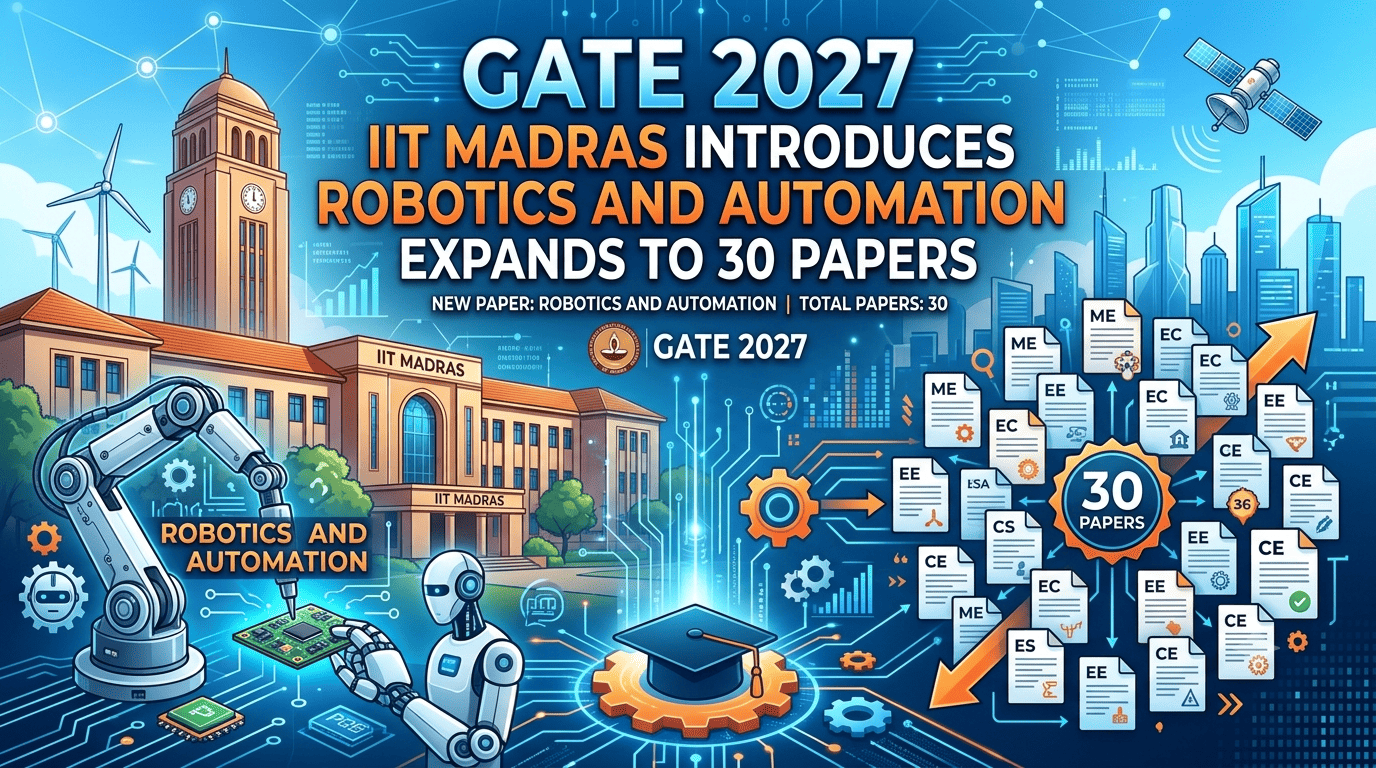
IIT Madras, the organizing institute for GATE 2027, has announced the introduction of a new Robotics and Automation (RA) paper, expanding the total number of test papers to 30. The Graduate Aptitude Test in Engineering (GATE) 2027 will be conducted across six dates: February 6, 7, 13, 14, 20, and 21, 2027, with the application portal expected to open in mid-August 2026 at gate2027.iitm.ac.in. This marks a significant evolution from the inaugural GATE examination held on February 26, 1983, which featured only two papers.
The transformation of GATE over more than four decades highlights its expanded role from a qualifying examination for postgraduate engineering admissions at five IITs and IISc Bangalore to a full assessment used for master’s and direct doctoral programmes, financial assistance, and recruitment by Public Sector Undertakings. The move to 30 papers, including specialized fields like Robotics and Automation, reflects the dynamic changes in engineering and science disciplines, catering to a broader spectrum of academic and career aspirations across India.
| Event | GATE exam evolution |
|---|---|
| Date | 26 February 1983 |
| Official portal | gate2027.iitm.ac.in |
| Status | Announced |
GATE 2027: Key Changes and Examination Structure
GATE 2027, organized by IIT Madras, will be a computer-based examination (CBT) conducted in both forenoon and afternoon sessions on each of the six scheduled dates. Candidates will have the option to appear for one or up to two test papers, subject to permitted two-paper combinations, which must be included in a single application. Each paper will carry 100 marks, with 15 marks allocated to General Aptitude and the remaining 85 marks covering the respective test-paper syllabus, as stated by IIT Madras.
A significant addition for GATE 2027 is the Robotics and Automation (RA) paper, which pushes the total discipline count to 31, including the Data Science and Artificial Intelligence (DA) paper launched in 2024. Also, IIT Madras has revised the syllabi and made changes to existing papers; for instance, the Textile Engineering & Fibre Science (TF) paper has been converted into a sectional paper within Engineering Sciences (XE). The examination will be conducted exclusively in English, and online registration will incorporate DigiLocker along with facial registration for a fair and secured process.
Evolution of GATE: from 1983 to 2027
The first GATE examination, held on February 26, 1983, was a two-paper assessment designed to select students for postgraduate programmes at five IITs and the Indian Institute of Science (IISc), Bangalore. In 1983, candidates requested application forms by sending a Rs 5 Indian Postal order and a self-addressed stamped envelope, with a registration fee of Rs 45 paid via demand draft. Admit cards were received by post, and candidates were expected to bring their own slide rule and instrument box, with electronic calculators permitted. The examination was conducted on a single day, with Paper I (General Engineering Sciences, 40% weightage) from 9 am to 11 am and Paper II (discipline-specific, 60% weightage) from 1 pm to 4 pm.
In stark contrast, GATE 2027 uses the GATE Online Application Processing System (GOAPS) for online applications, reflecting a complete digital transformation. The foundational roots of GATE trace back to the early 1980s, following recommendations from the Nayudamma Review Committee on Postgraduate Engineering Education. Initially, a GATE scorecard was valid for only a single academic year, focusing on screening candidates for financial assistance during 3-semester Master’s degrees. The Council of Scientific and Industrial Research (CSIR) linked the Junior Research Fellowship (JRF) scheme with GATE in 2002, further broadening its utility. The transition to a 100% Computer-Based Testing (CBT) format was completed in 2014, which also introduced Numerical Answer Type (NAT) formats and a unified three-year scorecard validity, a policy that continues for GATE 2027. The integrated virtual calculator was introduced in 2016, eliminating physical scientific calculators, and in 2021, eligibility parameters were relaxed to allow 3rd-year undergraduate students to participate, alongside the addition of Humanities and Social Sciences (XH) and Environmental Science (ES) streams.
GATE 2027: Important Dates
Candidates planning to appear for GATE 2027 should note the following schedule:
| Event | Date |
|---|---|
| Application Portal Opening (Expected) | Mid-week of August 2026 |
| GATE 2027 Examination Dates | February 6, 7, 13, 14, 20, 21, 2027 |
| Scorecard Validity | Three years from result announcement |
People Also Read




How to Apply for GATE 2027
Eligible candidates for GATE 2027 will need to follow an online application process through the official portal:
- Go to the official GATE 2027 website, gate2027.iitm.ac.in.
- Access the GATE Online Application Processing System (GOAPS) portal.
- Register online, which will involve DigiLocker integration and facial registration.
- Fill in the application form with all required personal and academic details.
- Select the desired test paper(s) from the 30 available options, ensuring adherence to permitted two-paper combinations.
- Upload necessary digital documents, including a photograph and signature.
- Pay the registration fee online.
- Review the application and submit it before the deadline.
- Track the application status through the GOAPS portal.
GATE Score: Broader Implications Today
While GATE 1983 was primarily a qualifying examination for postgraduate engineering programmes at IITs and IISc with linked scholarships, the role of a valid GATE score today is considerably broader. A valid GATE score remains valid for three years from the date of announcement of results and can be used for admission to master’s and direct doctoral programmes across various institutions. Furthermore, qualifying GATE can be used to seek financial assistance for higher studies. Significantly, several Public Sector Undertakings (PSUs) now use GATE scores as a criterion for recruitment, underscoring its importance beyond academic admissions into professional careers.
Frequently Asked Questions
When Is GATE 2027 Scheduled to Be Conducted?
GATE 2027 is scheduled across six dates: February 6, 7, 13, 14, 20, and 21, 2027, conducted in both forenoon and afternoon sessions.
How Many Test Papers Will Be Offered in GATE 2027?
GATE 2027 will offer 30 test papers, and eligible candidates can choose to appear for one or up to two papers.
What Is New in GATE 2027 Compared to Previous Years?
GATE 2027 introduces Robotics and Automation as a new test paper, revises syllabi, updates sectional codes for XE, XH, and XL, and converts Textile Engineering & Fibre Science (TF) to a sectional paper in XE.
What Is the Application Process for GATE 2027?
GATE 2027 uses the GATE Online Application Processing System (GOAPS), where candidates submit applications online, upload digital photograph and signature, and track status.







Further reading
📰 More Education News
- BSEB Class 10, 12 exam 2027 form submission reopens with late fee until October 31Oct 16, 2026 • Nishit Kumar
- Kerala Plus One SAY Improvement Biology exam on October 17: question paper, answer key soonOct 16, 2026 • Nishit Kumar
- Bihar STET 2026: Download admit card from Oct 18; exams start Oct 25Oct 16, 2026 • Nishit Kumar
- NIFT 2027 registration begins: apply by 16 November for UG, PG coursesOct 16, 2026 • Nishit Kumar