KKHSOU UG Minor 3rd Semester Practical Exam 2026 for Database Management starts October 12
In short
- The UG Minor 3rd Semester Practical Examination, 2026 for “Fundamentals of Database Management System” will commence on October 12, 2026.
- The examination is scheduled to begin at 10:00 AM on the specified date.
- Eligible learners who have opted for the course must appear for the practical examination.
- Candidates are required to report to the same Examination Centre where they appeared for their Theory Examination.
- Examination Hall Rules for Students are applicable for this practical examination.
Krishna Kanta Handique State Open University (KKHSOU) has released the schedule for the UG Minor 3rd Semester Practical Examination, 2026 for the course “Fundamentals of Database Management System”. The examination is set to begin on Monday, October 12, 2026, at 10:00 AM.
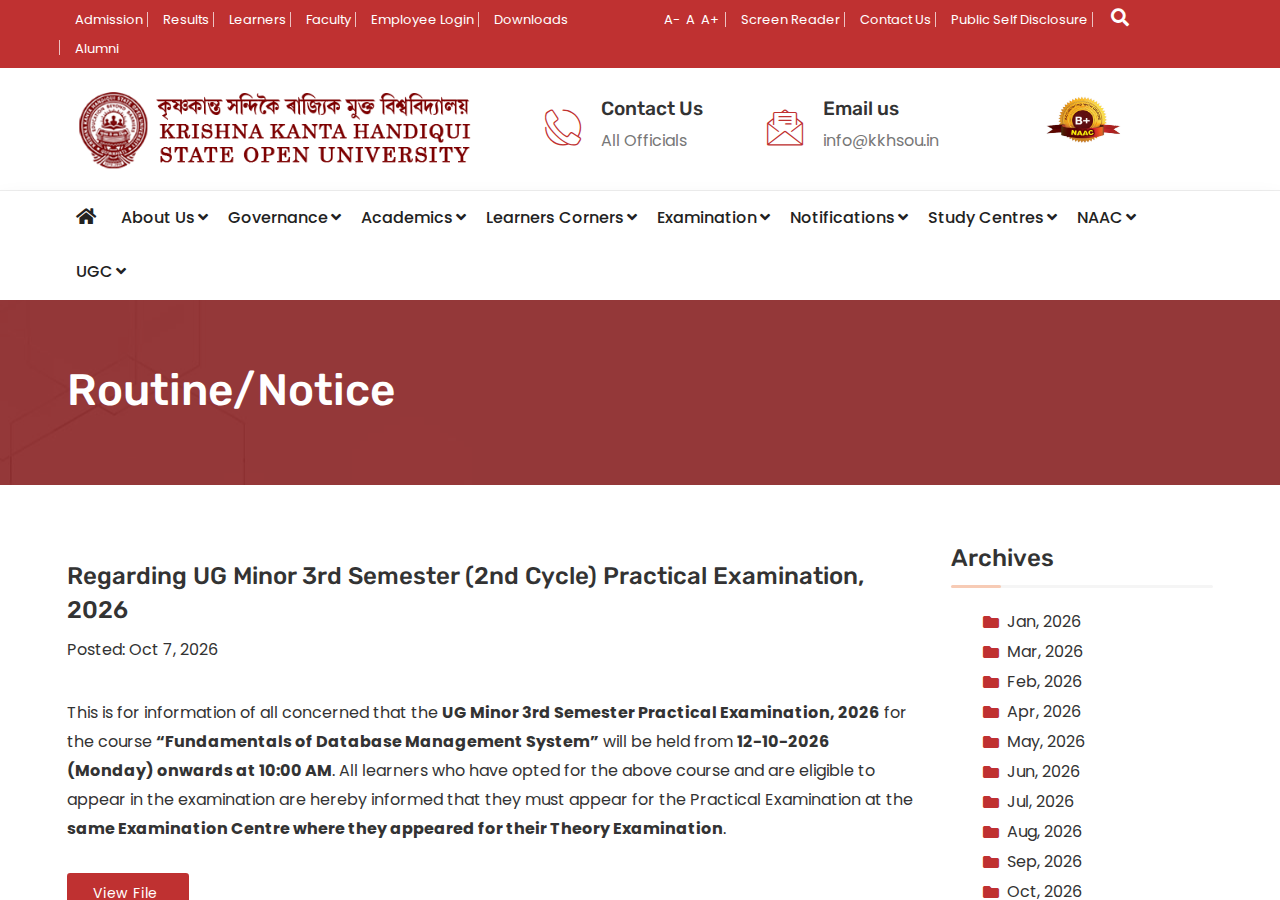
All eligible learners who have opted for the “Fundamentals of Database Management System” course are required to appear for this practical examination. The examination will be held at the same centres where candidates previously took their theory examinations.
Examination Details and Guidelines
The practical examination for the UG Minor 3rd Semester, 2026, specifically for the “Fundamentals of Database Management System” course, will start on October 12, 2026. Learners must ensure they report to their designated examination centres by 10:00 AM on the commencement date. This examination is a mandatory component for all students who have enrolled in and are eligible for the course.
The standard Examination Hall Rules for Students are effective for this practical examination, consistent with those applied to theory and other minor examinations. Invigilators at the examination centres are instructed to set up Level 1 of these rules to maintain the integrity of the examination process.
KKHSOU’s Reach and Institutional Affiliations
KKHSOU operates through various study centres across the region, supporting distance education. Institutions such as K.R.B. Girls’ College, Bengtol College, and Pragjyotish College host study centres for Krishna Kanta Handique State Open University. Bengtol College, established in 1981, has been imparting education through distance mode via KKHSOU.
K.R.B. Girls’ College, established in 1971, achieved a B++ rank in its third cycle of NAAC accreditation and offers BA courses in 10 subjects. Bengtol College, recognized under Section 2 (f) and 12 (B) of the UGC Act 1956 since 2009, is affiliated with Bodoland University, Kokrajhar, Assam, since 2020. These affiliations highlight the widespread network supporting KKHSOU’s educational initiatives.
Broader Educational Context and NEP 2020 Alignment
The examination takes place within a broader educational landscape that is increasingly aligning with the National Education Policy (NEP) 2020. The Four-Year Undergraduate Programme (FYUGP) in Education, for instance, has a flexible structure allowing completion in three or four years with multiple entry and exit points. Madhabdev University’s FYUGP syllabus for Education (1st to 8th Semester) was approved in May 2026, comprising 26 Core Courses and 8 Minor Courses.
A 4-credit course on Research Methodology is incorporated in the 7th semester of the FYUGP in Education, with Dissertation and Fieldwork included in the 8th semester. Institutions like Bengtol College and K.R.B. Girls’ College are implementing FYUGP under the Choice-Based Credit System (CBCS) and skill-based education as per NEP requirements, reflecting a shift towards more flexible and skill-oriented learning pathways.

Further reading
📰 More Education News
- Jammu University: Apply for National Scholarship Portal by October 6, 2026Oct 7, 2026 • Nishit Kumar
- CG Vyapam Group 2: Apply for 1,710 posts; exam on Jan 10, 2027Oct 7, 2026 • Nishit Kumar
- NPCIL internship for CA/CMA students: apply by 26 October 2026Oct 7, 2026 • Nishit Kumar
- NEET PG 2026 counselling schedule released: Round 1 registration from October 12Oct 7, 2026 • Nishit Kumar