MHT CET 2027 Chemistry syllabus and high-weightage topics detailed for engineering and pharmacy admissions
In short
- The MHT CET 2027 Chemistry syllabus is derived from the Maharashtra State Board Class 11 and Class 12 curricula.
- Approximately 80% of the Chemistry questions will be based on the Class 12 syllabus, with 20% from Class 11.
- The Chemistry paper will comprise 50 questions for 100 marks, and there will be no negative marking in the MHT CET 2027 exam.
- High-weightage topics include Alcohols, Phenols, and Ethers, Aldehydes, Ketones, and Carboxylic Acids, and Coordination Compounds.
- The official MHT CET 2027 syllabus PDF is anticipated to be released in the second week of October 2026.
Students targeting the MHT CET 2027 for admission to engineering, pharmacy, and agriculture degree programs in Maharashtra state universities and affiliated colleges should note the detailed Chemistry syllabus, high-weightage topics, and marking scheme. The MHT CET 2027 exam will be conducted online in Computer Based Test (CBT) mode across multiple sessions.
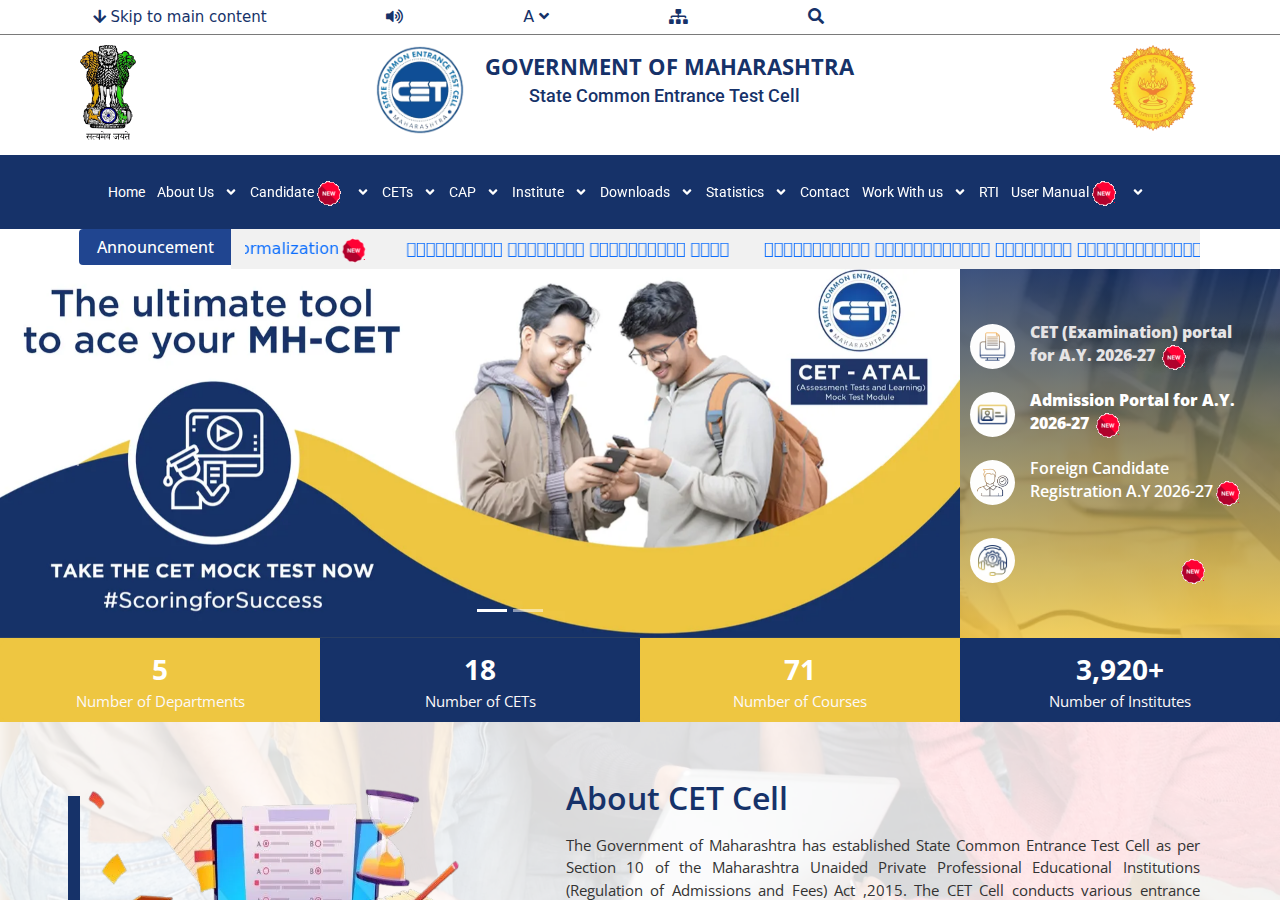
The MHT CET is Maharashtra’s primary gateway for these admissions, with over 4 lakh students appearing annually. While JEE Main scores are accepted for some engineering seats, MHT CET is the dominant route, particularly for the 85% state quota seats.
MHT CET 2027 Chemistry Syllabus and Weightage
The MHT CET 2027 Chemistry syllabus is based on the Maharashtra State Board (MSBSHSE) Class 11 and Class 12 curricula. Approximately 20% of the questions in the MHT CET 2027 Chemistry paper will be based on the Class 11 syllabus, while 80% will be derived from the Class 12 curriculum. The official MHT CET 2027 syllabus PDF is expected to be released by the State Common Entrance Test Cell, Maharashtra, in the second week of October 2026.
The Class 11 Chemistry topics include Some Basic Concepts of Chemistry, Structure of Atom, Chemical Bonding, Redox Reactions, Elements of Group 1 and 2, States of Matter (Gaseous and Liquids), Adsorption and Colloids (Surface Chemistry), Hydrocarbons, Basic Principles of Organic Chemistry, and Chemistry in Everyday Life. The complete Class 12 Maharashtra State Board syllabus is included, covering Solid State, Solutions, Ionic Equilibria, Chemical Thermodynamics and Energetics, Electrochemistry, Chemical Kinetics, General Principles and Processes of Isolation of Elements, p-Block Elements, d- and f-Block Elements, Coordination Compounds, Halogen Derivatives, Alcohols, Phenols and Ethers, Aldehydes, Ketones and Carboxylic Acids, Amines, Biomolecules, Polymers, Green Chemistry and Nanochemistry.
Exam Pattern and Marking Scheme for Chemistry
The MHT CET 2027 Chemistry paper (Paper 2) consists of 50 multiple-choice questions (MCQs) for a total of 100 marks. Each question carries 2 marks, and there is no negative marking in the MHT CET exam. The difficulty level for Physics, Chemistry, and Mathematics in MHT CET is on par with JEE (Main), while for Biology, it aligns with NEET (UG).
Paper 2, which includes both Physics and Chemistry, has a total of 100 questions (50 Physics + 50 Chemistry) for 200 marks (100 Physics + 100 Chemistry). The duration for Paper 2 is 90 minutes each for Physics and Chemistry. The overall MHT CET 2027 exam duration for both PCM (Physics, Chemistry, Mathematics) and PCB (Physics, Chemistry, Biology) papers is 180 minutes, with a total of 200 marks for both streams.
| Particular | Details |
|---|---|
| Exam Mode | Computer-Based Test (CBT) |
| Subjects (Engineering) | Physics, Chemistry & Mathematics |
| Subjects (Pharmacy/Agriculture) | Physics, Chemistry & Biology |
| Syllabus Basis (Level of Questions) | Maharashtra State Board Class 11 & 12 |
| Class 11 Weightage | Approximately 20% |
| Class 12 Weightage | Approximately 80% |
| Question Type | Multiple Choice Questions (MCQs) |
| Marking Scheme | No Negative Marking |
High-Weightage Topics in MHT CET 2027 Chemistry
Analysis of past trends indicates several high-weightage topics within the MHT CET 2027 Chemistry syllabus. Students are advised to focus on these areas for strategic preparation, as they are expected to contribute a significant number of questions to the exam. The State Common Entrance Test Cell, Maharashtra, conducts the MHT-CET, which is the primary basis for admissions to various degree programs.
Key high-weightage topics include organic chemistry chapters such as Alcohols, Phenols, and Ethers, and Aldehydes, Ketones, and Carboxylic Acids, which collectively can account for up to 10 questions. Inorganic and physical chemistry topics like Coordination Compounds, Electrochemistry, and Chemical Kinetics are also significant. The MHT CET 2026 exam introduced a change to be conducted twice a year, offering more opportunities for students.
| Chapter | Class | Avg. Questions | Priority |
|---|---|---|---|
| Alcohols, Phenols, and Ethers | 12 | 4-5 | Very High |
| Coordination Compounds | 12 | 3-4 | High |
| Electrochemistry | 12 | 3-4 | High |
| Chemical Kinetics | 12 | 3-4 | High |
| Amines | 12 | 3-4 | High |
| Aldehydes, Ketones, and Carboxylic Acids | 12 | 3-5 | Very High |
| Polymers and Biomolecules | 12 | 2-3 | Medium-High |
| Solutions and Colligative Properties | 12 | 2-3 | High |
Further reading

📰 More Education News
- JEE Advanced 2027 login to activate in April for registration, admit card, resultsSep 29, 2026 • Nishit Kumar
- MHT CET 2027 syllabus PDF expected in October: check Maths weightage, paper patternSep 29, 2026 • Nishit Kumar
- MHT CET 2027 Physics syllabus based on Class 11 and 12 curriculumSep 29, 2026 • Nishit Kumar
- West Bengal HS semester 3 exam 2027 dates revised: check new scheduleSep 29, 2026 • Nishit Kumar