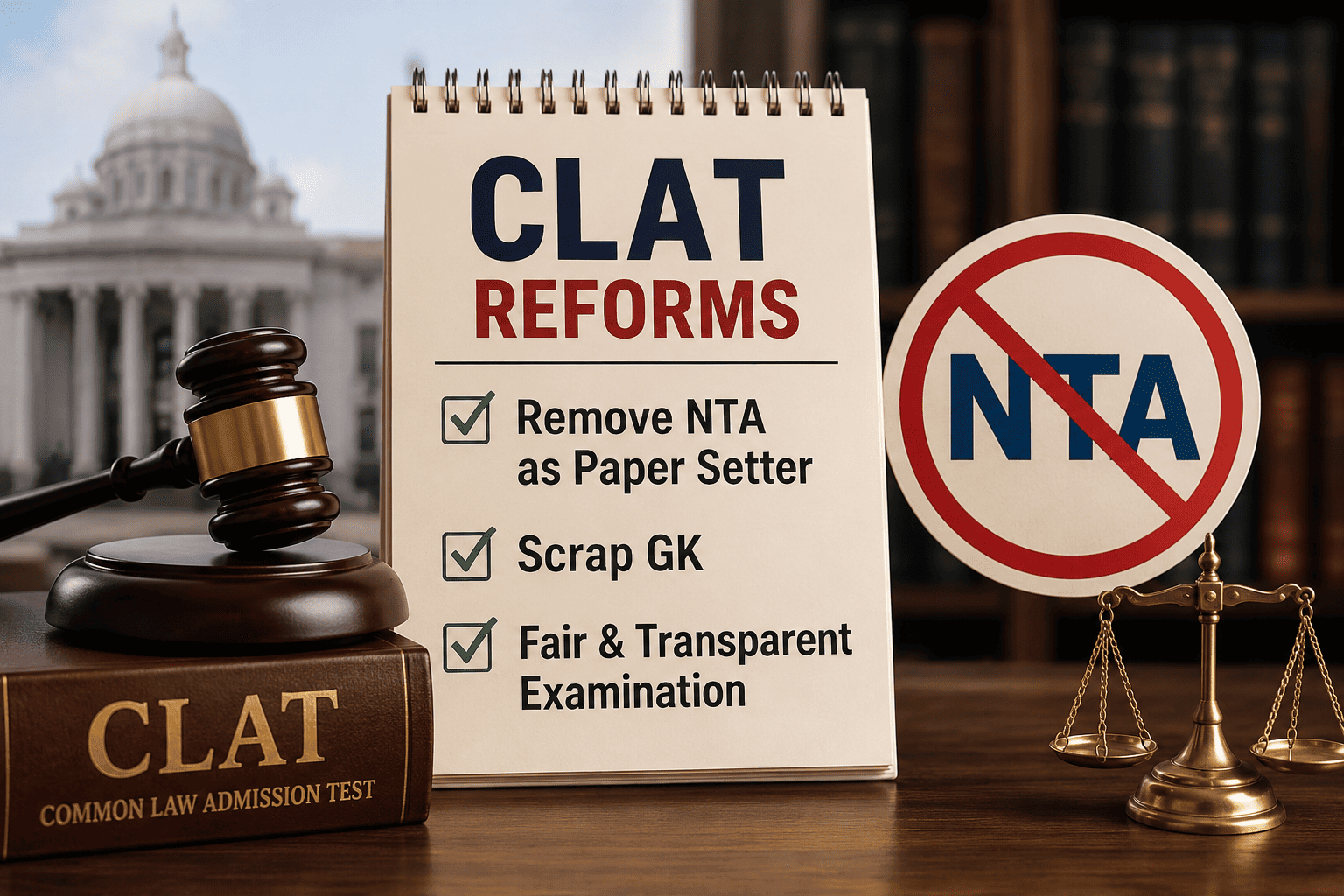
Remove NTA as Paper Setter, Scrap GK: Expert Committee Suggested CLAT Reforms
An independent expert committee set up by the Consortium of National Law Universities (NLUs) has submitted a groundbreaking report recommending sweeping changes to the Common Law Admission Test (CLAT).
The primary recommendation calls for a complete overhaul of the undergraduate entrance paper, explicitly advising against handing over exam management to the National Testing Agency (NTA) while urging the complete removal of the standalone General Knowledge (GK) and Current Affairs section.
The recommendations signal a decisive shift toward an aptitude-focused test, aiming to make admissions fairer and drastically reduce students’ reliance on expensive coaching centers.
Why the Expert Panel Recommends Big Changes
The panel—co-convened by global legal scholars including Prof. Dev Saif Gangjee (University of Oxford) and Prof. Tarunabh Khaitan (London School of Economics)—was set up following ongoing criticism regarding question quality, ambiguous answer keys, and legal disputes over previous CLAT papers.
The committee evaluated feedback from students, academic experts, and NLU Vice-Chancellors to redesign CLAT after benchmarking it against global legal entrance standards like the LSAT (USA) and LNAT (UK).
The committee found that the current pattern focuses heavily on rapid reading speed and factual recall rather than assessing actual legal aptitude, analytical thinking, and critical comprehension.
The Key Highlights of the Report
1. Ruling Out NTA and Keeping Control with NLUs
Amid rumors about centralizing entrance exams under a single body, the committee firmly recommended that the National Testing Agency (NTA) should not be appointed as the paper setter for CLAT.
The report emphasizes that setting questions for a specialized law exam requires a deep understanding of legal reasoning and analytical standards. Maintaining direct oversight by NLU academics ensures higher question quality, precise answer keys, and better academic standards.
2. Scrapping General Knowledge and Current Affairs
One of the most radical suggestions is dropping the dedicated Current Affairs and GK section.
The Core Problem: The panel observed that the current GK section rewards mechanical rote-memorization, daily trivia chasing, and factual recall.
By eliminating the separate GK section, the exam aims to discourage students from cramming endless monthly current affairs booklets, shifting the focus to core cognitive abilities instead.
3. Restructuring into a 3-Section Aptitude Test
The committee proposed restructuring the undergraduate paper from five sections down to three core aptitude domains:
-
Language and Comprehension: Replacing the current English section, this focus area moves away from testing ornamental grammar or vocabulary. Instead, it measures how effectively a student reads, interprets complex texts, grasps underlying context, and analyzes arguments.
-
Logical Reasoning and Legal Aptitude: Combining the previously distinct Legal Reasoning and Logical Reasoning sections into one integrated section. This evaluates how candidates derive rules from examples and apply them logically to given situations—requiring zero prior legal knowledge or memorized legal maxims.
-
Quantitative Techniques: Retaining basic numerical literacy and data interpretation skills to ensure candidates can analyze basic data logically.
4. Cutting Down Coaching Dependency
A central goal of these reforms is to level the playing field for students from diverse backgrounds. The current structure often gives an unfair advantage to candidates enrolled in commercial coaching institutes that churn out shortcuts and factual cheat-sheets.
By turning CLAT into a pure test of reading ability, critical thinking, and raw logic, the new framework ensures that a student’s natural comprehension skills matter far more than expensive coaching drills.
What Happens Next for Aspirants?
The Consortium of NLUs published the committee’s report to foster open public debate and invite feedback. However, these changes will not happen overnight.
| Exam Cycle | Official Status | Impact on Aspirants |
| CLAT 2027 | No Changes | The Consortium confirmed that the syllabus and exam pattern remain in the existing 5-section format. |
| CLAT 2028 onwards | Under Consideration | The Consortium will review stakeholder feedback before formally implementing the recommended 3-section layout. |

Further reading
📰 More Education News
- CUET B.Pharm question paper 2027: NTA clarifies subject choice, exam patternOct 23, 2026 • Nishit Kumar
- BSEB STET 2026 November 4 exam postponed to November 21 due to clash with KVS, NVS datesOct 23, 2026 • Nishit Kumar
- Delhi University recruitment 2026: apply for 126 assistant posts by 9 NovemberOct 22, 2026 • Nishit Kumar
- Apply for Vadodara Pharmaceutical Analysis courses by 2026Oct 22, 2026 • Nishit Kumar