TIFR GS Mathematics PhD at CAM 2026 exam details released
In short
- The TIFR GS2026 written exam for the Mathematics PhD at CAM is the sole test score considered for admission.
- The exam is 120 minutes long, comprising two sections, Part A and Part B, each with 10 multiple-choice questions.
- Negative marking applies in both sections, with varying penalties for wrong answers.
- Performance in the written exam will be used to shortlist candidates for an in-person interview at TIFR-CAM, Bengaluru.
- The syllabus covers Real Analysis, Linear Algebra, Topology, Complex Analysis, and other core mathematical topics.
The Tata Institute of Fundamental Research Graduate School (TIFR GS) has released details for the Mathematics PhD at CAM Question Paper for the GS2026 written examination. This examination, held today, 30 October 2026, is the only test score that will be considered for admission to the PhD programme in Mathematics at TIFR-CAM.
The written exam serves as the initial screening stage, with performance determining which students are shortlisted for the subsequent in-person interview process at TIFR-CAM, Bengaluru. The structure and marking scheme of this examination are designed to assess both analytical skills and conceptual understanding.
TIFR Mathematics PhD Exam Structure and Duration
The TIFR GS2026 written exam for the Mathematics PhD at CAM is a 120-minute examination, to be completed in a single sitting. It is divided into two distinct sections, Part A and Part B, with no additional time provided for individual sections. Both sections consist of 10 multiple-choice questions, each with exactly one correct answer.
Part A questions are formulated to evaluate candidates’ analytical and computational skills. These questions are based on core mathematical topics including Algebra, Linear Algebra, Real and Complex Analysis, and Geometry. In contrast, Part B questions aim to assess deep conceptual clarity and a precise understanding of mathematical logic.
Marking Scheme and Negative Marking
A strict marking scheme is in place for the TIFR GS2026 Mathematics PhD exam, featuring negative marking in both sections. For Part A, a correct answer yields +2 marks, while a wrong answer results in a deduction of -2 marks. No marks are awarded or deducted for unanswered questions. For Part B, a correct answer carries +4 marks, and a wrong answer leads to a deduction of -4 marks, with no penalty for unanswered questions.
This unique two-part format and strict marking scheme are characteristic of the TIFR Mathematics exam pattern. The detailed scoring breakdown is provided below:
| Section | Correct Answer | Wrong Answer | No Answer |
|---|---|---|---|
| Part A | +2 | -2 | 0 |
| Part B | +4 | -4 | 0 |
Syllabus for Mathematics PhD at CAM
The syllabus for the Mathematics PhD at CAM paper encompasses a broad range of advanced mathematical subjects. Candidates are expected to demonstrate proficiency in Real Analysis, Ordinary Differential Equations, Linear Algebra, Topology, Functional Analysis, Measure Theory, Complex Analysis, and Probability. These topics form the foundation upon which both the analytical and conceptual questions of the exam are built.
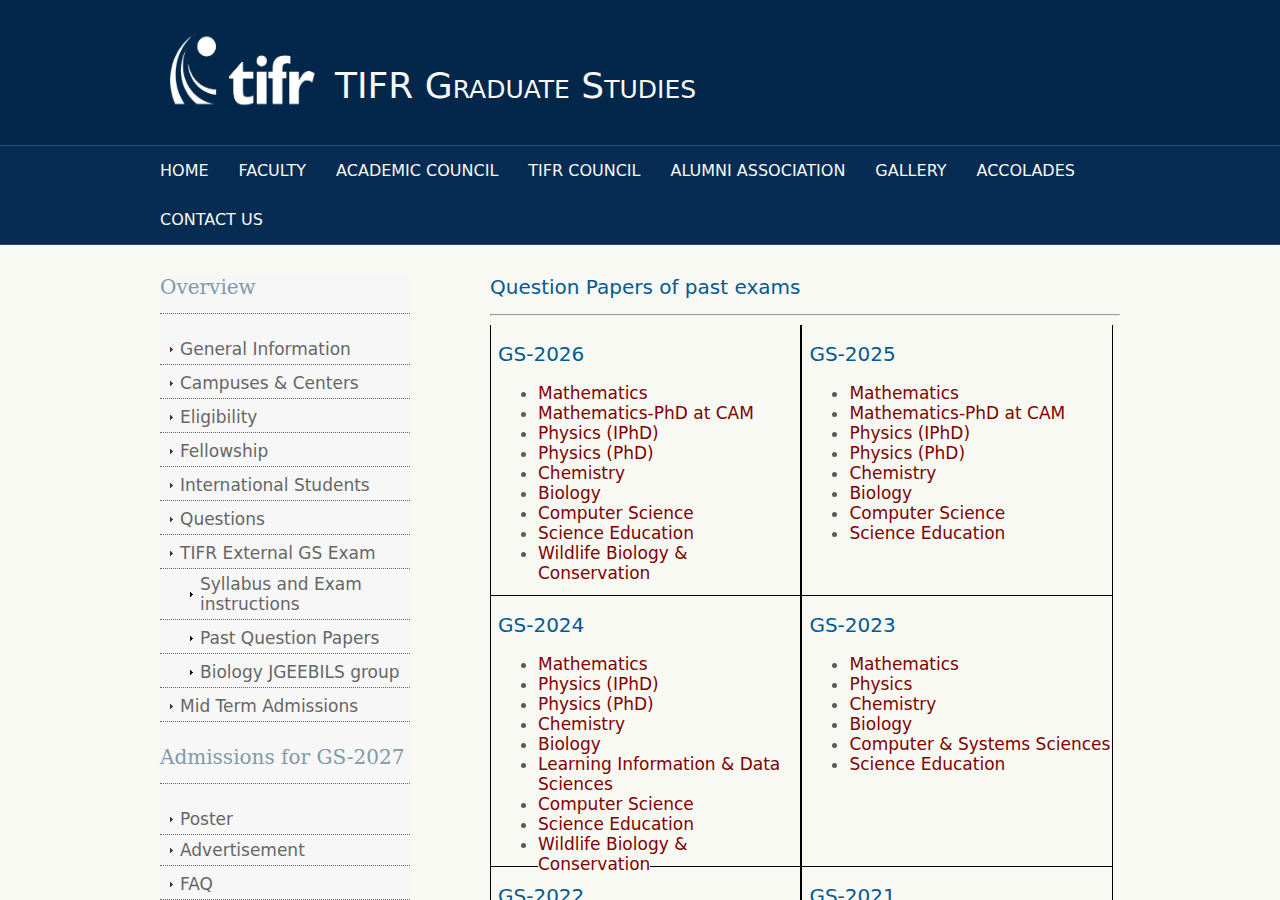
For preparation, past question papers from GS-2010 through GS-2025 are available. Aligning studies with the official TIFR Mathematics syllabus and practicing with these previous year question papers is recommended for candidates preparing for the examination.
Further reading

📰 More Education News
- Haryana ANM GNM 2026 counselling round 1 result out: report to colleges by 31 OctoberOct 30, 2026 • Nishit Kumar
- Karnataka Board SSLC, 2nd PUC exam 2027 datesheets released today: check scheduleOct 30, 2026 • Nishit Kumar
- Odisha refunds Rs 69.23 crore in college admission fees to 1.11 lakh studentsOct 30, 2026 • Nishit Kumar
- WeSchool PGDM 2027-29: Apply now for Mumbai, Bengaluru admissionsOct 30, 2026 • Nishit Kumar